How to organise a maintenance spares (MRO) store
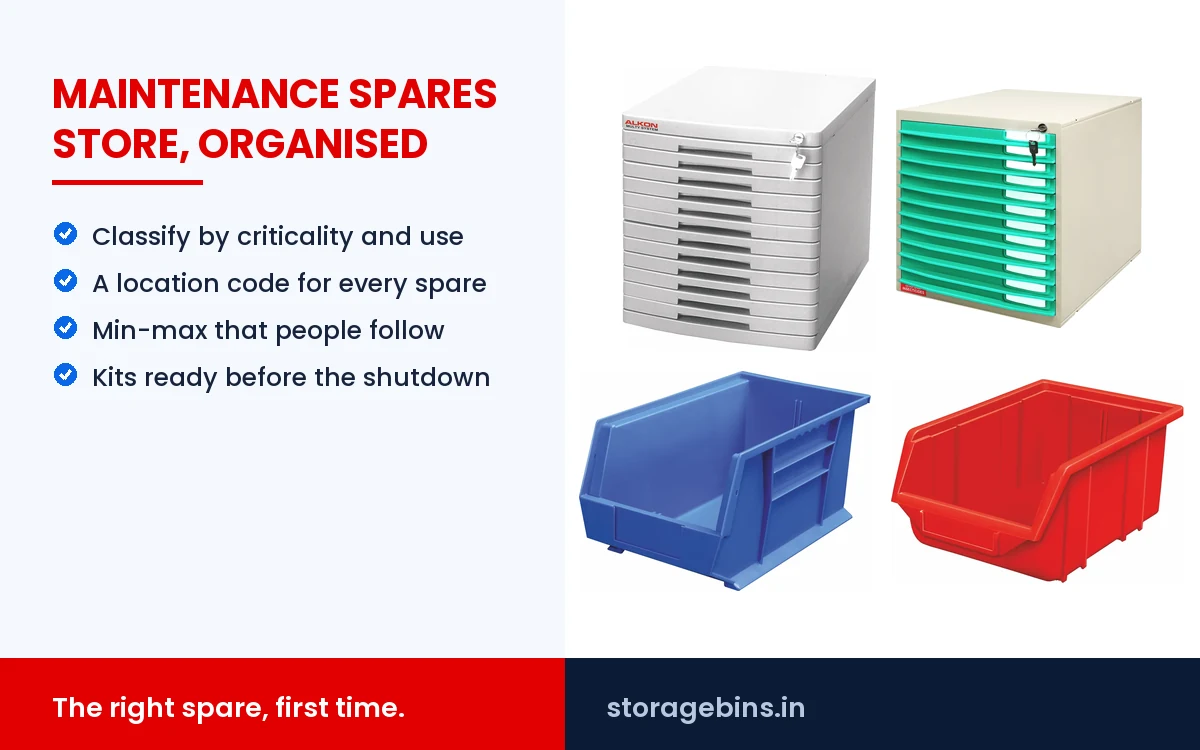
A maintenance store is not a small production store. Its demand comes from failure, not from a bill of materials. Here is how to classify, zone, code, trigger, protect and count one, with a 30-day plan.
A maintenance store is not a small production store
A production store exists to feed a schedule. Somebody writes a plan, a bill of materials explodes it into quantities, and the store issues known parts on known dates. A maintenance spares store has none of that. Its demand comes from failure, and failure does not consult the schedule. A bearing that has run quietly for six years gives up on a Sunday night, and the value of the whole store on that night is measured in how fast a fitter can put his hand on the right one. Nearly every design decision in an MRO store follows from that single difference, and most of the trouble in Indian plants comes from running the spares store on rules copied from the production store next door.
The second difference is the shape of the stock. A production store may hold two hundred line items that all move every week. A maintenance store in a medium plant near Pune or Coimbatore will hold several thousand line items, of which the large majority will not be issued even once in a year, while a small group of consumables turns over daily and a very small group of large assemblies accounts for most of the money tied up. Any single storage rule applied across that spread is wrong for most of it. The store has to be built as several stores under one roof, each with its own stocking policy, its own storage medium and its own counting cycle.
The third difference is the customer. A production store serves a planner who can wait until tomorrow. A maintenance store serves a fitter standing at a stopped machine with his supervisor behind him. He will not search. If the part is not found in a couple of minutes he will cannibalise another machine, send a man to the market, or fit something that is nearly right, and every one of those costs more than the part. So retrieval certainty beats storage density in an MRO store, which is the opposite of the trade-off a finished goods warehouse makes, and it justifies spending shelf face on visibility rather than packing every cubic millimetre.
What follows is a working method for building or rebuilding such a store: how to classify the stock, where each class physically belongs, how to code and address it, how to set triggers when demand is lumpy, how to kit for planned work, how to protect items that decay on the shelf, how to control access, how to count, and a thirty-day plan to do it. Labelling, colour coding and bin sizing are covered in their own detailed articles on this site and are referenced here rather than repeated, because both deserve more space than a single section could give them.
Classify before you move a single rack
Everything else in this article depends on two independent questions being answered for every line item. First, what happens if it is not on the shelf tonight? That is criticality, usually recorded as vital, essential or desirable. Second, how often is it actually asked for? That is movement, usually recorded as fast, slow or non-moving. Criticality is about consequence, not cost. A small limit switch on a safety interlock can be far more vital than an expensive motor that has a standby sitting beside it, and a store that classifies by value alone will end up protecting the wrong things beautifully.
Write the criticality test down in one line each so that two different people classify the same item the same way. Vital: the machine stops immediately, there is no standby, no bypass and no acceptable temporary repair, or a statutory or safety requirement depends on it. Essential: the machine degrades, output or quality drops, or a standby carries the load for a limited period. Desirable: the plant runs on until the next order arrives. For movement, use twenty-four months of issue history rather than twelve, because a great many maintenance items are consumed on annual or biennial overhaul cycles and a twelve-month window will label them non-moving when they are perfectly healthy.
Put the two classifications on a grid and the stocking policy writes itself for most of the store. Vital and non-moving is an insurance spare: a fixed location, preservation on a schedule, no free issue, approval to draw. Desirable and fast is a consumable: a two-bin visual loop outside the cage, no transaction paperwork at all. Vital and fast is the core of the store and belongs at the golden height nearest the counter with a hard minimum defended every month. The point of the exercise is that one classification decides four things at once: how much you hold, where it physically lives, who may take it and how often it gets counted.
If you have no issue history worth reading, which is common enough in a plant that has never run a maintenance system properly, do not wait for data to accumulate. Start from the equipment PM plans, the fitters' memory and the last two years of purchase invoices, accept that the first classification will be roughly a third wrong, and re-run it after twelve months of real transactions. A rough classification applied today is worth far more than a perfect one applied after the next breakdown has already been improvised around.
- If this item is not on the shelf tonight, does a machine stop, degrade, or neither?
- Is there a standby unit, a bypass, or an acceptable temporary repair available?
- How many times was it issued in the last twenty-four months, not the last twelve?
- How long does a replacement genuinely take to arrive, door to door, at your gate?
- Is it specific to one machine, or common across several machines in the plant?
- Does any statutory, safety, environmental or insurance requirement depend on it?
Zoning: giving every class an address that suits it
Draw the zone plan on one sheet before a single rack is bought. The counter and the free-issue consumables sit at the entrance, so nobody has to enter the controlled area for a washer. The vital and fast items sit in the first two bays inside, between knee and shoulder height, because that is where hands go fastest and where the store earns its reputation. Heavy assemblies sit at floor level on the route a pallet truck can actually reach. Slow movers and bulky light items go to the top levels. Insurance spares and high-value items go into locked bays, and kit staging gets its own rack with one position per job.
Then match each class to a storage medium instead of putting everything on the same shelving. Small parts in quantity belong in shelf bins on roll-post shelving. Very high part-number counts with very small quantities each belong in drawer cabinets. Items that arrive in cartons and stay in them, such as filters and bearings, belong in pigeon hole shelving where a bin would only waste the carton's own volume. Long items need cantilever arms or vertical tubes. Motors and gearboxes need floor and pallet space near the door. The same store will typically need four or five different media, and choosing them deliberately is what separates a store from a stack.
The bay arithmetic is worth doing on paper before ordering anything. ALKON Panda shelving units come as fixed configurations: an ASU 1 unit, 1275 mm high by 900 mm wide on 300 mm deep shelves, carries 108 Panda Shelf Bin 301 locations, each bin 315 x 100 x 60 mm outside and 293 x 86 x 55 mm inside. Step up to an ASU 3 with PSB 303 bins at 315 x 150 x 110 mm and the same footprint carries 48 locations with far more volume each. An ASU 7 on 400 mm deep shelves carries 108 PSB 401 bins at 415 x 100 x 60 mm, whose 393 mm internal length swallows keys, dowel pins, long screws and small shafts that will not lie flat anywhere else in the store.
Check the load figures at the same time, because the intuitive answer is wrong. ALKON rates the 300 mm deep ASUS 300 shelf at 90 kg uniformly distributed load, the 400 and 450 mm shelves at 80 kg, the 500 mm at 75 kg and the 600 mm deep ASUS 600 at only 70 kg, with a maximum bay load of 1000 kg where the shelves are bolted. The deeper shelf carries less per shelf, not more, which matters a great deal when somebody decides the deep bay is the obvious home for gearbox spares. Further detail on configurations, add-on bays and accessories is on the page for Panda shelving systems for spares racking.
Fasteners, consumables and the two-bin loop
Fasteners, cable ties, insulation tape, grease nipples, split pins, emery and welding consumables make up the highest transaction count and the lowest unit value in the store. Booking each issue costs more in storekeeper time than the item is worth, and it is also the paperwork that gets skipped first, which then corrupts the records for everything else in the ledger. The correct treatment is to take them out of the transaction system entirely, place them outside the controlled area on a free-issue wall beside the counter, and replenish them on a visual trigger rather than a system trigger.
The two-bin loop is the whole mechanism. Each part number gets two bins holding the same quantity, one behind the other, or one above the other on a rail. Picking happens from the front bin only. When it empties, the empty bin goes onto a hook at the counter and the rear bin slides forward, which is simultaneously the reorder signal, the buffer that covers the replenishment time and the proof that the loop is working. Supra SB 1 bins at 125 x 100 x 60 mm, Koala AKP-01 at 130 x 105 x 60 mm and Bull Bin 5 at 168 x 102 x 74 mm all suit this on louvre panels or rails. For a small satellite point near a line, the Poly Bins and Rails set PBR-205 gives twenty bins of 125 x 100 x 75 mm with five wall-mounting rails in a single order. Work out the quantities using the method in the guide to choosing the right storage bin size rather than guessing.
There is one hard rule on this wall, and it is a safety matter rather than a tidiness matter. Property class segregation must be physical. An 8.8 and a 10.9 bolt of the same size and head must never share a bin or sit behind one partition, and neither must mild steel and stainless of the same size, nor metric and imperial threads anywhere in the store. A partition is not segregation, because partitions get lifted out when bins are cleaned and put back one slot over, and parts bounce across a divider when a bin is slid in hard. The fitter at the free-issue wall at eleven at night is picking by feel and shape, and the consequence of a wrong grade shows up as a failed joint months later on a machine nobody is thinking about.
- Two property classes of the same bolt size, such as 8.8 and 10.9: separate bins, always
- Mild steel and stainless fasteners of the same size and head: separate bins, separate rows
- Metric and imperial threads: never in the same bin, never behind the same partition
- Two washer sizes one step apart, such as M6 and M8 flat washers: separate locations
- Self-locking nuts recovered from a job: a quarantine bin, never mixed back into new stock
- Anything a fitter picks by feel in poor light: its own bin, its own label, no exceptions
Bearings, seals, belts and hoses: the spares that die on the shelf
Rotating and elastomeric spares are the ones that fail while sitting still, and a store that gets everything else right will still hand a fitter an unusable part if it ignores them. Bearings first: the original sealed wrapper is a preservation system, not packaging, and it should not be opened to count, inspect or admire. Count the box, not the bearing. Store bearings flat and unloaded rather than standing on edge, keep large ones fully supported so the outer ring is not distorted, and keep the whole bearing area away from presses, compressors and anything else that transmits continuous vibration through the floor into the rack, because a stationary bearing under vibration develops indentations at the rolling element positions.
Elastomers are the second group. Seals, O-rings, diaphragms, gaskets and moulded rubber items age with heat, sunlight, ozone and compression, and they age whether or not anybody touches them. Store them flat in their bags, in the dark, away from windows and roof lights, away from operating electric motors and welding sets because both generate ozone, and never hang an O-ring on a nail or a wire hook where it will take a permanent set. Record the batch or cure date on the location card, follow the storage life the maker states rather than any figure invented in the store, and enforce first in first out physically by loading from the rear and picking from the front, because FIFO by intention never survives a busy Tuesday.
Belts and hoses have their own damage patterns. A V-belt hung over a thin rod is crimped at one point and will fail early at that point; use a wide flat-faced peg, or lay belts flat in a deep bin such as a PSB 305 at 315 x 300 x 135 mm or a PSB 306 at 315 x 300 x 185 mm. Hoses should never be coiled tighter than the bend radius the maker states, should have their ends capped against dust and insects, and should never sit on the floor where a trolley wheel will flatten a section. The transparent versions of the Panda shelf bins are genuinely useful across this whole family, because a supervisor can read stock levels down an aisle without pulling and re-seating fifty bins, and every pull is another chance to drop something.
- Bearings in the original sealed wrapper until the moment of fitting, never opened to count
- Bearing bays kept away from presses, compressors and any source of continuous vibration
- Seals and O-rings flat in their bags, out of sunlight, never hung on a nail or a wire hook
- Rubber items kept well away from operating motors and welding areas because of ozone
- V-belts on a wide flat peg or laid flat in a deep bin, never crimped over a thin rod
- Hoses capped at both ends, coiled no tighter than the stated bend radius, never on the floor
- Batch or cure date written on the location card so that first in is genuinely first out
Electrical and electronic spares, and the spare that needs maintenance
Drives, PLC cards, encoders, HMI panels and populated boards need a different area with different habits. Keep them in the original antistatic packaging until the moment of issue, and treat that packaging as part of the spare. ALKON has an ESD safe products category for storage inside a protected area, and the right way to specify it is to let your own ESD coordinator approve the medium, the location and the handling procedure rather than deciding it in the stores office. Boards should lie flat and separated, never stacked loose in a carton and never in a drawer that also holds loose screws, because mechanical damage to a connector is invisible until the board is fitted and the machine will not start.
Environment is the second issue and it is strongly geographic. Stores in Mumbai, Navi Mumbai and Chennai breathe humid, salt-carrying air for months at a stretch, while a foundry store in Rajkot or a cement plant store carries abrasive dust that finds every heatsink and fan. Closed storage is the answer for anything with a connector, a fan or an exposed board. ALKON supplies lockable doors for Panda shelving bays, ASUD 1275 and ASUD 1875, powder coated to match the shelves, and they protect contents from dust, damage and theft. Two practical caveats: they fit on alternate bays only, and because they pivot on top and bottom lintels the usable height inside that bay is reduced, so decide which bay gets a door before the bins are slotted. For small high-value items at the counter, a component organiser cabinet such as the ACO 18 at 457 mm high by 424 mm wide by 164 mm deep holds fuses, contactor tips, relays and terminals at one drawer per part number, and the shallow depth lets it live on a wall shelf where a full rack would not fit. There is more on drawer options in the guide to modular drawer storage systems for small spares.
The third issue is the one most stores miss entirely: some spares need maintenance while they are in stock. Stored variable frequency drives with electrolytic capacitors need periodic re-forming in the manner the maker specifies. PLC memory batteries go flat on a calendar, not on usage. Sealed batteries need charge cycles. A stored motor needs its shaft rotated periodically and an insulation resistance check before it is trusted. Raise every one of these as a scheduled job in the maintenance system with the stored spare as the asset, not as a note in somebody's diary. And store the configuration with the hardware: the parameter list, the program backup and the settings sheet, labelled and kept with the item. A drive without its parameters is half a spare, and the missing half is the half you need at two in the morning.
- Boards and drives left in the original antistatic packaging until the moment of issue
- The plant ESD coordinator approving the storage medium, location and handling procedure
- Closed, dust-protected storage for anything with a connector, a fan or an exposed board
- Desiccant inside every closed cabinet, with a dated replacement job on the PM calendar
- The program, parameter list or configuration backup stored with the spare and labelled
- Capacitor re-forming, battery replacement and shaft rotation raised as scheduled jobs
Filters, long items and heavy assemblies
Filters look like the easiest category and quietly cause the most waste. Keep them sealed in their cartons or bags until the moment of fitting, because a filter element stored open in a working store has already done part of its life before it reaches the housing. Respect the orientation the maker prints on the carton, and cap the stack height, because panel and cartridge elements crush under load and a crushed element looks perfectly fine until it is fitted. This is exactly the population that suits pigeon hole shelving rather than bins: ALKON's Panda pigeon hole system uses fixed partitions 295 mm high that give 270 mm of usable height between shelves, with bin fronts ASUBF 85 and ASUBF 135 at 900 mm wide to retain the contents, and it gives cartoned items defined locations without paying for a bin around each carton.
Long items are a storage-damage problem rather than a space problem. Shafts, lead screws, linear rails, pipe lengths, conveyor belting and structural sections all bow, sag or take a set if they are supported at one point or leaned against a wall, and the defect appears only at fitting, when the machine is already open and the crew is waiting. Support long shafts at two or more points along their length, or stand them vertically in tubes where the roof height allows, and keep the end face clear so the identification label can be read from the aisle without pulling the item out. Belting should be rolled on a core and stored on its edge on a stand, never flat under other rolls.
Heavy assemblies belong at floor level, on pallets or stands, within reach of whatever lifting equipment the store actually has, and close to the door so they never have to travel the length of an aisle. Write the mass and the lifting point on the location card. That one line saves the trip back for the right sling and the improvised lift that follows when the trip back is judged too slow. Follow the maker's instruction on fluids, because some gearboxes and pumps ship dry, some ship with a preservative charge and some with running oil, and an assembly stored with the wrong fluid inside can be scrap by the time it is opened. Record which state it is in on the card too, since the man who put it away will not be the man who takes it out.
Insurance spares and the preservation register
An insurance spare is an item held not because it will be consumed but because the consequence of not having it is unacceptable: a spare rotor, a gearbox, a large drive, a transformer, a special pump casing. The defining features are high value, long replacement time and very rare use. The decision to hold one is a business decision and it must be documented at the time it is taken, with the equipment it protects, the consequence of failure, the replacement time and the name of the person who approved it. Without that record the item becomes an unexplained large number in the stock ledger, and sooner or later a cost review will propose writing it off without anyone understanding what it is doing there.
Physically, insurance spares get a dedicated fixed location, a preservation treatment and a preservation card fixed to the item listing every action and its next due date. They are never free-issued and the issue needs a named approval. Keep a small register, one line per item, that an auditor or a new engineer can follow without asking anybody: item, internal code, location, date received, condition on receipt, preservation actions with dates, last check, next check and who signed. Ten items on one sheet is enough for most plants, and it is far more useful than the same information scattered across a maintenance system that nobody opens between audits.
The failure mode to design against is specific and it is brutal: the insurance spare found unusable on the night it is finally needed. Seized bearings from years of vibration, grease gone hard, a corroded shaft under the wrapping, a flat battery, capacitors that have not been re-formed, and most commonly of all, a missing fitting kit. A spare gearbox with no coupling, no mounting bolts, no gaskets, no oil, no drawing and no manual is not a spare, it is a large object. Store the complete fitting kit with the assembly in its own labelled tote, list the kit contents on the preservation card, and check the kit on the same schedule as the preservation. Also record which sister plants in the group run the same machine, because on the bad night that list is worth more than a purchase order.
Part numbering, where-used and location codes
Every spare has two identities and the store must be clear about which one is the master. The manufacturer's part number is what you buy against; your internal code is what you stock, locate, count and issue against. The internal code is the master, and behind it sits a cross-reference table holding every OEM number, every equivalent you have actually verified, and the supersession history for each. The commonest and most expensive failure in Indian maintenance stores is the same bearing stocked three times under three OEM numbers for three machines, with three separate minimum levels and three separate piles, all of which run short on the same night.
The where-used table is the other half, and it should be owned by maintenance rather than by stores. It links equipment to internal codes in both directions, so a planner can list every spare for a machine before a shutdown, and a storekeeper can answer the question that decides whether a non-moving item is dead stock or an insurance spare: what does this fit, and is that machine still in the plant? Keep attributes out of the code itself. No machine name, no department, no supplier abbreviation and no classification letter inside the part code, because every one of those changes and a code that has become a lie is worse than a meaningless one.
Location codes are covered in detail in the article on bin labelling and colour coding that holds up, including code grammar, character sets, label materials and mounting, and there is no point repeating that here. Three rules are specific to a spares store. One primary pick location per internal code, with any overflow locations recorded against the primary and never the other way round. Fixed locations for everything vital and everything fast, so that muscle memory and printed lists both work, and free locations only for bulk, packaging and dead stock awaiting disposal. And sort order that follows walk order, so that a picklist printed in code sequence is also a route through the store.
- One internal code per physical item, however many machines happen to use it
- A where-used table linking equipment to codes, owned by maintenance, not by stores
- A cross-reference holding every OEM number, supersession and verified equivalent
- Fixed locations for vital and fast items; free locations only for bulk and dead stock
- One primary pick location per code, with overflow recorded against it, never the reverse
- No machine, department, supplier or classification letter encoded inside the code
Minimum, maximum and reorder triggers when demand is lumpy
Standard reorder arithmetic assumes demand that occurs regularly enough to average. Most of a maintenance store violates that assumption completely, because most line items have zero issues in most months, and a formula fed with an average of 0.08 pieces per month will cheerfully recommend holding nothing at all. Split the store in two before setting any trigger. For genuine consumables with steady usage, ordinary reorder point arithmetic works and should be used. For vital slow movers, the question is not statistical: it is whether the plant can tolerate the replacement time, and if it cannot, the minimum is one or two irrespective of what the history says.
Two examples, both hypothetical and offered only to show the shape of the calculation. Take a gland packing consumed at about twenty metres a month with usage spread evenly, and assume for this example that a replacement order takes three weeks to reach your gate. Consumption over that period is roughly fifteen metres, add a buffer of ten for the late delivery, and the minimum is twenty-five, with a maximum of around sixty-five so that the order quantity stays sensible. Now take a vital coupling element for a main drive, issued twice in twenty-four months, where a replacement is assumed in this example to take ten weeks. No average helps here. The minimum is one, the maximum is two, and the rule is that a purchase requisition is raised the moment one is issued rather than when the stock reaches zero.
Whatever numbers you set, the trigger must fire by itself. A reorder point that relies on a storekeeper noticing is not a trigger, it is a hope. Consumables run on the visual two-bin loop, and the empty bin on the counter hook is the requisition. Everything else runs on the system, which must produce a requisition automatically when the balance touches the minimum. Two further disciplines keep the numbers honest. Reserve stock against planned shutdown work so that a breakdown on Thursday does not quietly consume the kit that Sunday's job depends on. And review, once a month, only two lists: items that touched zero, and items that have not moved in twenty-four months. Those two lists contain nearly all the useful information in the store.
Kitting for preventive maintenance
Consider a planned overhaul on a Sunday shutdown needing fourteen items, some of them slow movers. If the picking starts at six on Sunday morning, any shortage is discovered at the worst possible moment, with a crew standing idle and the machine already opened. Kitting moves that discovery to the middle of the previous week, when a shortage is a purchase problem rather than a shutdown problem. The kit list comes from the job plan, not from memory, and every kit picked is also a free audit of the job plan, because the items nobody can find are usually the items that the plan has recorded wrongly.
Mechanically it is simple. Pick against the job plan into a labelled container: a Tote AK-421 at 400 x 255 x 100 mm outside carries a typical mechanical kit comfortably, and small items inside it stay separated using drawer containers such as the A-45 at 150 x 150 x 45 mm or the C-45 at 75 x 75 x 45 mm, which carry label holders of their own. The kit label carries the work order number, the equipment, the shutdown date and the picker's name, and nothing else. Give kits a dedicated staging rack with one physical position per job per day, so that a kit is never described as being somewhere in the store, and keep that rack inside the controlled area so that a night shift cannot quietly rob it for a breakdown.
The return loop is the part that decides whether kitting helps or corrupts the records. Every unused item must come back through the counter with a documented return that puts it back into stock at its own location. A kit is not a write-off, and a kit tipped into the nearest empty bin on Monday morning does more damage to stock accuracy than a week of missed issues. Set a rule that any kit still on the staging rack a defined number of days after its job date is broken down and returned to stock, with the reason recorded. And keep the reserved quantities excluded from available stock for the whole time the kit exists, otherwise the reorder trigger will read a quantity that is physically committed elsewhere.
The issue counter, access control and the store's documents
Design the store around one counter and one direction of flow. Receipts enter at one point, issues leave at another, and the controlled area has a window rather than an open door. Every movement is recorded at that point and nowhere else. Unrecorded issues are the single largest cause of wrong stock records in Indian maintenance stores, and returns that never come back through the counter are a close second. If the layout permits people to walk in, pick and walk out because the counter is inconvenient, no amount of instruction will fix it; the layout is what needs fixing.
After-hours access is the honest test of any access policy, and refusing to plan for it simply means people plan around it. The workable arrangement is a small emergency cupboard outside the locked area holding a short, explicitly listed set of items that breakdowns actually need, with a tear-off slip book or a bound logbook, key custody held by the shift in-charge and reconciliation by the storekeeper first thing the next morning. Put free-issue consumables outside the cage as well, so that nobody ever breaks the discipline for a washer or a cable tie. Security should be graduated rather than uniform: lockable shelving doors on the bays holding high-value spares, modular cabinets with central locking for small high-value items at the counter, and everything else open inside the controlled area where staff can work quickly.
The store also holds the plant's paper, and it is usually held badly. Equipment manuals, general arrangement drawings, spare parts lists, inspection documents and vendor correspondence belong where the spare is issued, because a fitter collecting a seal kit at midnight is exactly the person who needs the exploded view. ALKON states that its Panda shelving systems store thirty box files in a 1275 mm high system, forty in an 1875 mm system and fifty in a 2175 mm system, which makes one bay at the end of the counter run enough for most plants. Where floor space is tight, ALKON's Roundafile is a rotary alternative in ABS, 780 mm in diameter with six partitions, holding twenty-four box files or eighty to a hundred flat files per tier, and ALKON states that it saves up to sixty per cent of the space needed for other filing systems. Add a tool tray or two on the counter wall for the screwdrivers, files and spanners the storekeeper actually uses, so that they stop migrating into bins.
Corrosion, damage and the monsoon
Indian storage conditions vary enough across the country that a single rule set does not transfer between plants. A store in Mumbai, Navi Mumbai or coastal Maharashtra deals with humid, salt-carrying air and four months of heavy monsoon from June. Chennai and coastal Tamil Nadu take their heaviest rain from October to December on the north-east monsoon, which catches plants that have planned all their pre-monsoon work for May. Kolkata combines high humidity with long spells of still, warm air. Delhi NCR swings from winter fog to severe summer heat, and it is the swing that drives condensation on cold metal. Gujarat and inland Karnataka are drier but dustier. Work out which of these you are, then plan the protection accordingly rather than copying a checklist from another plant.
The basic measures are cheap and they are mostly about habit. Nothing is stored directly on the floor; every shelving bay gets a kick plate at the base and pallets or stands carry the heavy items. Machined and unpainted ferrous surfaces are coated and wrapped, with the coating type written on the location card so that the next person knows what to remove and with what. VCI paper or VCI bags are worth the cost for ferrous spares in coastal and monsoon-exposed stores. Desiccant goes into every closed cabinet with a dated replacement job card, because desiccant that has been saturated for a year is worse than none at all, since it holds moisture against the contents it was meant to protect.
Mechanical damage deserves the same planning. Aisle ends, rack uprights and any column on a forklift or stacker route take strikes sooner or later, and rack protectors and deflectors fitted at the start cost far less than a bent upright and a bay unloaded in a hurry. Cap stack heights for cartons and write the cap on the location card rather than trusting judgement on a busy dispatch day. One material limit is worth stating plainly: the moulded polypropylene copolymer bins across these ranges have a service range of minus ten to plus seventy degrees Celsius, so a component just removed hot from a machine should never be dropped straight into a bin at the counter. Let it cool on a metal tray first, because repeated hot contact distorts the base and the bin then sits badly on the shelf for the rest of its life.
- Nothing on the floor; kick plates at the base of every bay, pallets or stands for heavy items
- Machined and unpainted surfaces coated and wrapped, with the coating type on the card
- VCI paper or bags for ferrous spares in coastal and monsoon-exposed stores
- Desiccant in every closed cabinet, replaced against a dated job card, never left saturated
- Roof, gutter and drain inspection completed before the monsoon your region actually gets
- Rack protectors and deflectors at every aisle end and column on a forklift or stacker route
Obsolete stock, scrap and cycle counting
Non-moving is not the same as useless, and treating the two as identical is how plants scrap their own insurance spares. Run the non-moving list against the where-used table before anything else happens. If the equipment has left the plant, the item is a candidate for transfer to a sister plant, for sale, or for scrap. If the equipment is still running and the item is vital, a twenty-four month absence of movement is precisely what a healthy insurance spare looks like and it should be left exactly where it is. The only items that genuinely qualify as dead are those with no live equipment behind them, or those superseded by a design change already implemented everywhere.
Give the disposal a process rather than a decision. A named committee of maintenance, stores and finance, a dated list with the where-used evidence attached, a hold period during which the list is circulated to sister plants in Maharashtra, Gujarat, Tamil Nadu, Karnataka or wherever the group operates, and then disposal with records and photographs. The prize is not only the money recovered, which is usually modest, but the location. Dead stock sitting at chest height in the first bay inside the door is a small tax on every single pick for years, and moving it out is often worth more to the operation than selling it.
Cycle counting replaces the annual stocktake that stops the store for three days and produces numbers nobody trusts. Count by class on different cycles: vital and high-value items on a short cycle, fast consumables by bin visual at replenishment, and the long tail by walking a defined number of locations every week until the store has been covered once a year. Count empty locations as well, because confirming that an empty bin is genuinely empty is the cheapest count there is and it catches items that were issued but never booked. When a count disagrees with the record, the job is not to adjust it but to find the cause: a missed issue, an unbooked return, a wrong unit of measure, a second location nobody recorded, or a substitution. Adjust only after the cause is written down, otherwise the same item will be wrong again next quarter and the count will have taught you nothing.
A thirty-day plan, and how to buy the hardware
Days one to seven are for measuring, not moving. Walk the store with the maintenance in-charge and record what is physically there, item by item, including the things in the corner that nobody has claimed for years. Pull whatever issue history exists, however poor, for the last twenty-four months. Mark every item for which no one can name a machine, since that list will drive the obsolescence work later. Then measure the room properly: clear floor area, column positions, door widths, roof and beam heights, drain lines, power points, and the route a pallet truck or stacker can physically take from the door to the heavy area. Nothing is ordered in this week and nothing is thrown away.
Days eight to fourteen are for classification and design. Run the criticality and movement classes and place every item in the grid. Draw the zone plan on a single sheet: counter, free-issue wall, fast pick bays, drawer cabinets, pigeon hole bays for cartoned items, long-item rack, heavy floor area, locked bays, kit staging and a quarantine area for returns and suspect items. Size the bays from real dimensions rather than by eye, using the shelf depths, bin sizes and load figures set out earlier. Fix the code grammar and the labelling standard now, taking both from the existing articles, so that nobody has to invent a convention under time pressure in week three.
Days fifteen to twenty-two are for ordering, and for building as the material arrives; confirm availability and dispatch timing with Shreeram before fixing these dates. Raise one consolidated order covering shelving bays, roll posts, shelves, kick plates, bins, partitions, bin stoppers, doors for the bays that need them, rails and louvre panels, drawer cabinets, rack protectors and five to ten per cent spare bins, because a top-up order for two bins six weeks later is the most expensive way to buy anything. Build and install bay by bay so the store keeps working throughout. Print labels against a frozen location master, then walk the aisle with the printed set and verify every card against reality before a single one is mounted, because a meaningful share will be wrong on the first pass and paper is cheap to correct.
Days twenty-three to thirty are for migration and for starting the routines that keep the store alive. Move one class at a time rather than one aisle at a time: consumables to the free-issue wall first, then fast vital items into the front bays, then the long tail, then heavy items, then insurance spares into their locked bay with their preservation cards written. Then start the disciplines on named days with named owners: the cycle count schedule, the weekly kitting day, the monthly min-max review, the preservation jobs loaded into the maintenance calendar, and the quarterly obsolescence list. A store that is built and then left alone reverts within a year; the routines are the store, and the racks are only where it happens.
On the buying itself, a maintenance store is bought in one order or it is bought badly. The reason is interchangeability: partitions, stoppers, rails, louvre panels, doors and shelves are designed around specific series, and a bay bought later from a different source that is nearly the same size will not take the same bin, the same partition or the same label stock. Write the specification once, listing range, size code, colour and quantity for every item including the accessories, and treat that document as the store's standard. Order the spare bins in the same lot, because a cracked bin replaced from a different family is the first step towards a store with four incompatible systems inside it.
Two questions are worth asking your supplier before the order goes out, and both are commonly skipped. First, confirm the load figures for the exact shelf depth you are buying rather than assuming, since the deeper shelf carries less. Second, confirm colour availability across every size you intend to use, because a colour scheme designed around a colour that is easy in one size and awkward in another will break quietly within a year. Ask for physical samples of the two shortlisted bin sizes and put them on your own shelf with your own parts, your own gloves and your own labels before releasing the order. Fifteen minutes with a real sample answers questions that no catalogue page can.
Shreeram Metafusion Engineers Pvt. Ltd. has been an authorised stockist and supplier of ALKON Plastics Pvt. Ltd. products for over thirty years, and ALKON describes itself as the manufacturer of the largest range of material handling bins in India. The catalogue on this site runs to 476 products across nine categories, covering material handling bins and accessories, Panda shelf bins and shelving systems, Roo tilt bins, Visipro rack protectors and deflectors, component organisers, ESD safe products, storage systems, Koala pick bins and other products. The complete range is set out on the page for the full ALKON industrial storage bin range, and the office is at Shop-1, Gagangiri CHS, Sector 17, Vashi, Navi Mumbai 400703, open Monday to Saturday from 10:00 to 19:00 on 93266 29967 or 98201 01937, with enquiries by email at enquiry@shreeram-metafusion.com.
One closing thought for the engineer who will actually do this. None of the above is difficult, and none of it requires software you do not already have. What it requires is that somebody decides, once, that the spares store is a maintenance function rather than a storage cupboard, gives it a named owner and a named backup, and defends the routines through the first six months while everybody is busy and the old habits are easier. The classification, the zoning and the racking can be done in a month. The discipline takes a year, and it is the part that decides whether the fitter standing at a stopped machine on a Sunday night finds the bearing or starts looking for somebody to blame.
- Week one: physical inventory, twenty-four months of issue history, and the building measured
- Week two: criticality and movement classified, zone plan drawn, code and label standard fixed
- Week three: one consolidated order for racking, bins and accessories; labels verified on paper first
- Week four: migrate by class, write preservation cards, load the routines into the calendar
- Ongoing: cycle counts by class, weekly kitting, monthly min-max review, quarterly dead stock list
- A named owner and a named backup for the store standard, written up on the notice board
Related pages