Plastic vs metal storage bins: which one suits your store
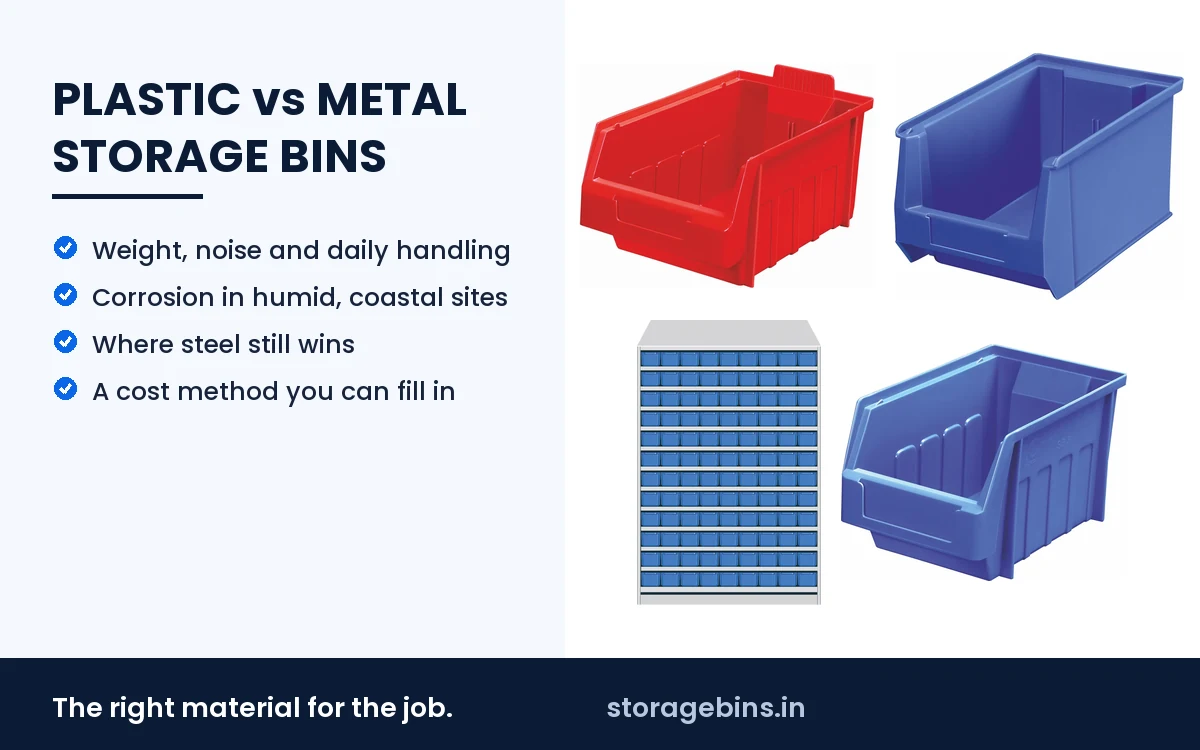
Steel does not rust-proof itself and plastic does not hold a hot casting. A location-by-location comparison of moulded PP bins against fabricated steel, with a cost-per-location method you can fill in.
Plastic or metal is a decision you make per location, not per plant
Very few plants get to answer this question on a blank sheet. Most stores already hold both: a run of fabricated steel trays that came with the original fit-out, a shelf of moulded bins bought three years later when somebody lost patience, and a corner where parts still sit in the cartons they arrived in. So the useful question is not whether plastic beats metal in general. It is which container belongs at a specific location, because the variables that settle it change from one end of a building to the other: contact temperature, mass per container, how sharp the contents are, how wet the area gets, whether the parts are static sensitive, and how often a human being actually picks the thing up.
It also helps to be precise about what is being compared. A moulded bin is a single piece produced in a tool. The Supra, Hippo, Bull, Rhino Tuff, Tote and Mammoth ranges are moulded polypropylene copolymer with a service range of minus ten to plus seventy degrees Celsius, and every unit of a given part number comes out of the same cavity with the same geometry. A fabricated steel bin or tray is cut from sheet, folded on a press brake, welded or riveted, then painted, galvanised or powder coated. Its strength comes from sheet thickness and joint design, its corrosion behaviour comes almost entirely from the coating, and its dimensions come from whoever set the brake that morning.
That single difference in how the two are made explains most of what follows. A moulded range arrives as a ladder of fixed sizes with stacking, nesting and accessory fit designed in, so a Supra SB 1 at 125 x 100 x 60 mm outside and 117 x 80 x 52 mm inside is a rung on a ladder rather than a one-off. Fabricated trays are usually whatever the fabricator could bend that week, which is why a store full of them rarely stacks, never nests and cannot be extended two years later without visible mismatch. Plastic buys you repeatability. Steel buys you the ability to make one odd size tomorrow morning.
Before reading further, do one hour of work that makes the rest of this usable. Walk the stores and the shop floor with a clipboard and list every distinct location class you have: machine-side work in progress, pick face, bulk reserve, kitting bench, maintenance spares, hot buffer, swarf and scrap, finished goods. Against each one write the contact temperature, the realistic full weight, whether the contents are sharp or wet, whether anything in it is static sensitive, and how many times a shift somebody lifts or slides it. Every section below is a rule you can apply to that list. Without the list, this is only opinion.
Weight, tare and the manual handling you are quietly buying
Tare weight is the number almost nobody writes down and the one that gets paid every shift. The measurement takes ten minutes: put an empty container of each candidate type on a scale, record it, then weigh the same container at its normal working fill. Full mass is tare plus contents, and the tare difference between a moulded bin and a fabricated steel tray of equivalent capacity is collected again on every single lift. A container that is handled twice a day is a rounding error. A kitting tote that is lifted forty times a shift by the same pair of shoulders is an ergonomics decision disguised as a purchase decision.
The distinction that matters is between containers that move and containers that sit. Shelf bins and pick bins are mostly slid forward and pushed back, so their tare barely registers. Totes, work-in-progress containers, kitting boxes and crash-cart bins are carried, and that is where material choice bites. A Tote AK-421 at 400 x 255 x 100 mm outside is a two-hand carrying size by design, and a Mammoth at 820 x 315 x 300 mm outside is a floor or pallet proposition before anything goes into it. Work out the full mass of each of those with your own parts, compare it against your own manual handling limit, and let the answer choose the material.
Height changes the same arithmetic again. A container lifted from knee height is a different task from the identical container lifted down from the top level of a bay, and Panda shelving bodies are available in bay heights of 1275, 1875, 2175 and 2375 mm, so the top level of a tall bay is genuinely overhead work. Extra tare at overhead height is where back and shoulder injuries come from, not from the weight itself. The practical rule is to put the lightest containers at the levels that need a reach and keep dense, heavy and steel containers between knee and waist, whichever material you end up choosing.
Corrosion, humidity and why coastal cities change the answer
Steel is not corrosion resistant. Steel is corrosion protected, and protection is a coating with a finite life on a component that gets handled, dragged, dropped and scraped for a living. In Mumbai, Navi Mumbai, Chennai and Kolkata the combination of salt-laden air, four months of monsoon and nightly condensation inside a closed godown is a harder duty than any of those cities admits. A powder-coated tray that looks perfect on the day it is delivered into a Turbhe or Taloja unit is on a clock from the first time a corner meets a rack upright.
The failure never starts in the middle of a panel. It starts at cut edges, at handle cut-outs, at spot welds and folded lap joints, and at every hole somebody drilled on site to fit a label holder. Folded seams are the worst of these because they hold a film of water and coolant that you cannot see and cannot dry, so corrosion works outward from inside the joint. That is also why field modification of a steel container is more expensive than it appears: the moment you cut or drill it, you have created an unprotected edge in the place most likely to sit wet.
The cost that actually hurts is not the container, it is the contents. Rust bloom transferred from a tray onto bright turned components, plated fasteners or ground faces becomes a quality reject, and in a Coimbatore pump shop or a Rajkot engineering unit, wet parts coming off a machining or washing step sit in that tray for hours. Moulded polypropylene does not rust, does not absorb water and does not swell, which is why it can be washed and left damp without consequence, and why a Mammoth in the mesh version is a sensible container for parts that still need to drain.
Geography is worth being honest about here, because experience does not transfer. A steel tray fleet that has behaved impeccably for a decade in Ahmedabad, Delhi NCR or Hyderabad, where the air is dry for most of the year, tells you nothing useful about the same fleet in Vashi, Chennai or Kolkata. If your organisation runs several plants and a corporate standard was set by whichever unit happened to write it, check whether the standard was written in a dry city and then applied to a coastal one. That single question has settled this argument in more procurement meetings than any specification sheet.
Dent versus crack: the two materials fail in completely different ways
Both materials fail, and the interesting difference is in the shape of the failure rather than in how often it happens. Steel dents. It deforms permanently, stays in one piece, and carries on being used for years afterwards. Polypropylene copolymer cracks. Copolymer is chosen over homopolymer precisely because it absorbs knocks better, but when it does eventually go, it goes as a split at a corner radius or along a rim after a drop, and the crack is visible from two metres away. Which of these is worse for you depends almost entirely on how disciplined your inspection routine is.
The quiet danger is the dent. A dented steel tray removes nothing from your production, so nobody reports it, but it has lost the flatness that let it register on a stack, it now jams going into a shelf slot, and the deformed edge is a snag that tears gloves and catches sleeves. Over years, a fleet of dented trays becomes a store where nothing sits square and every shelf has to be loaded by feel. A cracked bin, by contrast, announces itself, spills once, and gets taken out of service, which is annoying on the day and self-correcting over the fleet.
Repair economics run the other way. A steel tray can be beaten back into shape and rewelded, and many plants do exactly that, but the coating is destroyed at precisely the point that will now sit wet and corrode. Repair therefore buys you a container with a shorter remaining life than it looks like it has. A moulded bin cannot be repaired economically at all, so its answer is replacement with an identical part from the same tool, which is only genuinely cheap if the range is still in production and still held in stock. Continuity of supply is part of the plastic case, not a footnote to it.
Whichever material you run, the important thing is to write a reject standard down and apply it at a fixed interval, ideally alongside your stock count, rather than reacting to spills and complaints. Reactive retirement means the failures are discovered by an operator on his knees picking up four kilos of small parts, and by then the container has usually damaged a few of them on the way down. The criteria below are the ones that matter in practice, and once the list is printed and stuck on the stores wall they take a storekeeper about a second per container to apply. Keep a small buffer of replacement containers so that rejecting one is never a production decision.
- Steel: a dent deep enough to stop the container sitting flat or stacking square
- Steel: any bare metal at an edge, handle cut-out, weld or drilled hole, in a wet or coastal area
- Steel: a torn edge or burr anywhere a hand or glove passes
- Plastic: a crack running from a corner radius or along the rim, however short
- Plastic: a rim deformed enough that the bin above no longer registers on it
- Plastic: a permanently bowed wall or a soft, distorted base area
- Both: scoring deep enough to hold oil or residue where contamination carry-over matters
Noise, vibration and damage to the parts themselves
Noise is dismissed as a soft factor until you spend a full shift in the aisle. Steel containers on steel shelving generate a sharp impact every time one is slid, dropped or stacked, and that sound repeats a few hundred times a shift in a busy stores. The cumulative effect is fatigue, and the specific operational effect is that verbal instructions, andon calls and the sound of a machine going wrong all have to compete with it. Moulded bins are markedly quieter both on impact and on slide, which is a real benefit in an assembly cell where people need to hear each other.
The second effect is damage to the contents rather than to the container. A steel tray is harder than most of what goes into it, so plated fasteners, ground shafts, painted subassemblies, moulded housings and machined faces are all scuffed by contact with the container. Where the part is a raw casting this is irrelevant. Where the part is finished, plated, lapped or cosmetic, the container is a source of rework, and a polypropylene bin takes the scuff instead of the part. For finished goods, spares dispatched to customers, and anything with a visible surface, that argument usually settles the location on its own.
Vibration in transit is the third. On a trolley or a crash cart crossing a plant floor, contents move, and a steel tray with a flat bottom and low sides lets small parts walk to the edges and out. Moulded shelf bins are shaped for this: the Panda shelf bins carry an integral back stop so contents stay visible and contained, and ALKON also lists a Panda Bin Stopper in nylon, part number PSBS, which self-locks onto any size of Panda bin and forms a rear lip so the bin cannot come out of the shelf unless it is deliberately tilted upward. Small features like that are what turn a container into a system.
Temperature: the one limit that decides more cases than any other
The service range ALKON publishes for the Supra, Hippo, Bull, Rhino Tuff, Tote and Mammoth ranges is minus ten to plus seventy degrees Celsius, and it is a real limit rather than a conservative one. The violation is almost never ambient. A pressing shop in Ahmedabad in May, a shed in Nashik, a mezzanine in Chennai in June, all sit inside the range on air temperature. What takes a bin outside it is contact: a component that came off heat treatment, moulding, welding, induction heating or a hot wash and went straight into the bin while it was still holding heat, or a bin standing against a hot duct.
The symptom is not dramatic and that is why it is missed. The bin does not melt. Its walls go gently out of plane, so it stops registering with the bin above it, so a stack that was stable last year develops a lean this year, and nobody connects a bowed wall in September with hot parts binned in April. If you find bowed bins, look upward and backward: what is above them, and what went into them warm. The fix is procedural rather than a different bin. Let hot parts cool on metal, then transfer, and the problem disappears permanently.
This is where the plant boundary between the two materials actually falls, and it is a process boundary rather than a departmental one. Steel has no practical upper limit for the temperatures a store deals with, so the buffer at the exit of a furnace, a forging line or a heat-treatment batch stays steel. Two cautions come with that. Coatings have their own temperature limits, so ask the fabricator before assuming a powder-coated tray is a hot-parts tray. And a steel container holding hot parts becomes hot itself and is a burn exposure for the operator, which needs gloves and a rule, not just a tray.
At the cold end, a chilled room at two to eight degrees is comfortably inside spec and suits the moulded ranges without qualification. A hard freezer below minus ten is outside it, and the practical consequence is not sagging but brittleness: impact resistance falls as temperature falls, so the drop that a bin shrugs off at thirty degrees is the drop that cracks a corner at minus fifteen. If cold-side handling is unavoidable, keep the bin's dwell time in the cold short, load it, move it and get it out, and expect a higher retirement rate than the same bin in ambient service.
Cleaning, chemicals and contamination carry-over
Cleaning is where plastic has its easiest win and where people still manage to get it wrong. Warm water, mild detergent, a brush and a proper drying step is the whole routine, and because the material does not absorb water there is no consequence to washing frequently. ALKON describes the Panda shelf bins as resistant to most industrial solvents, and in practice the common workshop exposures, oils, greases, alcohols and ordinary cleaning chemicals, are not a problem. What you should not do is take a high-pressure hot jet to a bin on the assumption that harder is better, because concentrated jets can distort thin sections and drive contamination into moulding lines instead of out of them.
Steel cleans perfectly well too, right up until the coating goes, and then every wash is an accelerant. The two steps people skip are drying and inspecting: a washed steel tray put away damp in a Mumbai monsoon has effectively been prepared for corrosion, and seams and folded edges retain the water you thought you had shaken out. For the total cost comparison later in this article, the point to note now is that steel carries a recurring refinishing line that plastic does not. Touch-up paint, repainting and eventual replacement of the worst units are real, schedulable costs, and leaving them out of a comparison flatters steel considerably.
Two chemical cautions apply to the plastic side and deserve to be asked before an order rather than after. Strong oxidising agents and certain aromatic and chlorinated solvents will attack polypropylene, so if those are part of your process, raise it as a specific question with the model numbers in hand. Separately, some cleaning agents leave a thin insulating film, which quietly defeats the property you paid for on ESD-safe containers. And whichever material you use, segregate populations by what they have held. A container that has spent two years holding oily components is not a clean container because you washed it once, and scratches hold residue that a wipe does not reach.
Where steel still wins, and it is not a short list
Hot work is the first and clearest case. Anywhere parts leave a process above the plus seventy degree ceiling, anywhere welding spatter or grinding sparks can land, and anywhere a container sits close to a furnace, the container should be steel. This covers the forging and casting clusters around Rajkot and Coimbatore, heat treatment lines in Pune and Chennai, and the welding bays of practically every fabrication unit in the country. Nobody should be trying to engineer a plastic solution into these positions. The correct design puts a steel buffer at the process exit and starts the plastic fleet at the point where parts have come down to ambient.
Mass and sharpness are the second and third. Dense castings, forgings, billets, dies, heavy spares and anything that lands as a point load belong in steel or on steel. So does swarf, turnings, sheet offcuts, used blades and any scrap stream where the contents are actively hostile to the container, because metal turnings will score a plastic wall and eventually cut through it. These are not marginal calls. Trying to move a swarf stream into plastic bins is one of the few ways to make a storage decision worse in a single step, and it usually happens because somebody standardised on a container rather than on a job.
The structure is the fourth and the biggest by volume. Shelving, racking, roll posts, mezzanines, drawer cabinet bodies and bin fronts remain steel almost everywhere, and the load numbers show why. ALKON lists the Panda shelving shelves at a uniformly distributed load of 90 kg for the 300 mm deep ASUS 300, 80 kg for the ASUS 400 and ASUS 450, 75 kg for the ASUS 500 and 70 kg for the ASUS 600, with a maximum bay load of 1000 kg on bays fitted with bolted shelves. No moulded container is intended to do that job, and nobody is asking it to.
Security and dust exclusion are the fifth, and they are the ones stores managers forget until an audit. An open bin cannot be locked. ALKON offers lockable powder-coated doors for the Panda shelving system, part numbers ASUD 1275 and ASUD 1875 for the 1275 mm and 1875 mm bay heights, described as protecting stored contents from dust, damage and theft, and they can be added to existing units. If you are holding high-value spares, instruments, plated components or controlled items, the material question at that location is answered by the door, not by the bin.
Static and ESD: neither material is automatically safe
Standard polypropylene is insulative, and moving a component in and out of an insulative container generates exactly the charge you are trying to avoid. That much is well understood. What is less well understood is how wide the affected population has become. It is not only PCB assembly in Bengaluru, Chennai, Hyderabad and the Delhi NCR belt. Any stores holding a drive card, a sensor module, a controller or a populated board is holding static-sensitive stock, and that now includes automotive ancillary units around Pune and Chakan, machine tool builders, instrumentation firms and a great many maintenance stores that would not describe themselves as electronics plants at all.
The dangerous assumption is that a metal container solves it, and it does not. Bare steel is conductive, but a conductive container that is not part of a deliberate path to ground is a floating conductor, which can accumulate charge and then discharge it into a component all at once. Worse, most fabricated steel trays are painted or powder coated, and that coating is an insulating surface, so the container behaves as an insulator at exactly the point of contact with the part. A painted steel tray is therefore not an ESD control either, and using one because it feels like metal is a false comfort that shows up as field failures months later.
The honest answer is that this is a system question rather than a container question. ALKON carries a separate ESD safe products category for precisely this reason, and the container only does its job if the shelf, the trolley, the bench surface, the flooring and the operator are all part of the same intended path. Buy ESD by zone rather than by item, keep the ESD population visually distinct so nobody borrows one for washers, and be careful what you clean them with. An ESD container sitting on an ordinary shelf next to an ordinary bin is a comfort rather than a control.
Mixed systems: steel structure, plastic containers
The arrangement most Indian plants converge on after a few years is not plastic or metal but both, in defined roles: a steel skeleton carrying plastic containers. The Panda system is the clearest example of the pattern. Powder-coated steel roll posts and shelves form the structure, blue moulded polypropylene Panda shelf bins with black partitions form the containers, and even the retention accessory is a third material, the nylon PSBS bin stopper. A Panda Shelf Bin 301 measures 315 x 100 x 60 mm outside and 293 x 86 x 55 mm inside, and it is designed to fit roll post shelving rather than to be free-standing.
That division of labour is the design rule worth taking away. Let steel do span, height, load, security and anything that has to bolt to a floor or resist a forklift. Let plastic do the hand-sized container that gets pulled forward, picked from, carried, washed and eventually replaced. The interfaces between them are what you actually have to check at specification time: bin outside depth against shelf clear depth, bin outside height against shelf pitch, bin outside width against shelf width divided down to a whole number, and partition or stopper fit against the specific bin series rather than against a similar-looking one.
The same pattern repeats across the accessory range. Louvre panels, rails, universal rail, stands, trolleys and crash cart components are the presentation hardware that puts moulded bins where a hand can reach them, which is how a fixed-footprint assembly cell in Bengaluru or Coimbatore gains storage without losing floor. Panda pigeon hole shelving takes it further in the other direction, using fixed steel partitions of 0.8 mm CRCA sheet powder coated in light grey RAL 7035 to create locations with no container at all, which suits a tool crib or a spares counter where the shelf itself is the bin.
There is even a neat inversion that makes the point better than any argument. Visipro rack protectors and deflectors are ALKON products whose job is to protect steel uprights from forklift and pallet truck impact in the aisle. The protector takes the hit so the steel keeps its rated capacity. If you want one sentence to carry into a specification meeting, it is that the material follows the job rather than the department, and any standard which says the whole plant will be steel or the whole plant will be plastic is going to be wrong somewhere expensive. The detail on the shelving side sits on our Alkon Panda shelving systems page.
Repeatability, repeat supply and the ten-year fleet
A storage fleet outlives the manager who bought it, and repeatability is the quality that decides whether the next person inherits a system or an archaeology. A moulded part comes from a tool, so the PSB 301 ordered three years from now has the same 315 x 100 x 60 mm outside and the same 293 x 86 x 55 mm inside as the one on the shelf today, the partitions notch into the same slots, the stoppers self-lock the same way, and the labels land in the same position. That is not a marketing claim about quality. It is a consequence of how the part is made.
Fabricated containers vary, and the variation is not anybody's fault. Sheet thickness varies by supplier, bend radii vary by tooling, and two batches from the same fabricator six months apart will be a few millimetres different in ways that matter when you are trying to nest, stack or slot them. The consequence is that a fabricated fleet cannot really be standardised, only tolerated. This is the hidden cost of the local fabrication route, and it is invisible at the time of the first order because the first batch is internally consistent. It appears on the second order, and by then the shelving has been designed around the first.
Stacking deserves its own rule because it is where this goes wrong on the floor rather than in the drawing office. Stacking geometry is a designed relationship between the rim of the lower container and the base of the upper one, and it is designed within a range, not across ranges and certainly not across materials. Supra stacks with Supra, Bull with Bull, and a steel tray on top of a plastic bin is not a stack at all, it is two containers resting on each other until vibration from a passing truck walks the top one off the edge. Plan every shelf level as a single family.
All of which makes continuity of supply part of the material decision rather than a commercial afterthought. The reason a moulded range is worth standardising on is that you can reorder the identical item for a second cell, a second shift or a second unit in another state. Shreeram Metafusion Engineers Pvt. Ltd. has been an authorised stockist of ALKON Plastics Pvt. Ltd. for over thirty years and holds the range at Sector 17, Vashi, which is what makes that reorder a routine transaction rather than a fresh sourcing exercise. If you are still mapping the catalogue, the storage bins buying guide covers the nine product categories and how they relate to each other.
A total cost of ownership method you can fill in with your own quotes
Unit price comparisons between a moulded bin and a fabricated tray are close to meaningless, because the two rarely give you the same number of locations, the same usable volume or the same service life. The unit that does compare cleanly is cost per active storage location per year. Build it once in a spreadsheet, fill it with your own quotes and your own observed numbers, and it will answer this question for your plant in an afternoon. The method below deliberately contains no figures, because the only figures worth using are the ones your own purchase department and your own stores team can supply.
Collect the inputs for each candidate, and be strict about collecting the same ones for both. Then annualise: take purchase cost plus accessories plus any structural difference, divide by expected service life in years, add annual refinishing cost, annual cleaning labour, the handling labour difference and the annual cost of damage to contents, and subtract any residual value divided by life. Multiply the result by the number of locations you intend to fill. The output is a single number per option per year that a finance colleague will accept and that survives being questioned, because every term in it is traceable to something you measured rather than assumed.
Two inputs carry most of the answer, and purchase price is not one of them unless the fleet is tiny. The first is service life, and you should not guess it. Sample thirty containers of each type already in service, record the age of each and apply the reject criteria from the damage section, and you have a retirement rate drawn from your own floor rather than from a brochure. The second is the pair of handling and contents-damage terms, because a container that scuffs plated parts or adds tare to forty lifts a shift can be cheaper to buy and considerably more expensive to own.
Three pitfalls will distort the comparison if you let them. Compare usable volume rather than outside size, because the working fill line sits well below the rim in both materials. Include the structure, because a heavier container may force a heavier shelf or a shorter bay and that cost belongs in the comparison. And include the migration cost of a mixed fleet honestly, because running two incompatible populations through a transition period has a real cost in labelling, location assignment and picker confusion that neither quotation will ever show you.
- Purchase cost per container, and the quantity needed to fill the same number of locations
- Accessories required to make it work: partitions, stoppers, rails, louvre panels, stands, trolleys
- Any difference in the shelving or racking the container forces on you
- Expected service life in years, taken from a survey of your own fleet, not assumed
- Refinishing or repainting cost and how often it recurs
- Annual cleaning labour, including the drying step
- Handling labour difference: tare difference multiplied by lifts per shift per year
- Annual cost of damage to contents: scuffing, rust bloom, contamination rejects
- Residual or scrap value at end of life, and the cost of disposing of the rest
Four worked comparisons, framed as examples
Take a turned-parts machine shop in the Chakan belt near Pune, feeding automotive manufacturing customers, running coolant-flooded lathes with deburring and a wash step downstream. The inherited fleet is fabricated steel trays and the recurring complaint is rust bloom on components that sat wet overnight. Here the material boundary falls at the wash line. Steel stays only at the hot pre-wash buffer if there is one. From the wash onward, a Tote AK-421 at 400 x 255 x 100 mm handles batches between operations, and a mesh Mammoth at 820 x 315 x 300 mm outside takes parts that still need to drain. The measurable gain is not container cost, it is the rejects that stop happening.
Second, a forging and fettling ancillary near Rajkot in Gujarat. Hot forgings, heavy raw parts, shot blast and swarf are all on the same floor, and this is a plant where steel deserves to keep most of its territory. Steel containers hold everything from the furnace exit until the parts have cooled and been shot blasted, and the swarf stream stays steel permanently. The plastic fleet starts at the finished goods store and the bought-out spares store, where parts are ambient, clean and picked by hand, and where corrosion protection and quieter handling are worth something. Two materials, one plant, and a boundary anybody on the floor can point to.
Third, an electronics assembly unit in Bengaluru or across the border at Hosur in Tamil Nadu. Here the temptation is to buy painted steel trays because they feel industrial and to assume that metal is safe for boards. It is not, for the reasons already covered. The correct fleet is ESD-safe containers from the dedicated range, sitting on a grounded steel structure, with the whole zone treated as one system including bench surfaces, trolleys and flooring. Standard moulded bins, however good, belong in the mechanical stores of the same building and should be visually distinct so that nobody carries one into the ESD area for a handful of screws.
Fourth, a maintenance spares store in Kolkata, humid for most of the year and holding several thousand low-value line items with a handful of high-value ones. Steel does the structure and the security: Panda shelving bodies in a 1275 mm or 1875 mm bay height, with lockable ASUD doors on alternate bays holding instruments and expensive spares. Plastic does the containers, with transparent Panda shelf bins where nobody remembers what is in a location and standard blue Panda bins where a label is enough. For the very small, very numerous items, an ACO 18 component organiser at 457 mm high, 424 mm wide and 164 mm deep gives one drawer per part number in a space that a full-depth rack could not use.
A decision checklist you can take to the floor
Run the following list against each location class from the audit you did at the start. It is deliberately ordered so that the hard disqualifiers come first, which means most locations resolve in the first three or four questions and you only reach the cost comparison for the ones that are genuinely close. If a location answers yes to any of the early questions, the material is decided for you and there is no commercial argument to have with anybody. If it reaches the end of the list unresolved, it is a location where either material would work and the total cost method should choose.
Two closing habits make the difference between a good decision and a good decision that survives. Write down the rule you applied at each location class, in one line, next to the container you chose, because the next stores manager will otherwise reinvent all of this from scratch and probably reach a different answer. And do not attempt to switch a whole plant in one move. Migrate by location class, starting with the class where the current material is visibly failing, so that each step is self-justifying and you never have two incompatible populations sharing an aisle for longer than a planned changeover.
Before you commit any volume, get physical samples of the shortlisted containers, put them on your own shelf with your own parts, your own gloves and your own operators for a fortnight, and let the floor tell you what the specification could not. Shreeram Metafusion Engineers Pvt. Ltd. is an authorised stockist of ALKON Plastics Pvt. Ltd. and will talk through model numbers, inside dimensions and accessory fit before you raise the order. We are at Shop-1, Gagangiri Chs, Sector 17, Vashi, Navi Mumbai 400703, on 93266 29967 or 98201 01937, or at enquiry@shreeram-metafusion.com, Monday to Saturday between 10:00 and 19:00. Supply into the Mumbai, Thane, Pune and Nashik belt is routine, and into Gujarat, Karnataka, Tamil Nadu, Telangana, West Bengal and Delhi NCR it is a matter of planning rather than uncertainty.
- Will the contents ever touch the container above plus seventy degrees, or below minus ten? If yes, steel.
- Are the contents sharp scrap, swarf, turnings or blades? If yes, steel.
- Does the location need to be lockable or dust-excluding? If yes, a steel enclosure or door.
- Is the item load-bearing structure rather than a container? If yes, steel.
- Are the contents static sensitive? If yes, ESD-safe containers within a grounded zone, and never a painted steel tray.
- Is the area wet, coastal or humid, and are the contents bright, plated or machined? If yes, lean plastic.
- Are the contents finished, painted or cosmetic surfaces? If yes, lean plastic.
- Is the container lifted or carried more than a few times a shift, or handled overhead? If yes, lean plastic and weigh the tare.
- Does it need to stack, nest or accept partitions, and will you reorder it years later? If yes, lean plastic and stay inside one range.
- If none of the above decides it, run the cost per location per year and let the number choose.
Related pages