5S on the shop floor: getting storage bins right
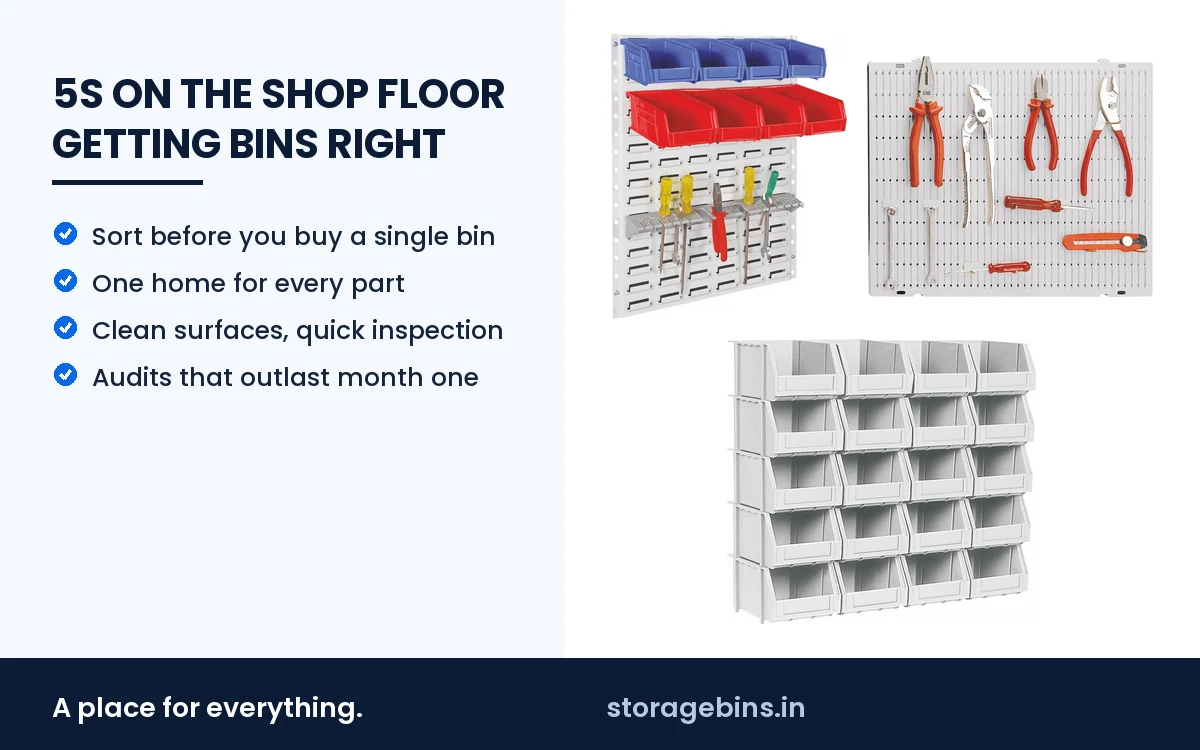
Most 5S programmes buy bins in week one and red-tag in week four. Do it the other way round. Here is how each S changes what you store, where it lives and what you should actually purchase.
Where 5S and storage actually meet
5S is usually introduced on an Indian shop floor as a housekeeping programme, and that framing is the first mistake. Sort, Set in order, Shine, Standardise and Sustain are decisions about where material lives and who is answerable for it, and almost every one of those decisions ends up expressed physically in a container, a panel, a rail, a drawer or a shelf. The floor tape fades and the launch banner comes down, but the bins bought in the first month stay on the wall for a decade and quietly define what the cell can and cannot do afterwards. That is why the storage decisions inside a 5S programme deserve far more thought than they normally get.
Each S makes a different and sometimes conflicting demand on your storage. Sort decides what exists at all, and therefore how much storage you genuinely need. Set in order decides where each item lives, which fixes the container size and the mounting. Shine decides what surfaces have to tolerate, because a container that cannot be emptied and wiped in one motion will not be cleaned by anybody, ever. Standardise decides how many different kinds of container you are willing to live with. Sustain decides who checks, how often, and against what written sheet. Treating storage as a Set in order problem alone is the reason so many programmes end up with a beautiful wall of bins that nobody maintains.
This article deals only with the storage side of 5S, and assumes you already understand the five steps in principle. It covers red-tagging both parts and containers, choosing homes and containers for a production cell, cleanability, standardising sizes, writing an audit sheet that measures access rather than appearance, and the procurement and maintenance decisions that follow. Real ALKON ranges and dimensions are used as worked examples where they genuinely fit, because arithmetic done on actual outside sizes is more useful than general advice about tidiness. The aim is a cell that still works in month six.
What not to buy before the Sort step is finished
The single most common way an Indian 5S rollout wastes money is a purchase order raised before a single red tag has been written. Somebody returns from a customer plant in Manesar or Sriperumbudur with photographs of a louvre wall, quantities get estimated by looking at the current clutter, and two hundred bins arrive. The clutter is exactly the thing Sort is supposed to remove, so you have sized your storage for a state that should not survive the exercise. Worse, once the bins are on site there is pressure to fill them, and filling them is the opposite of sorting. Hardware bought early becomes an argument for keeping things.
Hold the purchase until Sort is complete for the area you are working on, and hold it deliberately. At that point you will know how many part numbers actually belong at the cell, how much of each moves per shift, and how many usable containers you already own after the broken and mismatched ones are pulled out. In most first cycles the recovered bins cover a surprising share of the requirement, and the real purchase is smaller and much better specified than the first estimate. That is not a saving to be proud of so much as a sign that the first estimate was guesswork.
There are, however, a few things worth having in hand before Sort begins, and they are cheap. Buy one sample of each candidate bin rather than a carton, because the only reliable sizing test is pouring your own parts into the real moulding and seeing how they settle. Buy red tags, a register, floor marking tape for the red tag area, a tape measure and a clipboard. Everything else waits. If a supplier is willing to send a small sample set of the ranges you are considering, take that offer before you take a quotation, and keep the samples at the cell where operators can handle them.
- Do not buy bins in bulk, shelving bays or drawer cabinets before red-tagging is finished
- Do not print labels or fix a colour scheme while the part list is still changing
- Do not order trolleys or crash carts before the replenishment route is decided
- Do not commit to a bin size from a catalogue photograph without filling a sample
- Do buy one of each candidate bin, red tags, tape, a register and a tape measure
- Do agree in writing who signs the disposition of red-tagged items, before you start
Sort: red-tagging mystery parts, and red-tagging the bins themselves
Sort is not about throwing things away. It is about deciding, item by item, whether something belongs in this area within a defined horizon. Frame the question that way and the arguments become shorter. The test is not whether a part is useful in some general sense, because almost everything on a shop floor is useful to somebody eventually. The test is whether anybody needs it at this cell within the horizon you have agreed, which for a production cell is usually a matter of weeks rather than years. Anything that fails that test is not scrap; it is simply not a resident of this area, and it goes to the red tag area for a decision by a named person.
The hard cases are the mystery items: a tray of turned components with no number, a box of seals nobody recognises, three gauges with a rusted tag. Do not let them stall the exercise and do not let anybody quietly return them to the shelf. Give each one a number, photograph it, note its principal dimensions, put it in a single bin in the red tag rack and circulate the photographs to production, quality and maintenance with a closing date. A clear protocol here is what stops Sort from becoming an afternoon of quiet reshuffling. Maintenance spares deserve special care, because an unlabelled bearing can be the one item that matters at two in the morning.
The step most teams skip entirely is red-tagging the containers themselves. Walk the cell and pull out every bin that is empty, cracked, sun-brittled, missing its partitions, or holding four pieces of something nobody can name. Count what comes out by range and size, because that count is your real starting inventory and it usually funds a large share of the reslot. Separate them into three heaps: usable as they are, usable after washing, and finished. A bin whose front lip is cracked will fail again within weeks and should not go back on a panel, however tempting it looks when it is clean.
Write one line of output from the Sort step and get it signed: the number of part numbers that remain resident at this cell, the number of containers recovered in usable condition, and the number of items sent to the red tag area with their decision date. Everything you buy afterwards refers back to that line. If you are red-tagging a maintenance store rather than a production cell, the horizon and the disposition rules are genuinely different, and the guidance on organising a maintenance spares store is worth reading before you start, because the cost of a wrong scrap decision there is much higher.
Running a red tag area that does not become a second store
A red tag area with no closing date becomes a second store within three months, and then a third area needing its own 5S. Mark it on the floor, give it a shelf or a run of bays, address those positions the same way you address everything else, and put a dated register beside it. Every item entering gets a tag number, a date, the area it came from, the name of the person who tagged it and a decision due date. Every item leaving gets a disposition recorded against the same number. Without the register you cannot tell, six weeks later, whether the area is clearing or filling, and a red tag area that is filling is a programme in trouble.
Agree the disposition categories before you need them, because deciding under pressure produces inconsistent outcomes. Five categories cover almost everything: return to the central store, transfer to another cell or plant, hold for a defined period pending a claim, sell or scrap, and keep here with a defined home that must be created. That last category is the honest one, and it is used more than people expect: an item may genuinely belong at the cell but have had no home, which is a Set in order failure rather than a Sort failure. Recording it as such is what tells you how much storage to buy.
Authority matters as much as categories. Scrap decisions should need two signatures, typically stores and production, and maintenance should be consulted on anything that could be a spare. Over-zealous clearance in the first flush of a 5S drive is a real risk, and one critical spare thrown out costs more than a year of the clutter it was hiding in. The opposite failure, a hold category with no end date, is equally corrosive. Set the hold period, put the expiry date on the tag itself so it is visible without opening the register, and review the expired tags on a fixed day each month with the same two signatures present.
Set in order: decide the home before you choose the container
Set in order has two halves and they must be done in that order. First decide where each item lives, then decide what it lives in. Teams that reverse this end up fitting their process to whatever container was bought. The governing rule is one home per part: exactly one address where that item belongs, known to everybody, with a label that says so. Two homes is the commonest silent failure on an Indian shop floor and it is how stock records go wrong, how a part is reported out of stock while forty pieces sit in a carton at the bench, and how a 5S audit passes while the cell is quietly running on memory.
Point of use is the right default, but it is not the same as putting everything at the machine. Line side space is the scarcest space in the plant, and filling it indiscriminately simply moves the clutter closer to the operator. The disciplined version holds at the point of use only the quantity consumed between replenishments, with the balance in the central store where it can be counted and controlled. A cell that is topped up once a shift needs one shift of consumption plus a margin at the panel, which is usually a far smaller container than the team first proposes and makes the whole layout cheaper.
Work through a short set of criteria for each item rather than debating case by case, and write the answers on the slotting sheet. The criteria below settle most decisions in a minute. Where a cell sits inside a larger store, the frontage arithmetic matters too, and the treatment of golden zone heights and running metres in the guide to cutting picking time with a better bin layout applies directly to a cell wall; a panel run is frontage in exactly the same sense as a shelf bay, and the same trade between visible positions and depth behind each front applies.
- How often is it used: every cycle, every shift, weekly or rarely?
- Who uses it: this operator only, this cell, or several cells sharing?
- How much moves between replenishments, at peak rather than average?
- Does it need security, traceability, ESD control or a controlled environment?
- Is it consumed here, or does it travel to and from another area?
- If it disappeared today, how long before the cell stopped, and who would notice?
Line-side storage: panels, rails and the bins that hang on them
Once homes are decided, the wall or panel beside the cell is usually the cheapest frontage available. Louvre panels convert a blank surface into hanging bin positions, and the small open-front ranges are what normally hangs on them. Sizes matter more than range names here. An ALKON Supra SB 1 measures 125 x 100 x 60 mm outside with 117 x 80 x 52 mm inside, so it presents about a 100 mm front and holds roughly half a litre inside; the wider Supra bins step up from there, and the full ladder of sizes in the Supra range is set out on the Supra bins page. About eight or nine positions per running metre per level is the arithmetic to plan with: ALKON's louvre chart puts 24 SB 1 bins on a 457 x 457 mm LP 1 panel, which is four across.
Different duties suit different ranges. A Hippo 612/T at 100 x 110 x 53 mm outside is a small, shallow container for fasteners and electrical items at a bench. A Bull Bin 5 at 168 x 102 x 74 mm gives more depth for the same class of part. A Rhino Tuff ARTB-05 at 109 x 104 x 49 mm belongs where bins get dropped, kicked or handled with gloves. All these ranges are moulded in polypropylene copolymer with a service range of minus ten to plus seventy degrees Celsius, so they do not rust and they wash down, which is the property that makes the Shine step feasible at all.
If you want a self-contained starting point for one cell without designing a panel layout from scratch, the ALKON Poly Bins and Rails set, art no PBR-205, is worth knowing about: twenty bins of 125 x 100 x 75 mm and five wall-mounting rails, in light grey, with the bins usable either stacked or mounted on the rails. For tilting storage, ALKON crash cart rails, which ALKON designs specifically for mounting on hospital crash carts, measure 665 mm wide by 80 mm high by 12 mm deep, made from 1.5 mm CRCA steel powder coated in light grey RAL 7035, and Roo Tilt Bins mount on them with the RTB clips supplied. Note that if you prefer to bolt them, suitable M6 bolts and nuts are not provided, which is exactly the sort of detail that stalls a Saturday installation.
Keep the larger containers off the panel and out of the working envelope. A Tote AK-421 at 400 x 255 x 100 mm is the right thing for kits arriving from the store and finished parts leaving the cell, on a marked footprint on a stand or trolley. A Mammoth bin at 820 x 315 x 300 mm is a bulk and inter-departmental container for castings and rough parts, and belongs at the aisle end, not at the operator's elbow. Hippo 612/S bins at 150 x 110 x 75 mm running on small channels of 665 x 79 x 18 mm are a compact way to get a dense row of small parts onto a trolley or a mobile bench.
Tools: trays, boards and the drawer question
Tools fail 5S differently from parts, because tools come back. A part leaves its bin and is consumed; a spanner leaves its home and has to return to it, usually by a tired person at the end of a shift. That is why the home for a tool has to be faster to use than the bench top, not merely tidier. Three homes cover nearly everything: an open tray for the handful of items used every cycle, a hanging board for items used several times a shift, and a drawer for precision instruments, gauges, sets and anything that must be protected or controlled. Choosing the wrong one of the three is why shadow boards end up empty by the second month.
ALKON's multi-purpose Tool Tray is made for the first case: it holds screwdrivers, files, pliers and spanners, can be screwed to a wall or a workstation, and can be used on louvre panels. That last point is the useful one for a 5S layout, because it means the tools and the parts bins share a single panel and a single standard, rather than the tools needing their own separate fixture on a different wall. Keep the tray to the genuinely every-cycle items. A tray holding eighteen tools is a pile that happens to have a rim, and the operator will search it exactly as they searched the bench.
For hanging storage, the ALKON Multy Display Board MDB-500 measures 505 mm wide by 390 mm high, is made from polypropylene copolymer and comes with 451 hanging holes and 38 steel hooks, eight large and thirty small, together with 38 plastic locks, and is extendable when more area is needed. ALKON catalogues it for samples and displays rather than as a shop floor shadow board, so treat it as a candidate to discuss with your supplier rather than an off-the-shelf answer; the properties that matter for 5S are the hole density, the locking hooks and the ability to extend. Whatever board you use, mark the outline of each tool, because an unmarked board tells nobody that something is missing.
Drawers are for what must not sit in the open: micrometers, dial gauges, inserts, taps, and small sets that lose members. ALKON's Multi System and Modular System cabinets take interchangeable drawers in four sizes in a 1:2:3:4 ratio, with internal drawer sizes of 360 mm deep by 270 mm wide and heights of 16, 39, 62 and 87 mm for D1 to D4, in a Multi System cabinet of 410 mm deep by 310 mm wide by 333 mm high, offered with or without a central locking system; the wider question of when a drawer beats a bin is covered on the modular drawer storage systems page. Inside existing steel tool cabinets, ALKON drawer containers in sizes such as A-45 at 150 x 150 x 45 mm, B-45 at 150 x 75 x 45 mm and C-45 at 75 x 75 x 45 mm subdivide a drawer into defined compartments, each with a label holder.
Shine: cleanable surfaces and inspecting while you clean
Shine is widely misread as cleaning, when its actual purpose is inspection. The reason the operator wipes the machine and the bins is that wiping is the only activity that puts a hand and an eye on every surface in the cell at a fixed frequency. Oil under a bin means a leak somewhere above it. Chips in the bottom of a parts bin mean the bin is sitting where swarf can reach it, which is a layout problem, not a cleaning problem. A bin that is always half full of coolant mist residue is telling you it is in the wrong place. Write the checklist so that what is found gets recorded, not just cleaned away.
Cleanability is decided at purchase. The bin ranges in polypropylene copolymer wash down with water and ordinary detergent and do not rust, and their quoted service range of minus ten to plus seventy degrees Celsius is a clear boundary: no steam lances, no hot degreasing tanks, no parking against a furnace wall or under an unshaded mezzanine roof sheet in a Gujarat or Tamil Nadu summer. Note that the modular cabinets, drawer containers and tool trays are made from high impact polystyrene, which is a different material with different tolerances, so do not assume a solvent that is safe on one is safe on the other. Ask before introducing any aggressive cleaner.
Bin geometry decides whether cleaning actually happens. If a container can be lifted off its rail, tipped out and wiped in one motion, it will be cleaned. If it is bolted, overfilled, too heavy for one hand, or has internal corners that trap swarf, it will be wiped on the outside and left dirty inside. That is a genuine argument for sizing bins to the replenishment interval rather than the purchase pack, and for keeping partitions to a minimum in areas with fine chips. Fix the cleaning route as a walking sequence with a start point and an end point, so nobody has to decide what to clean while holding a rag.
- Coolant or oil under any bin, tray or footprint: find the source, do not just wipe
- Swarf inside a parts bin: the bin is in the wrong position or needs a lid or a shield
- Cracked lips, whitened stress marks or brittleness: replace, do not return to the panel
- Loose rails, panel fixings or bent tilt bin clips: tighten or replace the same day
- Labels lifting at the corners, or a card that is no longer readable at a metre
- Any item found without a home, or any home found with two different items in it
Standardise: fewer sizes, one grammar and visual controls
Standardise is the S that removes choice, and it is unpopular for exactly that reason. The practical content is short: fix the number of bin sizes used plant-wide, fix the panel and rail type, fix the label format and the label material, fix what a colour means, and fix where the min and max marks go. Three or four bin sizes across a whole plant is a realistic target and it pays back constantly, because every extra size multiplies your spare stock, complicates replenishment, makes shelf and panel pitch harder to plan, and gives the next person a decision to make where there should have been none.
The labelling and colour half of Standardise is a subject in its own right and is dealt with fully in the article on bin labelling and colour coding, which covers location codes, card materials, barcode placement and the rule that one colour must carry exactly one meaning across the whole site. Do not design a second scheme for the shop floor that differs from the store; a picker walking from a Panda shelving run in the store to a louvre panel at a cell should be reading the same grammar. The only thing worth repeating here is that colour should shorten a search, never carry the data itself.
The visual control that matters most at a cell is the standard layout photograph. Once the panel is set, photograph it, print it at a readable size, date it, have the cell leader and the supervisor sign it, and mount it at the cell. That photograph is the standard against which the next shift, a relief operator or an auditor compares reality, and it takes five seconds to use. Add the marked footprints for totes and trolleys, the min and max lines inside or beside the bins, and the empty-bin signal position. Anything that requires reading a document to check is a control that will not be checked.
Sustain: audit sheets that measure reach, not tidiness
Most 5S audit sheets in circulation score appearance, and appearance is the one thing a cell can produce on demand for an hour. Score access instead. Can the operator put a hand on a named item within a few seconds without asking anybody? Does every item at the cell have exactly one home and does every home hold exactly one item? Is the min and max visible without opening anything? Does the empty container reach the replenishment rail rather than going back on the panel? These questions cannot be answered by sweeping the floor before the auditor arrives, which is precisely why they are worth asking.
Keep the scoring binary. A line either passes or it does not. Five-point scales invite negotiation between the auditor and the cell about whether something is a three or a four, and that negotiation consumes the whole audit. What you report is not the score but the fail list with locations, and what you trend over months is the pattern of fails. If the same cell keeps failing on adhesion of labels, the mounting method is wrong. If it keeps failing on two homes, the part list has grown without a slotting decision. The pattern names the cause; the score never does.
Fix the cadence and keep it small. A daily check by the cell itself should take five minutes at the end of a shift and cover perhaps eight lines. A weekly check by the supervisor covers the same sheet plus the condition items. A monthly check involves a layer above. Longer audits done rarely are worse than short audits done constantly, because the cell learns the calendar rather than the standard. Put the blank sheets at the cell, not in an office, and keep the completed ones in a clip on the wall where anybody walking past can see whether yesterday's was done.
- Every item at the cell has one home, and the home is labelled and readable at a metre
- No item is stored on the floor, on a machine table, on a window sill or on a panel top
- Empty containers are on the replenishment signal position, not back on the panel
- Min and max are visible for every consumable held at the cell
- Tool tray and board match the dated standard photograph, with nothing missing
- No cracked, unlabelled or foreign container is in use anywhere in the cell
Layered audits and who owns what
Sustain fails most often because ownership is vague, and vague ownership shows up as a 5S coordinator doing everybody's Sustain for them. Write an ownership line for each element instead. The operator owns the point of use bins, the tool tray and the board. The cell leader owns the panel layout, the min and max quantities, and the standard photograph. Stores owns replenishment, the bin master and the label printing. Maintenance owns machine-side storage and the spares kit. The plant head owns the audit calendar and the decision to protect the cell from being used as staging space during a month-end rush.
Layered auditing simply means the same sheet is walked by different levels at different frequencies. The value is not in the extra inspection; it is that the senior layer looks at the same lines the operator looks at daily, so the standard cannot drift into two versions. A plant head walking a cell needs only three questions: show me the standard photograph and its date, show me yesterday's daily check, and show me one item you had to look for last week. The answers to those three tell you more about the health of a 5S programme than an hour of walking will.
Shift and contract churn is the practical enemy, and it must be designed for rather than complained about. In plants running two or three shifts, the handover should include a thirty-second look at the panel against the photograph, with anything missing raised then and not later. Contract and housekeeping staff need a short induction covering the red tag rule, the one-home rule and what the colours mean, because otherwise well-meaning tidying moves items to plausible but wrong places. Monsoon absence in Mumbai and Kolkata and long festival leave in Rajkot and Coimbatore both put unfamiliar people in front of the panel, which is exactly when the standard has to hold.
Why 5S programmes fade after the first month
The most common reason a 5S programme fades in an Indian plant is that it began as an event rather than a standard. A customer audit is scheduled, a drive is announced, teams clean for a fortnight, photographs are taken, the audit is passed, and the reason for doing it disappears on the same day. A second reason follows directly: no storage hardware was bought at all, or the wrong hardware arrived, so items that were tidied have no home to return to. The floor is then the only available home, and within weeks the cell looks exactly as it did, with everybody privately concluding that 5S does not work here.
Three further causes are worth naming because each has a specific fix. Ownership placed with a coordinator rather than the line means the standard belongs to somebody who is not present when it is broken. An audit that scores tidiness teaches the cell to tidy for the audit, so score access instead. And production pressure at month end converts the best-organised aisle into a staging area, because somebody needed a place to put a pallet for an hour and nobody had the authority to refuse. That last one is not an operator problem; it is a decision the plant head has to make once, in public, and then defend.
There is also a simple scoping error that kills good programmes: trying to do the whole plant at once. A plant in Peenya or Satpur MIDC that launches 5S across eight bays simultaneously will run out of attention before it runs out of bays, and the half-finished areas discredit the finished ones. Do one cell properly, prove it at week four with the same measurement you took at week zero, and let the second cell be a rollout of a known standard rather than another experiment. Plan the second cell before the first is signed off, so there is never a month in which nothing is happening.
Worked example: 5S on one machining cell
Take an illustrative example rather than a real case: a three-machine machining cell with a deburring and inspection bench, of the kind common in the auto component belt around Chakan and Ranjangaon near Pune, or in the pump and valve units around Coimbatore. The numbers that follow are invented to show the method. The Sort walk finds 46 items stored at the cell, of which 11 have not been used in twelve months, 3 cannot be identified at all, and 4 belong to a cell two bays away. It also finds 26 containers in five different sizes, of which 9 are cracked or brittle and 5 are empty with no assigned part.
Sort output is therefore 28 resident part numbers, 17 usable containers recovered, and 14 items in the red tag area with a decision date three weeks out. Only now is the container requirement calculated. Set in order allocates a two metre louvre panel run at the bench with two levels in the operator's comfortable working band. At roughly a 100 mm front, a Supra SB 1 sized bin gives about eight or nine positions per running metre per level, so four 457 mm LP panels offer about thirty-two positions against 28 resident part numbers, with room to grow. Deeper items go into Bull Bin 5 units at 168 x 102 x 74 mm on the lower level, and the deburring station, where bins get knocked about, uses Rhino Tuff ARTB-05 bins.
The rest of the cell follows the same logic. Raw castings sit in a Mammoth bin at the aisle end on a marked footprint, finished parts leave in Tote AK-421 boxes of 400 x 255 x 100 mm on a trolley, and the every-cycle hand tools live in a tool tray mounted on the same louvre panel as the bins. Inserts, a micrometer and two plug gauges go into a lockable drawer cabinet at the bench, with drawer containers subdividing the drawer so each item has a compartment with a label holder. Job cards and drawings, which otherwise drift onto the machine table, get a defined home rather than a habit.
Shine sets a five-minute end-of-shift route with a fixed start and end point and six things to look at while cleaning. Standardise produces one dated photograph of the panel, signed by the cell leader, plus min and max marks on the six consumables and a defined position for empty bins to signal replenishment. Sustain adds an eight-line daily sheet clipped to the panel, a weekly supervisor walk and a monthly layered walk. Note what was deliberately not done in the first cycle: no colour coding scheme, no new shelving, no relabelling of the main store. Those are cycle two, once the cell has held its standard for a full month.
Procurement and maintenance notes after the first cycle
Specify the purchase from the Sort output, not from the wish list, and specify it precisely. List range, art number, outside size, colour and quantity for each line, plus the panels, rails, stands and partitions, because the mounting hardware is what makes a layout hold its shape and it is the thing most often left out of the first order. Check what is and is not supplied with each item: Roo Tilt Bins come with RTB clips for mounting on crash cart rails, but M6 bolts and nuts are not provided if you intend to bolt them instead. Confirm colour availability across every size you plan to use before you design anything around colour.
Buy a modest buffer against the second cell and against breakage, and hold it as a stocked item with its own minimum and maximum, exactly like any other consumable. Replacement matters because a cracked bin that cannot be replaced quickly gets used anyway, and one improvised container is enough to start the drift back. Keep a small spares kit at the plant covering partitions, rail sections, tilt bin clips, board hooks and label stock. When reordering, quote the art number rather than describing the bin, and keep one sample of each size in the stores so that a new person can match by eye. For cells short of floor space, the ALKON Rounda Storage Unit at 780 mm diameter by 1750 mm high is worth knowing about as a rotary alternative to a run of shelving, and for the cell's paperwork ALKON states that its Roundafile system saves up to 60 per cent of the space needed for other filing systems.
Shreeram Metafusion Engineers Pvt. Ltd. has been an authorised stockist and supplier of ALKON Plastics Pvt. Ltd. for over thirty years, with 476 products listed across nine categories covering material handling bins and accessories, Panda shelf bins and shelving, Roo tilt bins, Visipro rack protectors and deflectors, component organisers, ESD safe products, storage systems, Koala pick bins and other products. Shreeram Metafusion Engineers Pvt. Ltd. stocks the range in Vashi, Navi Mumbai, and the team can be reached on 93266 29967 or at enquiry@shreeram-metafusion.com if you want to talk a layout through before ordering. Bring your measured panel run, your part list from the Sort step and a sample of the actual components to that conversation.
Related pages