Maximising workspace efficiency: a working guide to Alkon Supra bins for industrial and commercial storage
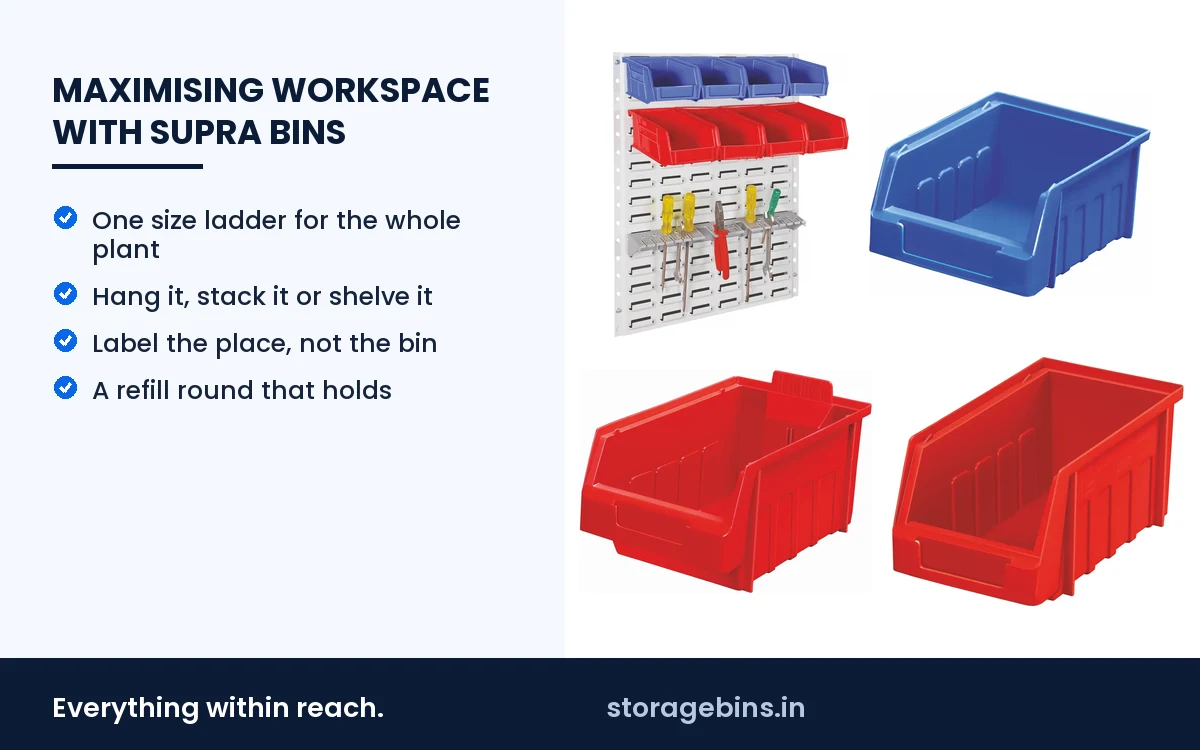
Supra bins are easy to buy and easy to install badly. This is the application guide: how to lay out a bench or picking face, what the catalogue sheet actually promises, and how to keep the face alive.
Small parts storage is a productivity decision, not a housekeeping one
Nobody records the minutes lost to hunting for a part, which is precisely why those minutes are the easiest cost in a workshop to ignore. An operator who cannot see the M6 washers puts down the sub-assembly, walks to the next bench, opens two cartons, finds them in the third, and walks back. None of that appears on a production report. It appears instead as a cycle time that will not come down, as a line that misses its last hour, and as a supervisor who spends half a shift answering the question of where something is. The container is the smallest unit of a workstation and the one every pair of hands touches hundreds of times a day, so it deserves to be specified rather than inherited.
Improvised binning fails in a predictable sequence, and once you have seen it three times you can predict it on sight. A cut-down carton works for a week. Then it sags, the writing on its side becomes unreadable, somebody adds a second part number because there is room, and a fortnight later nobody can tell whether the bench is short of stock or simply short of visibility. Picking errors follow from that, because two similar parts in one soft-sided container are a mix waiting to happen, and a mixed fastener found at final test costs more than every carton ever saved. Morale follows too: a bench that looks temporary gets treated as temporary.
What a standardised container actually has to do is narrower than most buyers assume. It must show its contents and its emptiness from two metres away. It must let a gloved hand enter, close and withdraw without scraping. It must sit in the same place tomorrow as it did today, with the same label, whoever refilled it. And it must belong to a family, so that when the next part number arrives there is a code that fits rather than an argument. That is the brief the Alkon Supra range was drawn against. The specifications and the full size ladder already sit on the Alkon Supra Bins range page, so what follows is the application side: what happens after the delivery arrives.
What an Alkon Supra bin is, read straight off the catalogue sheet
Supra is Alkon's open-front picking bin family (FPO Bins), moulded in polypropylene copolymer, coded SB 1 at the small end through to SB 8, with SB 7X listed alongside SB 7 as a variant of that rung. Alkon describes itself as the manufacturer of the largest range of material handling bins in India, and Supra Bins is the family within that catalogue built specifically for a hand that goes into the container many times an hour. The sheet's own phrase for the front is clear access to contents, which is the honest description: the front is cut away so that contents stay visible and reachable rather than needing the bin to be lifted down and tipped out.
The service range for the moulding is minus ten to plus seventy degrees Celsius. Read the upper figure as the top of the range rather than a failure point, because polypropylene softens and creeps under sustained load well before it visibly deforms. In practice that rules out three placements rather than a climate: components tipped straight into a bin off a curing oven or a hot wash, bins parked against a furnace wall or a compressor casing, and bins stored in the roof space of an uninsulated shed. None of those are exotic, and all three turn up on a summer walk through sheds in Ahmedabad, Rajkot or the older industrial pockets of Chennai. All three are fixed by a cooling rack rather than a heavier bin.
What makes Supra Bins a system rather than a box is the accessory set listed against it: partitions on the codes that carry slots, louvre panels, the universal rail AUR-1, free-standing Louver panel stands, Alkon Tuff stands and panels, and shop floor trolleys. That changes how you buy. You are not ordering plastic containers, you are specifying a bin-and-carrier arrangement that has to fit a bench depth, a gangway width and a reach height you already have. The choice of louvre panels, rails and stands is therefore part of the specification, not an afterthought, and a bin bought without deciding its carrier ends up stacked on the bench within a month.
- Moulded polypropylene copolymer, service range minus ten to plus seventy degrees Celsius
- Open front for clear access, so contents and stock level read from the aisle
- Reinforced base, sides and stacking rim, and resistant to most industrial solvents
- Identification card holders on all bins in the range
- Rear lip for louvre panels or rails on SB 1 to SB 6, but not on SB 7, SB 7X or SB 8
The feature list, checked line by line against the catalogue sheet
It is worth walking the feature list against the sheet rather than against a summary, because several commonly repeated claims need correcting. The material claim is sound: polypropylene copolymer, every code in the range. The chemical claim needs tightening. Alkon's wording is resistant to most industrial solvents, and most is doing real work in that sentence. It is not a statement that the bin is immune to anything a process can spill on it. Chlorinated and aromatic solvents, especially warm, are a different question from a light machine oil or a water-based coolant, and the sensible course for a wet process is to keep one bin in your own conditions for a few weeks and look at it before ordering five hundred.
The stacking claim is the one most often overstated. The sheet says the bins are designed to stack one on top of each other, and that a stopper prevents stacked bins from shifting forward. That is a stopper against forward movement, not a positive interlock in every direction, and the difference matters before you build a tall column on a trolley that crosses a floor joint. The safety stop is a separate feature and the sheet is specific about where it lives: a safety stop at the back, incorporated in SB 4, SB 5 and SB 6, for use on shelves. It is not present across the whole ladder, so do not plan a shelf installation on the assumption that every code has it.
The rear lip is the feature that quietly divides the range in two, and here the sheet is unambiguous: a strong rear lip for use with louvre panels or rails, except for SB 7, SB 7X and SB 8. SB 1 through SB 6 can hang; the top three codes cannot. You can verify that without taking anybody's word for it, because every accessory table in the catalogue stops at SB 6. The louvre panel bin counts, the AUR-1 rail counts and the Alkon Tuff stand and trolley counts all list SB 1 to SB 6 and no further. SB 7, SB 7X and SB 8 are shelf, pallet and floor containers, and a layout that hangs them is a layout that will not be delivered.
The partition claim needs the largest correction, because partition slots are not a feature of the whole range. The sheet lists slots for partition as NA against SB 1, SB 2 and SB 3. SB 4 carries three slots for horizontal partitions or one slot for a vertical partition. SB 5 carries three slots for vertical partitions. SB 6 carries seven slots for horizontal partitions or one for a vertical. SB 7, SB 7X and SB 8 each carry three slots for vertical partitions. If the plan was to subdivide the small codes on a fastener bench, that plan does not survive the sheet, and the answer is a smaller code rather than a divider.
- Resistant to most industrial solvents, which is not the same as chemically inert
- Stopper prevents stacked bins shifting forward; that is the specific claim
- Safety stop at the back on SB 4, SB 5 and SB 6 only, for use on shelves
- Rear lip on SB 1 to SB 6 only, which is why every accessory table stops at SB 6
- Partition slots start at SB 4; SB 1, SB 2 and SB 3 are listed as NA
Stack or hang: the effective height figure that decides it
There is a column on the Supra sheet that almost nobody reads and that settles more layout arguments than any other number in the catalogue. Alongside outside and inside dimensions, Alkon publishes an effective height for every code: 25 mm for SB 1, 40 mm for SB 2, 73 mm for SB 3, 80 mm for SB 4, 83 mm for SB 5, 85 mm for SB 6, 120 mm for SB 7 and SB 7X, and 170 mm for SB 8. Set each against the inside height of the same bin and the pattern is consistent, running between about half and two thirds of it, which is the signature of a front opening measured below the stacking rim.
The working consequence is straightforward. When you stack Supra bins directly on each other, the clear front opening left on the lower bin is that effective figure, not the inside height. An SB 1 stacked three high gives the two lower bins about 25 mm of opening each. That is a fingertip pick, fine for circlips or small washers taken in twos and threes, useless for anything scooped and useless for a gloved hand. Hang the same SB 1 on a rail or a louvre panel with clear air above it and the whole front is available. The bin did not change; the mounting decided how much of it you can reach.
So read the ladder in two halves. SB 1 to SB 6 have the rear lip, so the honest question for those is whether a part is picked often enough to justify a rail or a panel: fast movers hang, slow movers can stack, because losing most of the front opening on a part touched twice a week costs nothing. SB 7, SB 7X and SB 8 have no lip, so for those the effective height is the whole story. Before fixing any pitch, load a sample, stack a second bin on it, put on the gloves your operators actually wear and pick thirty times. If the hand scrapes or the top bin gets lifted off, the answer is a looser pitch or a different rung, not more training.
Laying out the bench: face width, projection and the pitch you can use
Three numbers set out a Supra bench and they come from different columns. The face width is the outside width, because that is what runs along a rail or across a panel: 100 mm on SB 1 and SB 2, 130 mm on SB 3, 178 mm on SB 4, 363 mm on SB 5, 180 mm on SB 6. The projection is the outside length, because that is what reaches towards the operator: 125 mm on SB 1, 170 mm on SB 2, 220 mm on SB 3, 290 mm on SB 4 and SB 5, 440 mm on SB 6. The pitch is the vertical spacing between rows, and unlike the other two it is yours to choose, which is exactly why it is where most benches go wrong.
Work face width first, because it decides how many distinct part numbers the bench can present, and at an assembly station that count usually matters more than litres. A 915 mm universal rail takes nine SB 1, nine SB 2, seven SB 3, five SB 4, two SB 5 or five SB 6, which are simply the rail length divided by the face width and rounded down. Then check projection against what you actually have behind the work area. An SB 6 gives five positions per rail, the same as SB 4, but it reaches 440 mm towards the operator, and on most benches that is the difference between a tidy back edge and a bin the operator fights every hour.
Then set the pitch from bin height plus real hand clearance, and be generous, because this is the cheapest thing on the bench to get right and the most expensive to correct. If the gap above a bin only just clears the moulding, operators start lifting bins off to fill and pick them, and a bin that leaves the face stops going back to the same place. Once that starts, the address on the card is a fiction and the fiction spreads along the row within a fortnight. Twenty-five to forty millimetres of clear air above the bin is not waste; it is what keeps every label meaning something six months later.
A short worked example, with invented numbers to show the method rather than a real installation. Take a sub-assembly bench with a single-sided free-standing stand carrying two LP 2 panels one above the other, giving a face 457 mm wide and 1220 mm high on that side. Alkon's chart puts thirty-two SB 1 on one LP 2, which works out at four across and eight rows, or a 76 mm pitch on a 60 mm bin. Take six rows instead, at a pitch of about 102 mm, and you have twenty-four positions per panel with 42 mm of clear air above each. You have traded eight positions for a face people will still be using correctly next year.
- Face width is the outside width; it sets positions per metre of rail or panel
- Projection is the outside length; it sets how far the bin reaches into the operator's zone
- Pitch is yours to choose; set it from bin height plus 25 to 40 mm of clear hand access
- Count positions against part numbers first, litres second, at any assembly bench
- Test the pitch with a filled sample and the gloves actually worn, not with an empty bin
Louvre panels LP 1, LP 2, LP 3 and LP 6: the charted maximum is a geometric limit
The louvre panels come in four heights on a common 457 mm width: LP 1 at 457 by 457, LP 2 at 457 by 610, LP 3 at 457 by 914 and LP 6 at 457 by 1829, all in 1.5 mm CRCA steel powder coated in light grey RAL 7035. Alkon publishes a lip count for each: 72, 96, 144 and 288 respectively. Divide those counts into the panel heights and the ratio is identical across all four, which tells you something useful. The lip rows repeat at a fixed vertical step and the number of lip positions across the 457 mm width is the same on every panel, so your row pitch can only be a whole multiple of that step. Measure the step on a physical panel before setting out a bench to the millimetre.
That also explains the bin count charts and why they should be treated as a ceiling rather than a specification. Alkon lists twenty-four SB 1, sixteen SB 2, nine SB 3, six SB 4, three SB 5 and six SB 6 on an LP 1, scaling up through LP 2, LP 3 and LP 6. Work backwards from those figures and the larger codes are sitting at roughly a 150 mm pitch, which leaves under ten millimetres of clear space above a 143 or 145 mm bin. That is a geometric maximum achieved by butting rows together. It is the right number for checking feasibility and the wrong number for a bench where somebody has to work all shift.
So use the chart in two directions. Read it upward to test feasibility, because if the maximum count will not cover your part numbers then the panel is too small whatever pitch you choose. Read it downward to plan, by setting your pitch from bin height plus clearance and counting the rows that fit. The difference is usually one or two rows per panel. Settle one more thing at drawing stage: your deepest bin sets the gangway clearance for the whole installation, not the average, so a face mixing SB 1 above and SB 6 below needs 440 mm plus the operator in front of it, drawn in plan before the aisle marking goes down.
The universal rail AUR-1: fitting out benches you already own
The universal rail is the lightest way to give Supra bins a home and, for a plant fitting out benches it already owns, usually the most sensible. AUR-1 is 915 mm long and 60 mm high in 1.5 mm CRCA steel, powder coated in light grey RAL 7035, and Alkon states it can be mounted on walls, benches, slotted angle systems, stands and trolleys. Capacity is published per code: nine SB 1, nine SB 2, seven SB 3, five SB 4, two SB 5 and five SB 6 per rail. SB 7, SB 7X and SB 8 do not appear, for the reason established earlier, and no amount of asking will change it.
Rails suit incremental spending in a way panels do not. Adding a rail to the back edge of an existing bench can be done between shifts and is a much smaller commitment than building a panel wall, and you can add a metre at a time in step with what the line actually needs rather than buying five rows on day one and finding three never get used. For a plant standardising slowly across ten or twelve benches, whether in a Navi Mumbai MIDC unit or a shed in Peenya, that shape of spend is far easier to get approved than a single large fit-out, and it lets each bench be corrected before the next one is done.
Alkon makes one note about the rail that is worth acting on. When rails are mounted one below another, from the second rail downwards the top part of the rail can support the lower part of the bin hanging from the rail above, while the bottom part of the same rail carries the next bin, and the stated benefit is fewer rails where bins taller than 130 mm are used. On the Supra ladder that means SB 4 at 143 mm and SB 5 and SB 6 at 145 mm. Be honest about limits too: no load figure is published for AUR-1, so thin bench backs and hollow blockwork need proper anchors, the run must be set level with an instrument, and one filled bin should sit on the far end before you commit the row.
Weight per bin position: dividing the load charts into something usable
Alkon publishes load-bearing capacities for the louvre panels: 180 kg on LP 1 with 72 lips, 240 kg on LP 2 with 96 lips, 360 kg on LP 3 with 144 lips and 780 kg on LP 6 with 288 lips, with a maximum of 12 kg per lip in each case. The Alkon Tuff stand panel ATSLP, at 914 by 610 mm, is listed at 420 kg over 192 lips, again at 12 kg per lip. What the sheet does not publish is how many lips a given bin engages, so the practical way to turn a panel rating into a planning figure is to divide the panel's capacity by the number of bins of that code the same sheet says the panel holds.
Do that arithmetic and it comes out consistent, which is a good sign the two tables were drawn together. On LP 1, LP 2 and LP 3 a panel filled with SB 1 works out at about 7.5 kg per bin. SB 2 lands near 11 to 12 kg, SB 3 at about 20 kg, SB 4 and SB 6 at about 30 kg, and SB 5 at about 60 kg, with LP 6 running marginally higher in every case. These are figures divided out of Alkon's own two tables rather than published allowances, so treat them as a sanity check on a layout and confirm with Alkon or with us before designing anything to the limit.
The same arithmetic delivers one result worth knowing before you compare carriers. The Alkon Tuff single-sided stand mounts three ATSLP panels and is listed at 216 SB 1 on that side, which is 72 bins per panel against a 420 kg rating, or about 5.8 kg per bin, noticeably less than the 7.5 kg a louvre panel allows for the same code. The Tuff panel carries more bins in the same area, so each position gets a smaller share. Two further limits sit underneath all of this: the bin's own capacity, which you should ask for by code rather than infer from size, and your own manual handling policy for a full bin lifted from shoulder height.
- Divide the panel rating by the charted bin count to get a per-position planning figure
- On LP panels that lands near 7.5 kg for SB 1, about 20 kg for SB 3, about 30 kg for SB 4 and SB 6
- The Tuff ATSLP panel holds more bins per area, so allows less per position
- Ask for the bin's own load figure by code; do not infer it from the bin's size
- Check the full-bin weight against your manual handling policy before fixing a mounting height
Standardising a facility on one ladder, and the SB 5 against SB 6 shape rule
The real prize in the Supra range is not any single code, it is running a whole facility on a short list of them. Pick three as standing stock and a storekeeper can replace a cracked bin, relabel a position and reassign a whole row to a new model the same afternoon. Pick one of everything and none of that is possible, because on the day a line changes, the code you suddenly need forty of is the code you have four of, and the gap is filled with cardboard inside a week. A workable pattern is one small code for fasteners and small pressed parts, one mid code for sub-assemblies and one large code for kits and bulk, with a fourth added only when a measured requirement demands it.
Before fixing that list, do one piece of arithmetic on the inside dimensions, because the numbering is a size sequence rather than a strictly rising volume sequence and this trips people up. SB 5, inside 265 by 340 by 130 mm, is a larger box than SB 6, inside 415 by 154 by 130 mm. The higher number holds less. They share the same 145 mm outside height and are simply two shapes: SB 5 presents a wide 363 mm face and reaches 290 mm towards the operator, while SB 6 presents a narrow 180 mm face and reaches 440 mm. Choosing between them on volume alone will hand you the wrong bin roughly half the time.
Choose between them on the bench instead. Per 915 mm rail, SB 6 gives five positions and SB 5 gives two, so SB 6 wins when part number count matters and the bench is deep enough to absorb 440 mm. SB 5 wins where depth is scarce but one large open face is needed, typically for long items laid across the bin or anything taken with a scoop that needs room to tilt. Standardising also means writing down where each code sits in the reach envelope: fast movers between elbow and shoulder height, slow movers and consumables top and bottom, heavy-when-full codes low. If the station is seated the whole band drops, and a tall carrier becomes a tall carrier with two useful rows.
Partitions: only from SB 4 upward, and how to decide
Because the small codes carry no slots, the partition question only arises from SB 4 up, and the accessories are specific rather than generic. The horizontal partition HP SB 4/6 serves SB 4 and SB 6 and is packed twenty per carton. The vertical partition VP SB 4/5 serves SB 4 and SB 5, VP SB 6 is the vertical for SB 6, VP SB 7 covers SB 7 and SB 7X and VP SB 8 serves SB 8, each packed ten per carton. Slot counts differ too, so confirm which orientation the numbers refer to against the drawing before ordering, because horizontal and vertical are read differently by different people looking at the same bin.
The decision between dividing a bin and dropping a rung is about replenishment rather than volume. Divide when the items are consumed together in a fixed ratio and refilled by the same person on the same round, because presenting them at one reach position genuinely saves hand travel and one label position. Step down the ladder instead when the items have independent consumption or belong to different owners, because a divided bin with one empty compartment and one full one sends a confusing signal to whoever walks the round. This is exactly why a two-bin refill loop breaks when someone partitions the trigger bin: the empty-bin signal only works if the whole bin empties.
There is one situation where partitions are simply wrong and it is worth stating flatly. If two parts in a divided bin look similar, do not share the bin at all. An M6 and an M8 flat washer, two lengths of the same screw, two colours of the same terminal: use two bins in two addresses with two cards, and accept the extra face as the price of not building wrong product. Partitions get lifted out during cleaning and dropped back in the wrong slot, and parts jump a divider when a bin is pushed home hard. Skip partitions entirely where a part is taken with a scoop, because the scoop needs the full internal width to be tilted and lifted.
- No partition slots on SB 1, SB 2 or SB 3; the option starts at SB 4
- HP SB 4/6 for horizontal division in SB 4 and SB 6, twenty per carton
- VP SB 4/5, VP SB 6, VP SB 7 and VP SB 8 for vertical division, ten per carton
- Divide only what is consumed together and refilled together on the same round
- Similar-looking parts never share a bin, however convenient the division looks
Carriers for the very common case where there is no wall
Most Indian shop floors do not have a good wall where the work actually happens. Machines sit in the middle of a bay, sub-assembly happens at benches that move, and the only real wall is thirty metres away behind the material stack. Stands solve that by putting the picking face where the hands are. The free-standing panel stand FSS/C, at 457 mm wide by 630 deep by 1560 high in 25 mm mild steel square section, mounts LP 1, LP 2 or LP 3 on one or both sides. FSS/LP6, at 457 by 905 by 2160 mm, is the taller stand built specifically for the LP 6 panel and is listed with a levelling base, which matters more than it sounds on an older floor.
The panel arithmetic on FSS/C is published and is not the obvious one, so check it before sketching. Single sided the stand takes two LP 1, two LP 2 or one LP 3; double sided it takes four LP 1, four LP 2 or two LP 3. A double-sided FSS/C carrying four LP 2 panels therefore gives two working faces, each 457 mm wide and 1220 mm high, on a footprint only 457 mm wide and 630 mm deep. Two operators work back to back off one floor position, which is often the cheapest square metre available in a crowded bay, and the stands come fitted with plastic shoes for stability.
The Alkon Tuff family is the heavier alternative and uses its own panel, ATSLP at 914 by 610 mm. The single-sided stand ATSSS is 915 wide by 550 deep by 1925 high and mounts three panels on one side; the double-sided ATDSS is 915 by 700 by 1925 and mounts three each side. Published Supra capacities on ATSSS run 216 SB 1, 144 SB 2, 72 SB 3, 60 SB 4, 24 SB 5 and 60 SB 6, doubling on ATDSS. Those are large numbers and they are the geometric maximum again, so apply the same pitch discipline before using them as a design figure rather than a feasibility check.
For work that travels, the shop floor trolley SFT is 970 wide by 600 deep by 1100 high with an aluminium chequered top plate, handles both sides and two LP 2 panels per side; the Alkon Tuff trolley ATTB is 995 by 700 by 1430 measured over the castors and handles, with two of its castors braked. Both ship without panels and bins, which is the note first-time buyers miss and then chase. Load the heaviest bins low and centrally, never on the top row, check every bin is fully seated because vibration will shake a part-seated bin off a moving trolley, and measure the trolley width against the narrowest door it must pass rather than estimating it.
Addressing the face, and the card that makes it survive a shift change
Every bin in the Supra range carries an identification card holder, and it is the accessory that decides whether the installation still works in month three. The moment a bin is emptied and refilled by somebody who was not there when the face was set up, the position loses its identity unless the card says what belongs there. Use the holder rather than sticking a label on the front face, because a label on the moulding gets scuffed by hands and solvent within weeks while a card can be reprinted and swapped in seconds. Print the part number and the bin address on the same card, large enough to read from where the operator stands rather than from arm's length.
Address the face itself, not just the bin, and this is the step almost always skipped at bench level. A panel or rail run should carry a position address in the same grammar the store uses, so that a pick list, a kanban card and a stores query all refer to the same string. Row and position is enough at a bench, as long as it is marked on the panel or rail and not only on the card, so that an empty position still has an identity. When a bin goes away for washing the address stays visible and nothing else moves in to occupy it, which is how a face quietly reorganises itself into nonsense.
Colour and the wider labelling grammar belong to the whole site rather than to one bench, so keep whatever scheme the store already uses and do not invent a second one for the shop floor. The one rule worth repeating is that colour should shorten a search and never carry the data itself. If Supra bins are going in as part of a wider programme, the guidance in 5S on the shop floor covers how the standardise and sustain steps tie labelling, the audit sheet and ownership together. Finish by photographing the face, dating the print and mounting it beside the bench, because that print is what the next shift and the next auditor compare reality against in five seconds.
A refill routine that does not need anybody to count
The point of a Supra face is that stock level is visible, so the refill routine should exploit that rather than run alongside it on a spreadsheet. The simplest arrangement that works is two bins per part number, one in use at the front position and one behind or above it. When the front bin empties the operator brings the reserve forward and puts the empty in a defined signal position, and the empty bin itself is the order. Nobody counts anything, nobody raises anything, and the signal is visible to a supervisor from the aisle. With nine SB 1 positions per 915 mm rail, a two-bin loop on four fast part numbers occupies one rail cleanly.
Size the bin to the interval you actually observe, not the one in the procedure. If the milk run is scheduled every two hours but in practice arrives twice a shift because the store has one person who is also issuing against job cards, then the real interval is four hours and a bin sized on the shorter figure will starve the line every day. Walk the route yourself for one shift with a watch before fixing any size. The method for turning an observed interval and a measured piece density into a volume is set out in the guide to choosing the right storage bin size, and it is the input most often taken on trust.
Where a two-bin loop will not fit, mark a fill line and a minimum line physically on the bin and treat the minimum as the trigger, because a number written on a card gets ignored and a mark cannot be. If one part genuinely needs more than the largest standardised code will hold for the interval, do not answer it by oversizing every position on the bench: step that one part up the ladder and leave the rest alone, which is precisely what a fine-stepped ladder is for. Then walk the face once a week against a position list, looking for a position with no card, a card with no bin, two part numbers in one bin, and anything on the bench with no home.
Mistakes that kill a Supra bench, and the ones to catch early
Overfilling is the first and the most common. An open-front bin filled above the front lip spills every time it is knocked, and a small code filled with dense steel parts loads its walls and its rear lip far harder than the same bin holding plastic clips. If a bin is bowing at the sides, or the rear lip has begun to splay, the bin is telling you it is the wrong code or the wrong range for the duty. Do not answer it with a stricter instruction to the operator. Step up the ladder, or move to a heavier range, and ask us for the load figure for the specific code rather than guessing it from the size of the bin.
Bad fixing is the second and it is quiet, because it passes inspection while the run is empty. Rails and panels fixed into hollow blockwork with the wrong plug, or into a thin bench back that flexes, hold fine until they are loaded and knocked, then fail progressively. Set the run level with an instrument, load-test the far end with a filled bin before committing the row, and re-check every fixing a month after commissioning, because that is when a marginal fixing declares itself. Mixing carriers is a related error: the same bin gets a different weight allowance on a Tuff panel, so redo the division rather than assuming a layout travels unchanged.
The third is environmental and it is nearly always a placement decision rather than a product one. Bins parked in the sun on a loading dock, on a rooftop landing, or beside an oven or compressor are being used outside what the moulding was specified for, and unless a sheet states a product is UV stabilised, do not assume it is. Wash with warm water and a mild detergent, which is all most bins ever need. Avoid steam and hot degreasers above the seventy-degree limit, avoid chlorinated and aromatic solvents, and do not scour the inside, because scratches hold oil and swarf. Air-dry fully before bins return, particularly for unplated steel parts in the coastal humidity of Mumbai, Navi Mumbai or Chennai.
The fourth failure is organisational and it is the one that actually kills installations. Bins get moved, cards fall out, somebody puts an unrelated item in an empty position, and within two months nobody trusts the face. Three habits prevent it and none of them costs anything: every position has a printed card, every new part number gets an address assigned before its first delivery arrives, and one named person walks the face weekly against a list. A Supra installation is cheap to buy and cheap to maintain. The one thing it cannot survive is being nobody's job, which is why the ownership line matters more than the hardware.
- Bowing sides or a splayed rear lip means the wrong code, not a training problem
- Load-test the far end of a new rail or panel run before you fill the whole row
- Re-check every fixing a month after commissioning, when marginal ones declare themselves
- No steam, no hot degreasers, no chlorinated or aromatic solvents, no scouring inside
- Assign an address to every new part number before its first delivery arrives
Specifying and buying: cartons, freight volume and a clean enquiry
Supra bins are ordered in standard cartons and the pack quantities vary sharply across the ladder, which ought to shape how you standardise rather than surprise you at despatch. The sheet lists sixty pieces per carton for SB 1 and SB 2, fifty for SB 3, ten for SB 4 and SB 6, six for SB 7 and SB 7X, and five for SB 5 and SB 8. So a bench needing thirty-one SB 1 positions is half a carton, and the sensible move is either to fit out two benches from one carton or to take the carton and hold the balance as spares. Spares are not indulgence: a bin will crack, a contractor will carry one off, and a new part number will appear next quarter.
Freight on plastics is charged on the space they occupy, so the volume per box column repays a minute before consolidating. The sheet gives 0.0458 CBM for a carton of sixty SB 1, roughly 0.0008 CBM per bin, against 0.0786 CBM for five SB 5, about 0.0157 per bin, close to twenty times as much for each position. A facility standardising on the large codes is buying far more freight volume per bin position than one standardising low on the ladder, and that difference usually outweighs anything negotiated on the bins. Consolidating a plant's whole requirement into one despatch also means the installation goes up in one day instead of arriving in pieces.
An enquiry becomes a clean order when it carries six things: the bin codes with quantities against each, the colour, the partition art numbers with divisions per bin, the carrier with its art number and panels per side, the panel and rail quantities, and the delivery address with an unloading contact. Add a photograph of the bench and a sketch marking bench depth and available height. The full list of material handling bins and accessories is on the site if you want to check an art number before writing it down, and a picture of the real station usually saves a week of correspondence, because it lets the conversation reach the useful part.
Our position in the chain is worth stating plainly. Alkon Plastics manufactures; Shreeram Metafusion Engineers Pvt. Ltd. has been an authorised stockist and supplier of Alkon products for over thirty years and holds the range at Shop-1, Gagangiri Chs, Sector 17, Vashi, Navi Mumbai 400703, open Monday to Saturday from 10:00 to 19:00, on 93266 29967 or 98201 01937, or at enquiry@shreeram-metafusion.com. Being in Vashi puts the stock beside the Navi Mumbai MIDC estates and the container corridor, with the Pune belt up the expressway and the Nashik belt up the highway, and the same stock goes to Ahmedabad and Rajkot in Gujarat, Coimbatore and Chennai in Tamil Nadu, Bengaluru in Karnataka, Hyderabad, Kolkata and the Delhi NCR belt.
Before a large rollout, take a sample and use it properly. One bin of the code you intend to standardise on, held at the real station with the real parts and the real gloves for a fortnight, will tell you more than any sheet about whether the inside dimension suits the part, whether the effective height suits the grip, and whether the operator picks from it willingly. Ask for the rung either side as well, so the trial can actually compare. And if the bench is an electronics one, ask about the conductive Supra codes in black, which run SB 1-C to SB 8-C in the same sizes, with SB 8-C subject to a minimum order quantity, rather than adapting a standard bin, because that is the substitution where damage is invisible until final test.
Read next