Cycle counting with storage bins: how to keep stock records honest
A stock record is only as good as the last time somebody looked at the bin. How fixed bin locations, a sensible count list and a short weekly routine replace the annual stock-take that nobody trusts.
The count that never matches
Every stores department knows the afternoon. The system says there are 340 pieces of a gasket, the maintenance planner has raised a purchase request on the strength of that number, and the storekeeper has just walked to the shelf and found sixty. Somebody asks where the other 280 went. Nobody knows, and the honest answer is that they probably never existed in the form the record claims. A receipt was keyed twice, a batch was issued to a job that was later cancelled and the pieces were never returned, a carton of a similar gasket was booked against this code, or sixty is simply what is left after two years of small, undocumented borrowings.
The usual response is a stock-take. The shutters come down for a weekend, everybody counts everything, the differences are written off, and for about a month the records are good. Then drift starts again, because the thing that caused the drift, a floor on which stock moves faster than paperwork, has not changed. By the following March the same gasket is wrong by a different amount and the same planner is making the same trusting mistake.
Cycle counting is the alternative, and it is far less dramatic. Instead of counting everything once a year, you count a small slice of the stock every working day, so that every location is visited several times a year and the important ones many times. Nothing stops. The people counting are the people who work in the store and know what the parts look like. Errors are found while the memory of what caused them is still fresh, which is the only time a root cause can actually be traced. This article is about doing that well, and about one point that tends to be missed: how much of cycle counting is decided not by the count procedure but by the containers the stock sits in.
Why the annual stock-take does not work
A full physical stock-take has three structural weaknesses, and none of them is the fault of the people doing it. The first is volume. Counting several thousand part numbers in a day or two means counting fast, and fast counting of small parts produces its own errors, so the exercise manufactures a fresh batch of discrepancies at the same moment it claims to remove the old ones. The second is timing. By the time the count sheets are reconciled and the adjustments posted, a week has passed and the stock has moved, so a variance can no longer be explained, only absorbed. The third, and the most expensive, is that it teaches the wrong lesson. A store that expects to be corrected once a year does not treat daily accuracy as its own job.
None of this means the annual count disappears. Many companies are required by their auditors to carry out a physical verification of inventory once a year, and a well-run cycle count programme is a perfectly good way to satisfy that requirement, because it can show that every location was counted at least once in the year, with documented tolerances and adjustments. What changes is the reason for counting. The aim stops being a number for the balance sheet and becomes a working store whose records can be relied on between audits.
What cycle counting actually is
Strip away the vocabulary and cycle counting is four decisions. Which locations will be counted today, who counts them, how a difference is judged, and what happens to the stock record afterwards. Everything else, from ABC classification to blind counts, is a refinement of one of those four. A store that makes those decisions explicitly and writes them on one page already has a cycle count, even if it has never used the phrase.
The idea has been around in manufacturing for decades and sits comfortably alongside lean practices such as 5S and kanban. It rewards discipline in the physical layout more than it rewards software. A spreadsheet and a printed list will run a cycle count for a few thousand locations perfectly well. What you cannot do without is a store where each part has one address, each address holds one part, and a person standing in front of that address can tell at a glance what is supposed to be there.
That final sentence is where bins matter. A cycle count is a comparison between a record and a physical fact, and the cheaper and more certain the physical fact is to read, the more often you can afford to compare. A part loose in a carton on a cluttered shelf can only be counted by emptying the carton. A part in the same fixed bin on a labelled shelf face can often be counted in the time it takes to look, which changes the economics of the whole programme.
Why bins make counting cheap
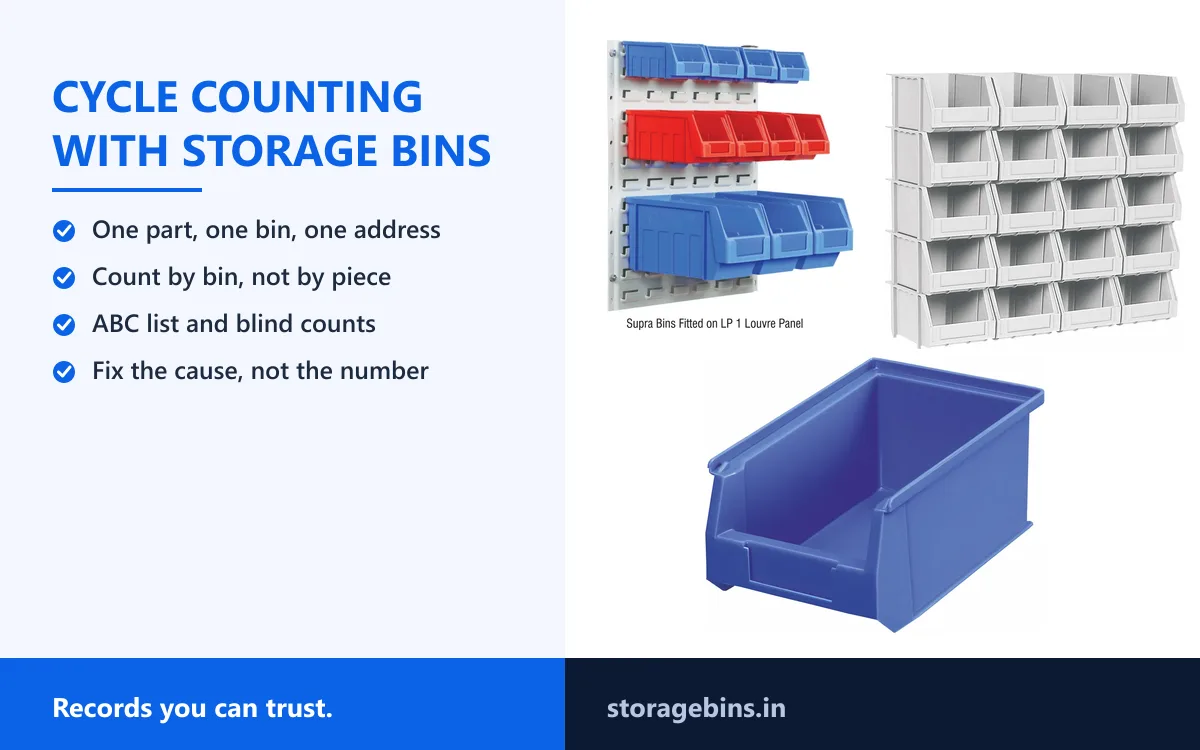
Think about what a count has to establish. First, that you are looking at the right place. Second, that what is in that place is the right part and only that part. Third, how many there are. A bin with a label holder, sitting at a fixed address on a shelf or louvre panel, answers the first two questions before the counter has done anything. ALKON's moulded bins carry identification card holders as standard, which sounds like a minor feature until you see a count team work through a hundred locations without opening a single cabinet to check a part number.
The third question, how many, is helped by three properties of a good bin. The first is a known capacity. If a Supra SB 2 has inside dimensions of 157 x 80 x 75 mm and a particular fastener fills it to a marked line at around 400 pieces, then a bin filled to that line is a bin of about 400, and nobody needs to count one at a time. The second is visibility. An open-front bin such as the Supra, Bull or Hippo ranges, or a transparent Panda shelf bin, lets the counter see the fill level from the aisle. The third is containment. A bin has walls, so stock does not wander off to a neighbouring location, and the quantity in a bin on Monday is the quantity less what was issued on Tuesday, rather than whatever migrated.
These are small advantages individually. Together they usually cut the time per location by half or more compared with counting from a mixed shelf, and the difference widens as parts get smaller. That is the real argument for putting a standardised bin family under the count list: it lets a store afford to count more frequently with the same number of people.
Building the count list: classify before you count
The first design decision is how often each location is visited, and the standard tool is a classification of parts by their importance, usually called ABC analysis. Rank every part by annual consumption value, meaning the quantity used in a year multiplied by its unit cost. A small number of parts account for most of the money, a large tail accounts for very little, and the middle sits between. The class boundaries differ by business, but the principle is dependable: spend your counting effort where an error costs most.
A common working pattern looks like this. Class A parts, the top fifth of items that carry the bulk of the value, are counted every month or even every fortnight. Class B parts, the middle band, are counted every quarter. Class C parts, the long tail of low-value consumables, are counted once or twice a year, often in bulk by weight or by bin fill. The exact frequencies are yours to choose, and you will adjust them within a year, but the shape matters. It stops the store from spending an hour on a box of washers and ten minutes on a critical bearing.
Two refinements are worth adding. The first is to promote any part that has caused a line stoppage or an emergency purchase in the last year, whatever its value. A twenty-rupee relay that halted a packing line for four hours is not a Class C part. The second is to count a location whenever something unusual touches it: a stock-out reported by a user, a negative balance, a large receipt, or a transfer between stores. These event-driven counts catch errors at the moment they are cheapest to trace.
Once the list is built, convert it into a calendar. If a store has 2,400 locations and the schedule requires about 6,000 location-visits in a year, that is roughly twenty-four a working day, which is a morning's work for one person with a clipboard. The arithmetic is worth doing before the programme is announced, because it shows whether the plan is realistic or whether you are about to promise something the store cannot staff.
Prepare the location: one part, one address, one bin
Most failed cycle counts fail before the first number is written, because the shelf was not ready to be counted. Four conditions have to hold, and bins make each easier to achieve.
That fourth point comes from the kanban principle that the quantity and identity of a location belong to the shelf, not to the container. It is covered in more detail in our guide to two-bin kanban, and it matters just as much here. A cycle counter who finds a part in the wrong bin must be able to say so without arguing about which of the two labels is correct.
For very small parts, partitions are the tool that lets one bin hold several part numbers without mixing them. Supra, Hippo, Bull and Rhino Tuff bins all have partition accessories, and a partitioned bin should be counted as separate locations, each with its own sub-address. A label that reads 14-C-3-B, meaning aisle 14, bay C, shelf 3, compartment B, is perfectly workable and eliminates the argument about which compartment holds which part.
- Every part has exactly one primary location, and that location has a code that appears on the shelf, on the bin and on the count sheet in the same format.
- Every bin holds one part number only. Mixed bins are the single largest source of unexplained variances, because the count compares one record to a pile that contains several.
- Overflow is not left lying around. If a delivery does not fit the bin, it goes to a clearly marked reserve location with its own address, and the bin and the reserve are counted as two locations.
- The label is on the location, not only on the bin. If a bin is borrowed for another part, the label on the shelf still says what the address is meant to hold, and the discrepancy is visible at once.
Count by bin, not by piece
The most useful trick for counting small parts in bulk is to stop counting pieces and start counting bins. Establish a standard fill for each part: the number of pieces in a full bin of a defined bin type, level with a marked line or to a fixed height. Record that number against the location. When a bin is full, the count is the standard fill. When it is half full, it is roughly half. Only when a bin is a quarter full or less does the counter need to count piece by piece, and by then the numbers are small enough that this is quick and accurate.
Standard fills work best when the bin sizes themselves are standardised. A store that uses three sizes of the same family, say Supra SB 1, SB 2 and SB 3, can attach a standard fill to each part-and-bin pairing, and a new storekeeper can learn the system in an afternoon. A store that has fourteen random sizes from four manufacturers cannot, which is one of the quiet costs of accumulating bins instead of choosing them. The sizing exercise in our bin size guide pays back here.
For parts that are heavy relative to their count, such as washers, small bushes, screws and rivets, weight counting is an even better tool. Weigh a sample of fifty pieces, calculate the weight of one, and weigh the contents of the bin in a tare-corrected container. The result is accurate to within a few pieces and takes seconds. Keep a calibrated scale at the counting station, record its calibration date, and note on the location sheet which parts are counted this way. Weight counting should not be used on parts with large weight variation, such as castings or parts that carry coolant or oil.
The routine: who counts, when, and how long
A cycle count only survives if it is a boring daily habit instead of a project. Fix it at a time of day when issues and receipts are quiet, which in most plants means the first hour of the shift or just before lunch, and give it a named owner. The best counter is a storekeeper who does not normally handle the parts being counted, because a person who issues from a bin every day will count what they expect to see. Rotating counters between zones solves most of this without any extra staff.
The routine itself should fit on one side of an A4 sheet.
Tolerances should reflect value and counting reliability. For a high-value part, any difference at all may need explaining. For a low-value fastener counted by weight, a tolerance of one or two per cent may be perfectly sensible. Whatever you choose, write it down, because a store with no stated tolerance ends up arguing about every difference or ignoring them all.
- The count sheet lists the day's locations, the part description and the unit of measure. It does not show the system quantity. This is a blind count, and it is the single most effective way to prevent the counter from nudging a number towards the expected one.
- The counter visits each location, confirms the part and address, counts, and writes the figure.
- The sheet goes to a second person, who compares it with the system record.
- Any difference outside tolerance triggers a recount by a different person before anything else is done.
- Only a confirmed difference proceeds to investigation and adjustment.
Reading the variance: where the missing pieces go
A count that finds a difference is not a failure. It is the whole point of the exercise, and its value lies in what you learn from it. Variances in a store fall into a small number of families, and learning to recognise them turns a pile of corrections into a list of process fixes.
The point of listing them is to make investigation systematic. A counter who finds a difference should look at issues in the last two weeks, at neighbouring locations and at recent receipts before anybody suggests that someone has been stealing. In most stores, a large majority of variances turn out to belong to the first four families, and every one of those has a process remedy.
- Issue without a record. The part was taken for a job, a breakdown or a trial and nobody booked it out. This is usually the largest family, and it points to an access-control or paperwork problem rather than a counting problem.
- Wrong bin on return. The part came back from the shop floor and was placed in a neighbouring bin. This produces a pair of variances, one positive and one negative, in adjacent locations, which is a strong clue when you look for it.
- Unit of measure confusion. Packs, boxes and individual pieces get mixed up between purchase order, receipt and issue. A variance that is an exact multiple of a pack size almost always comes from this.
- Substitution. A user took a similar part, with the storekeeper's agreement, and nobody amended the record.
- Receipt error. The goods receipt was keyed against the wrong code, or a short delivery was booked in full.
- Damage and scrap. Parts that were damaged or contaminated were discarded and not written off.
- Loss and theft. A real possibility, but the last one to conclude, not the first.
Investigate before you adjust
The temptation after a recount is to correct the record and move on. Resist it. An adjustment without an explanation hides a process failure and guarantees a repeat. Give every confirmed variance a short entry in a log with five fields: the location and part, the system quantity, the counted quantity, the cause as far as it was established, and the corrective action. After a few months the log becomes the most useful document in the store, because it shows which causes dominate and where to spend effort.
Authority to adjust should be proportionate. Many stores allow a storekeeper to correct small differences on low-value items and require a supervisor's signature for medium differences and a manager's for large ones. The thresholds do not need to be elaborate. They do need to exist, and the adjustment entry should state the reason in a form that an auditor can follow.
One discipline deserves emphasis: do not adjust the record in a way that hides the process cause. If the log says issues without records are the largest family, the remedy is not a more forgiving tolerance. It is a counter-sign at the issue point, a cage or a locked cabinet for critical parts, or an issue slip pre-printed with the part and location. The count shows you where the process leaks; fixing the leak is a separate job.
Layout choices that make errors visible
Some layouts hide discrepancies and some expose them, and with the same stock a store can move from one to the other by changing the containers.
Open-front bins on louvre panels, rails and stands present the face of every part to the aisle. An empty bin is visible from several metres away. A part in the wrong place is obvious because the labels are all at one height and one orientation. A store that lays its small parts out this way can often spot a misplaced bin on a walk-through, and a counter can scan a panel in seconds. The Supra, Hippo, Bull, Rhino Tuff and Koala ranges all mount on louvre panels or universal rails in this way, and the mounting hardware is standard across the family.
Transparent Panda shelf bins serve the same purpose on shelving. The ALKON catalogue includes thirteen transparent Panda shelf bin variants for exactly the case where seeing the contents matters more than anything else. Pharmacy stores, electronics stores and any location with many similar-looking parts benefit from seeing the part itself rather than reading a label.
Colour can carry meaning too. Many stores assign a colour to each count class so that an A-class location is visibly different from a C-class one, or colour-code by production line or supplier. This is covered in our article on labelling and colour coding, and the same principle applies: pick a small number of meanings, publish them on the wall, and stick to them. A colour that has two meanings has none.
Closed drawers and cabinets have their place, particularly for expensive or sensitive parts, but they make counting slower, because each drawer has to be opened. Where drawers are used, drawer containers and partitions inside them restore the one-part-per-compartment discipline, and a sketch of each drawer taped inside the front panel lets a counter confirm the layout at a glance.
Small parts, kits and the problem of the loose pile
Small parts are both where cycle counting is hardest and where it pays back most. A bin of ten thousand rivets is a count nobody will do piece by piece, so the store needs a method: standard fill for a few full bins, weight counting for the loose remainder, and a clear rule on how a half-used bin is handled when a fresh carton arrives. The common mistake is to tip the new carton in on top of the old stock. This destroys any standard-fill logic and makes batch traceability impossible. Instead, finish the old bin and swap, or keep the partly used bin separate and mark it for use first.
Kits and sub-assemblies cause a different problem. A kit bin holds a set of different parts for one job, and the question is whether to count the kit or its contents. The best answer is to give each kit a location and a kit code, count complete kits as one unit, and break a kit only through a documented process that returns the loose parts to their own locations. A kit that has been opened and partly consumed should be flagged, because its contents no longer reconcile to the bill of materials.
Trolleys complicate counting because stock moves. Parts on a shop-floor trolley are stock in transit between a store and a line. The practical rule is to give each trolley a location code, count the trolley as a location, and treat the trolley's contents as belonging to that location until formally transferred. Without this, a trolley parked at a workstation becomes a blind spot where parts can sit for weeks without appearing in any count.
Measuring whether it is working
A cycle count programme needs a few numbers to tell whether it is improving anything. Three are enough.
Post these on the stores notice board with a plain chart. A store team that sees its own numbers improve week by week tends to protect them, and a plant manager who sees them has a better argument for the next round of investment.
It helps to keep a record of the time per count as well. If a morning's count has crept from ninety minutes to three hours, either the locations are less ready than they were or a new type of container has crept in, and a short investigation will usually find which.
- Inventory record accuracy. Of the locations counted in a period, what fraction matched the system within tolerance on the first count? This is the headline measure. A store that starts at 70 per cent and reaches the high nineties over a year has transformed its operation, and the exact figure matters less than the trend.
- Count coverage. Of the locations scheduled, what fraction were actually counted? A programme that is ten per cent behind schedule in month two will be thirty per cent behind in month six, and the plan needs adjusting early.
- Repeat variances. How many locations produced a variance more than once in a quarter? Repeat variances show where the cause has not been fixed, and they are the first places to look when the programme plateaus.
A twelve-week rollout that a small store can actually run
Cycle counting works best when it is introduced in stages rather than announced as a transformation. A schedule that suits most small and medium stores looks like this.
By the end of the twelve weeks the store should have a calendar, a log, a set of measures and a team that has done it long enough to trust the process. From there it is a matter of keeping it going and tightening the tolerances as accuracy improves.
- Weeks one to two: fix the addresses. Walk the store, give every shelf and bay a code, and mark the location on the shelf face. Remove obviously dead stock to a quarantine area so it does not clutter the count.
- Weeks three to four: fix the containers. Put every small part into a bin of a standard size, one part per bin, with a label holder and a printed label. Start with the fast movers and the A class, and leave the long tail until the routine is running.
- Week five: classify. Run the ABC analysis, decide the frequencies and build the first calendar. Check the arithmetic: locations times visits per year divided by working days must be a number the team can do in a morning.
- Weeks six to eight: pilot one zone. Count it daily for three weeks, using the blind count and the log. Do not post adjustments yet; use the pilot to find the process problems.
- Weeks nine to ten: fix what the pilot found. Typical fixes are a counter-sign at issue, a clearer return procedure and a few bins re-sized or re-labelled.
- Weeks eleven to twelve: extend to the rest of the store and begin posting adjustments with the new authority levels.
The mistakes that sink most programmes
Most cycle count programmes that fail do so for predictable reasons, and none is technical.
The first is starting with the count rather than the containers. Counting a messy store tells you the store is messy, and the energy that should have gone into fixing it goes into arguing about the numbers. Prepare the locations first.
The second is showing the counter the system quantity. A counter who sees the expected number rarely finds a difference, and the programme reports excellent accuracy while the shelf is wrong.
The third is adjusting without investigating. The count becomes a ritual that corrects the numbers every week and changes nothing about why they drift.
The fourth is making the count a punishment. If storekeepers are blamed for every variance, they will hide them, and the cycle count will find nothing because nothing is allowed to be found. A programme that treats a variance as information about the system, not as a fault in a person, gets honest numbers.
The fifth is letting the routine lapse during a busy month. A count that is skipped for three weeks does not resume at the same pace; it is dropped. Protect the daily slot and, if it has to move, move it rather than cancel it.
Choosing bins that are easy to count
If you are buying bins with counting in mind, a few practical rules make the later work easier.
Choose a small family and stay inside it. A store that standardises on, say, Supra bins for small hardware, Panda shelf bins for shelved stock and Mammoth or Tote bins for reserve will find its standard fills, its labels and its count sheets are all simpler than a store with a patchwork. The dimensions are published for every ALKON bin, so the sizing is arithmetic rather than guesswork, and the full set is listed in the product catalogue at storagebins.in.
Prefer bins with a label holder at the front, and fit it with a label that carries both the part code and the location code. Prefer a bin whose open front lets the counter see the fill level without lifting anything. Where visibility matters most, choose a transparent variant. Where parts are delicate or small, add partitions to separate part numbers inside the bin instead of mixing them.
Plan the mounting system with the bins. Louvre panels, rails and stands let you change the arrangement as the part range changes without replacing the bins, and the bins stay interchangeable between panels, rails, trolleys and shelves, which means a bin moved to a new address keeps the same label and the same standard fill.
Finally, plan for a spare stock of empty bins and labels. A store that runs out of the right bin during a busy week reverts to cartons and polythene bags, and every one of those is a future variance.
Putting it together
Cycle counting is not a software feature and not an audit exercise. It is a habit in which a few trusted people look at a few locations every day and compare what they see with what the system says. The habit is much easier to keep up when the physical store has been set up for it: one part per bin, one address per bin, a label the counter can read from the aisle, a standard fill that makes a full bin a known number, and a layout in which a wrong or empty bin stands out.
If you are starting from a cluttered store, begin with the containers. A few weeks spent putting the fastest-moving and highest-value parts into properly sized, labelled bins will do more for stock accuracy than any change to the count procedure. If you are not sure what size to start with, or which mounting system suits your racking, Shreeram Metafusion Engineers can help from Vashi, Navi Mumbai, as authorised stockist of ALKON Plastics Pvt. Ltd. for over thirty years, with the full catalogue of 476-plus products described on the product pages of this website.
Read next