Two-bin kanban with storage bins: a working guide
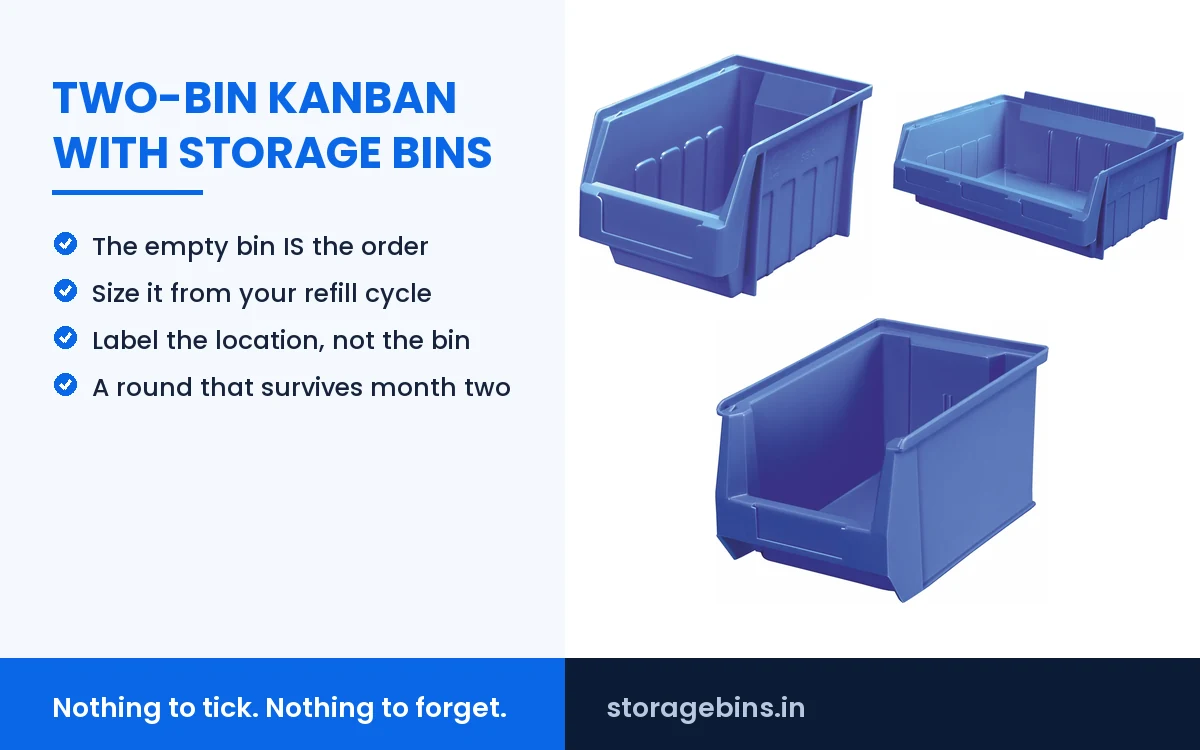
Two-bin kanban works when the empty bin is the only order you raise. How to size it, where to put the second bin, and why walking the round more often beats buying bigger bins.
The line that stopped at eleven o'clock
Every stores in-charge has had this conversation. An assembly line stops mid-morning for want of a small retaining clip. The system shows forty pieces. The search turns up twelve in a polythene bag at the workbench, none in the location the system points at, and a packet of the wrong variant in the next bay. The line restarts after ninety minutes, and the review concludes that the stock record needs tightening, or the reorder level was too low, or the operator should have spoken up sooner.
None of those is the cause. Consumption information had to travel from the hand that used the part to the person who could order it, through a record nobody updates at the moment of use: the clip went at nine, the record was read at four the previous evening. Tightening the record does not close that gap, and asking the operator to speak up sooner is a request for vigilance, the one resource on a shop floor that cannot be scheduled.
Two-bin kanban closes the gap by making the container carry the information: when a bin runs out, the empty bin is the order, and it travels to the person who can fill it. What decides whether it survives month one is everything around the two bins, above all how often somebody walks the round. That number is almost always treated as fixed, and it is the strongest lever on the list.
What two-bin actually is, and the one rule that holds it together
Every kanban part number sits at the point of use in exactly two containers of the same size, holding the same fixed quantity. The operator picks from the front one until it is empty, then picks from the second while the empty one travels away to be refilled. There is no counting, no reorder level and no form, and the quantity is decided once and marked on the location rather than on the bin.
There is one rule, and everything else is detail. The empty container must physically leave the point of use. The moment anybody tops up a bin in place, by tipping in a half packet, borrowing from the bin next door, or walking to the store with a hand-written chit, the system has no signal and you are back to vigilance. It gets broken first, usually with good intentions, and it is the one to be inflexible about for two months. It is also what makes the second bin worth its space: that bin is not spare stock, it is the time you bought to run the refill loop without stopping.
Why min-max on a spreadsheet keeps failing, and what the bin replaces
A minimum and a maximum against every part number is the normal arrangement in a stores department, and it has a structural problem that care does not fix. A minimum is a number about the future, compared against a stock figure that is a number about the past. The comparison is valid only when both are true at the same instant, and that instant almost never arrives: issues are posted at the end of the shift, or the next morning, or in a batch on Saturday. Even a correct minimum only triggers when somebody looks, so a nightly exception report is already a shift late on a part consumed that morning.
Be precise about what the bin replaces, because overclaiming is how pilots lose credibility. It replaces the stock count as the trigger for replenishment at the point of use, not the stock record, the ERP or purchasing. When audit asks how stock will be controlled, the answer is that kanban stock at the line is fixed, visible and countable: two containers per part number, and nothing else permitted at the cell.
What the bin does not replace is thinking about demand. Two-bin is reactive: it responds well to a steady or slowly varying rate and badly to a step change. If the line is about to double its output, or a new variant is coming, the quantities have to be recalculated before the change rather than discovered afterwards through a stockout. The kanban is an execution mechanism, not a forecast.
Choosing which part numbers belong on kanban, and which never should
Two-bin is not a plant-wide policy, and applying it to the wrong parts is how programmes get a bad name. The parts it suits are consumed repeatedly, at a reasonably steady rate, in small physical units, from a known location, by people who are not responsible for ordering them: fasteners, clips, grommets, washers, terminals, sleeves, small bearings, seals, inserts, rivets, cable ties. If a part is picked several times a week and fits in a hand, it is a candidate.
Write the exclusion list before the inclusion list, so nobody argues case by case later. Anything with a shelf life or cure date needs date control a two-bin loop does not provide, because the loop is deliberately indifferent to which pieces are older. Anything serialised or lot-traceable needs a record at the moment of issue, which is exactly the record two-bin removes. Anything on the brink of a design change will sit in the second bin and become obsolete stock. Anything consumed once a quarter does not generate enough signals to keep the loop honest. Write the reason against every line, including the rejections, because the rejections are what you will be asked to defend.
- Is it consumed at least a few times a week, at a rate that does not swing wildly?
- Is the physical unit small enough that several days of use fits in one bin?
- Is it free of shelf life, cure date, serial number or lot traceability requirements?
- Is the design stable, with no supersession or engineering change pending?
- Is there exactly one location at the line where it is used, not three?
- Would a stockout stop work within a shift, making the signal genuinely urgent?
Sizing in brief, and reading the specification correctly
The bin quantity is the only number in the system. It comes from peak hourly consumption, not average, multiplied by the replenishment lead time in hours, plus a stated margin of fifteen to twenty-five per cent. The lead time is where this goes wrong: it is the elapsed time from the bin reaching the signal position to the refilled bin being back at the line, not the time the store takes to pick it. If the round walks every four hours and the store needs an hour to pick and return, a bin that empties just after the round has passed waits nearly four hours for the next one and an hour to be filled: five hours of lead time, not one, and sizing on picking time alone understates the bin fivefold.
That worst case, its margin argument and the topping-up failure it guards against are derived in full in the post on storage bins for automotive manufacturing. The arithmetic is the same wherever the round walks, so what follows takes it as settled and goes after the number that feeds it.
Converting pieces into volume needs a fill test with the actual component: count a known quantity, pour it into a measuring jug or sample bin, read the level. Fasteners with flanges or heads pack very differently from plain pins of the same mass, so a pieces-per-litre figure measured on your own parts turns bin selection into arithmetic rather than argument.
Then read the specification correctly. ALKON's tables list an outside dimension, an inside dimension and an effective height, and on an open-front bin it is the effective height that governs usable volume, because it is the height you can fill to before pieces come over the front. A Supra SB 3 has an inside size of 200 by 115 by 115 mm, about 2.6 litres, but an effective height of 73 mm, so the volume to plan with is 200 by 115 by 73, about 1.68 litres, a third less. The same gap exists on every size in the range; the full ladder is in the Supra bins workspace guide.
Three worked sizings with real bin dimensions
Take an illustrative cell. The piece quantities and packing densities below are invented and labelled as such; the bin dimensions are real catalogue figures. The cell builds 200 units per shift over eight hours, so 25 an hour. The round walks twice a shift and the store needs about an hour to pick and return, so five hours worst case, and twenty per cent on top gives six hours of consumption per bin.
The first part is an M8 flange bolt, four per unit, so 100 an hour and 600 pieces per bin. An illustrative fill test gives 230 pieces per litre, so 600 pieces is 2.6 litres of usable volume. A Supra SB 2 at 170 by 100 by 85 mm outside gives 157 by 80 by 40 mm usable, about half a litre or 115 pieces, and an SB 3 gives 1.68 litres or 386: both short of the 600 wanted. A Supra SB 4, 290 by 178 by 143 mm outside with a 265 by 155 mm inside and an 80 mm effective height, gives 3.29 litres and about 756 pieces. That is the right bin on volume, and the next section is why you may not get to use it.
The second is a rubber grommet, two per unit, so 50 an hour and 300 pieces per bin. Grommets are bulky and light; call it 60 per litre, so you need five litres. A Koala Pick Bin AKP-32 at 300 by 140 by 140 mm gives 270 by 125 by 65 mm usable, 2.19 litres or 131 pieces, and an AKP-33 at 300 by 215 by 140 mm gives 3.51 litres or about 210. An AKP-43 at 400 by 215 by 200 mm gives 360 by 200 by 95 mm usable, 6.84 litres and about 410 pieces, which works. That changes the layout: ALKON lists full-length rear lip supports on AKP-01, 11, 22, 32, 33 and 35, but not on AKP-42, AKP-43 or AKP-64. The grommets go on a shelf, not the panel.
The third is a cast housing, one per unit, so 150 pieces per bin. Call it 0.9 litres a piece, so 135 litres of usable volume wanted. A Koala AKP-64 at 605 by 292 by 200 mm gives 540 by 272 by 110 mm usable, about 16 litres: eighteen housings, or forty-three minutes of production. A Mammoth bin AM83S at 820 by 315 by 300 mm outside has an inside size of 740 by 250 by 290 mm and an effective height of 175 mm, so the planning volume is 740 by 250 by 175, about 32 litres, or roughly 36 housings and an hour and a half. Its outside envelope works out at 77 litres, and planning on that would have promised more than twice the coverage it can give. No size rescues this part: bulky items need a pallet, stillage or trolley as the kanban unit, with a much shorter loop.
Round frequency is a lever, not a given
Volume arithmetic gives you a bin, and then the mounting hardware sometimes takes it away again. ALKON's louvre panel chart gives two different limits: a total for the panel, from 180 kg on LP 1 up to 780 kg on LP 6, and a maximum of 12 kg per lip on all four sizes. They are not the same kind of limit. The panel figure governs everything hung on it; the per-lip figure governs one heavy bin in one position, and that is the one a kanban bin runs into. Go back to the M8 flange bolt. A Supra SB 4 filled to its effective height holds about 756 of them, and at an illustrative 19 grams each that is over 14 kg of steel before the weight of the bin. The volume arithmetic says SB 4; whether it can hang depends on how many lips it sits across, and that is a check to make before the layout is drawn rather than after.
There are three honest responses. Put the heavy bin on a shelf and keep the panel for light parts. Fill only to a marked line below the effective height, accepting coverage the loop was not sized for. Or shorten the loop itself, which is where replenishment frequency stops being an operational habit and becomes a design parameter.
Walk the round every two hours instead of four and the worst case falls from five hours to three. With twenty per cent safety that is 3.6 hours of consumption, about 360 bolts, or 1.56 litres. A Supra SB 3 at 220 by 130 by 125 mm outside, with 1.68 litres usable, now fits, and 360 bolts is under 7 kg, inside the lip limit. One change to the walking schedule has made the bin smaller, made it hangable, and cut the stock in that position from 600 pieces to 360. Nothing was bought and nothing was redesigned.
Frequency goes unexamined because it sits with a different person from the one sizing the bins: the industrial engineer sizes containers, the stores supervisor owns the walking roster, and neither has reason to open the other's file.
Using frequency as a lever means pricing it, and the price is handler minutes. Those minutes scale with the route rather than with the quantity moved: walking an aisle twice as often doubles the walking and the handling of empties, but not the picking, because the same total quantity moves in more and smaller trips. A route with many stops close together therefore absorbs a frequency increase far better than one with two stops at opposite ends of the plant. Walk the route once with a watch and write down the split between walking, picking and handling; if walking is the small part, doubling frequency is cheap.
What those minutes buy is three things at once. Line-side stock falls in proportion to the coverage you no longer need. Bin sizes fall, so more part numbers fit in the same frontage. And weight per position falls, which brings a bin back inside a lip limit or a shelf rating. A frequency change is also easy to undo, where a bin change is a purchase order, a relabelling exercise and a layout argument.
Two refinements. Frequency need not be uniform: a two-hourly route for the half-dozen high runners at one cell and a four-hourly route for everything else is sound, provided the two are separately timetabled and separately staffed rather than quietly merged on a busy day. And there is a floor: once the interval approaches the time it takes to walk the route and refill a bin, raising frequency stops buying coverage, because the lead time is no longer dominated by waiting but by the refill itself. Past that point the next gain has to come from moving the stock closer, which is what a supermarket does.
Where the second bin lives, and how many positions that costs
There are three sensible places for the second bin, and each buys something with something else. Directly behind the first is cheapest in frontage, because the two bins share one position and the operator never looks anywhere but straight ahead. It costs depth. ALKON lists Panda shelf bins in thirty standard sizes, with bin lengths of 315, 415, 465, 515 and 615 mm to match 300, 400, 450, 500 and 600 mm shelving: one bin filling the depth of the shelf it is made for. That is the catch, because the behind arrangement wants two bin lengths of depth and not one. Two 315 mm bins nose to tail need 630 mm of shelf, deeper than the deepest standard. In practice the second bin goes on the level below rather than behind it, unless the racking already runs deeper than the bin it carries. Either way it is a racking decision hiding inside what looked like a labelling exercise.
Below the first, on the next shelf down or the next louvre row, costs one picking position but keeps everything shallow and visible, and makes the state of the loop legible from the aisle: a supervisor can see which parts are on their reserve bin without reading anything. The cost is real, in that a wall serving 28 kanban part numbers now needs 56 positions. The third option is a supermarket, where all the second bins live together away from the line and the round brings a full bin forward when an empty arrives: most space-efficient at the line, most expensive in walking, and it adds a second place where the part can be out of stock, so address and label it like any other location.
Because two-bin halves every published bin capacity, do the position arithmetic before anything is ordered. A single LP 6 louvre panel, 457 by 1829 mm, carries 96 Supra SB 1 bins, which is 48 part numbers in less than half a metre of wall. An Alkon Tuff double sided stand ATDSS at 915 by 700 by 1,925 mm takes 432 SB 1 bins, which is 216 part numbers in 0.64 square metres of floor. For a supermarket bay, a Koala pick bin shelving unit ASU 133 is built from an ASUB 213 body, 13 ASUS 300 shelves and one ASUKP kick plate, and the catalogue lists it complete with 72 AKP-32 bins: 36 part numbers in one bay. Take every published capacity and halve it.
Card or no card: when the bin is the signal
The textbook version uses a card. The empty bin is set down, the card pulled off and posted to a board, the board read by the material handler, and the card travels back with the refilled bin. Cards carry the location code, quantity, supplier and a barcode, and they can be counted on a board to show the state of the whole loop at a glance. They also reintroduce the one thing two-bin was supposed to remove, a step a human can forget: a card that falls behind the rack, or is replaced by a hand-written slip, takes that loop down silently.
For most line-side loops the bin can be the signal. The empty bin arriving at the signal position is the authorisation to refill it, the location label says which part and how many, and the bin on the collection rail does the job the card did on the board. ALKON lists identification card holders on all Supra bins, an extra wide front face for identification labels on Koala pick bins, and a small handle on Panda bins specifically so the maximum area of the front face is free for labels, so a card has somewhere to live if you later want one.
Cards earn their place in two situations: a supplier loop, where the signal has to leave the plant and come back as a delivery, so the card is both document and receipt; and any loop where you want to adjust the stock in circulation without buying or scrapping bins. If neither applies, run cardless and spend the saved discipline on the location labels.
Labelling inside a two-bin loop
Inside a kanban loop the location carries the identity and the bin is a consumable sitting in it, because the bin is the thing that moves: label the shelf edge, the louvre lip row or the rail with the location code, part number, description and bin quantity, and a cracked bin can then be swapped for any bin of the same size without a thought. Whether that rule should hold across the whole store is a separate question with a different answer, and the article on bin labelling and colour coding works through the general case, including when a travelling container does need a label of its own.
Colour has one genuinely good two-bin use. Several ALKON ranges, including the Supra, Bull and Rhino Tuff bins, are listed in red and blue, so bin one can be blue and bin two red, and a red bin at the front tells a supervisor from the aisle that the part is running on its reserve. That works only if red means that and nothing else anywhere on site.
The replenishment round: who walks it, what they carry
A two-bin system is really a walking schedule with storage attached, and the walking is designed last and abandoned first. Somebody has to collect empty bins, take them to the store, fill them and bring them back, on a timetable that does not depend on who is in a good mood. Name that person and that timetable before you install a single panel. The robust arrangement is a dedicated material handler per aisle or cell group on a fixed route at fixed times; a shared duty of the store assistants means it happens when the counter is quiet, which is never.
What the handler carries matters as much as when they walk, because a trolley with bin positions lets full and empty bins travel in one movement instead of two. ALKON's shop floor trolley SFT, 970 by 600 by 1,100 mm with an aluminium chequered top plate on castors, takes two LP 2 panels per side, which at 32 SB 1 bins per LP 2 is 64 bins single sided and 128 double sided. The Alkon Tuff trolley ATTB at 995 by 700 by 1,430 mm carries 144 SB 1 bins single sided and 288 double sided, and ALKON notes two of its castors are braked, which is what stops a loaded trolley rolling on a sloping floor.
One property changes the return leg. ALKON states that Koala pick bins nest, and nested empties occupy far less space than the same bins travelling out full, so the trolley can bring every empty on the route home in one trip. ALKON's own saving figure for nesting Koala bins is quoted as transportation cost rather than volume, so treat the nesting as an operational fact, not a space calculation. Nesting and stacking are different properties that trade against each other, as the comparison of stackable and nesting bins sets out, so check the empty leg before you buy.
What breaks in month two, and the countermeasure for each
Month two is where two-bin systems are won or lost, and the failures that arrive then are behaviours rather than hardware faults, which is why better bins fix none of them. The first is borrowing. An operator two cells away needs the same clip, their bin is awaiting replenishment and yours is full, so they take a handful. Nothing is recorded, nobody is at fault in their own eyes, and your bin empties early with no explanation. The countermeasure is a slotting change, not a lecture: if two cells use the same clip at similar rates, either give them one kanban location with a bin sized for both, or give each a bin and make borrowing visible by requiring the empty to reach the signal position.
The second is hoarding, the mirror image. An operator burned by a stockout in month one keeps a private reserve in a carton under the bench. The bin never quite empties, the signal never quite arrives, the loop looks beautiful, and then the private reserve runs out on a Friday and the stockout is total. Hoarding is a rational response to an unreliable loop, so fix the loop and publish the fill rate.
The third is part supersession, the expensive one. An engineering change arrives, the new variant is issued, and the second bin of the old variant quietly feeds obsolete parts into the product for weeks. The countermeasure has to be agreed with engineering rather than imposed on the store: every change notice lists the kanban locations affected, and closing the change requires a signature that those locations have been emptied and relabelled.
The fourth is the shutdown spike. A plant comes back from a Diwali or maintenance shutdown and runs hard to recover a delivery, and consumption for a fortnight is nothing like the rate the bins were sized for. Plan the spike: raise the round frequency for the recovery period, which needs no change to a single bin, and add a temporary third bin on the highest runners, removed on a dated review. Both are reversible, which is why they beat resizing the wall.
Slow movers, insurance spares and the parts kanban cannot hold
Every store has a long tail of items that move once a quarter, once a year, or never until the day they matter, and putting them on two-bin is a mistake that looks like thoroughness. A loop with one signal a quarter has no rhythm: the handler stops expecting anything from that location, the label fades unread, and the bin consumes a picking position in the best part of the rack for nothing.
Treat slow movers as stock-controlled items and say so. They keep a labelled location, because everything keeps a labelled location, but replenishment is triggered by a periodic review rather than an empty bin, and a quarterly check of one named section by one named person with a printed sheet suits them better than an automated minimum, because a review date is a diary entry rather than a calculation. Put them in a clearly different part of the rack so nobody expects a kanban response.
Insurance spares, held not because they are consumed but because their absence stops production for days, are a different problem again, and the guidance on organising a maintenance spares store deals with them and their preservation records directly.
A thirty-day plan to put one aisle on two-bin
Start with one aisle or one cell, chosen because it has a steady product mix, a cooperative supervisor and a current problem people can name. Week one is measurement and nothing else: pull three to six months of issues for the part numbers used at that cell, work out peak hourly consumption for each, and walk the actual replenishment path with a watch to find the real lead time. Write down the split between walking, picking and handling while you are there, because that is what tells you whether frequency is cheap to buy. Order no hardware this week.
Week two is selection and sizing. Run the part list through the inclusion test and write the reason against every line. Do the fill tests with real components and one sample of each candidate size, calculate each quantity, then check every heavy bin against the 12 kg per lip limit. Decide the round frequency deliberately rather than inheriting it, knowing it changes every bin size on the sheet and is the only input you can still change for free. Only now do you know what to buy.
Week three is installation: mount the panels, rails or shelves, fix the location labels before any stock arrives, mark the signal position on the floor, set out the collection rail or trolley, fill the bins to their marked quantity and place the second bins. Brief the operators and the handler together, standing at the wall, and make the one rule explicit. Expect at least one bin size to be visibly wrong when real parts go into it, and change it that week rather than defending it.
Week four is running it with somebody watching. A named person checks the wall once a day: locations labelled and readable, no bin holding a part that is not its own, empties reaching the signal position, nothing stored outside its location. Log every stockout with part number, time and cause, then at day thirty review every quantity against the actual issues of those days, adjust, and only then decide whether to extend.
What to measure, and the honest limits of the method
A kanban installation is easy to report with the wrong number: bins installed, part numbers converted, a photograph of the wall before and after. All of those can be true of a wall that is quietly failing. Measure four things instead, none of which needs software: stockouts as events with a part number, a time and a cause; loop fill rate, the proportion of empty bins returned full within the promised lead time; line-side stock held, in pieces or litres of occupied bin volume rather than money; and positions used against positions available.
Fill rate matters most, and it costs something to collect, because it needs the handler to note two times. It is worth the trouble because a published fill rate is what kills hoarding: an operator who can see the loop keeping its promise stops keeping a carton under the bench. Read it as a pattern, not a score. Repeated stockouts on one part mean that part's quantity is wrong; stockouts scattered across many parts mean the round is not happening as timetabled, which is a roster problem no resizing will touch.
Two-bin has clear boundaries, and knowing them stops it being oversold. It handles steady consumption well and step changes badly. It is indifferent to which pieces are oldest, so it is wrong for anything with a shelf life, a cure date or a traceability requirement. It carries a deliberate cost in stock, the price of removing the counting. It depends entirely on a walking round actually happening, and it says nothing about buying the right quantity from the right supplier. Within those limits it does what no record-based system can: it puts the replenishment trigger in the hand that consumes the part, at the moment it is consumed.
When you specify hardware, the enquiry that gets a useful answer carries five things: the part list with calculated quantities, your own measured pieces-per-litre figures, the frontage and depth available at the cell, the round frequency you have chosen, and a handful of the actual components to fill-test against sample bins. Shreeram Metafusion Engineers Pvt. Ltd. stocks the ALKON range in Vashi, Navi Mumbai, and can be reached on 93266 29967 or at enquiry@shreeram-metafusion.com to work through a two-bin layout before an order is raised. Do the fill test before the purchase order, not after it.
Read next