E-commerce seller storage: how to set up a small warehouse that ships fast and counts right
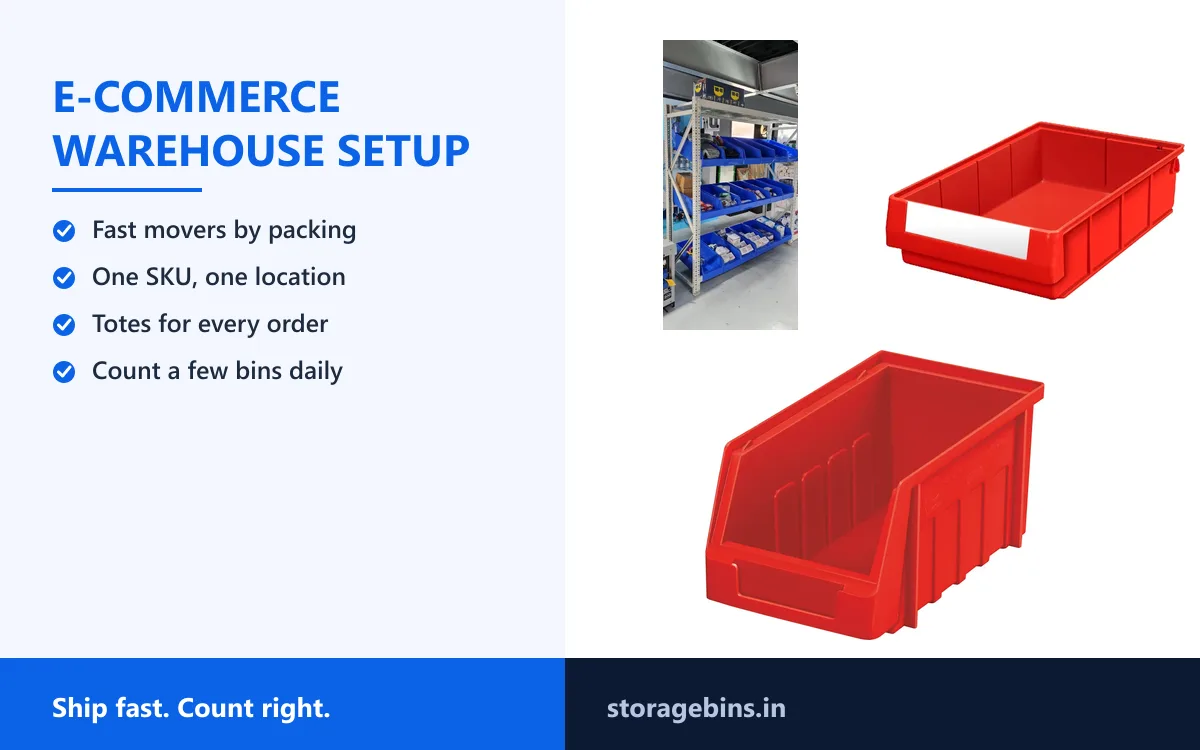
A spare room, a shop's back store or a rented godown can run a serious online business, if it is laid out like a warehouse. SKU storage, pick faces, a packing station, a returns corner and a counting routine, built from bins, shelving and totes.
The business that outgrew the spare room
Many online sellers in India start the same way. A few products, a spare room or the back of a shop, cartons stacked against the wall, orders packed on the dining table. It works for ten orders a day. At fifty, the cracks show: a customer gets the wrong colour because two cartons look alike, a bestseller shows as in stock online when the last unit shipped yesterday, the packer spends ten minutes of every hour hunting for a mailer or a tape roll, and returns pile up in a corner where nobody knows what is resellable.
At two hundred orders a day, the same habits become expensive. Every mis-pick is a refund and a bad review, every stock-out is lost sales and every hour spent searching is an hour not spent growing the business. Marketplace rules add pressure: late dispatch and cancellation rates feed directly into a seller's ranking and standing.
The fix does not need a big warehouse or expensive software. It needs the habits of one: every product has a fixed, labelled place; the most-sold items are the easiest to reach; packing materials are within arm's length of the packing table; returns have their own corner; and somebody counts a few locations every day. This article sets out how to build that with bins, shelving and totes, for a seller handling anything from fifty to a few thousand orders a day.
Start with your products, not your shelves
Before buying anything, understand what you sell. Make a simple list of every product, or SKU, with its dimensions, weight, how fragile it is, how many you typically hold and how many you sell per day. A spreadsheet is enough.
Group the SKUs by size. Tiny items, such as jewellery, phone accessories, cosmetics, spare parts and stationery, fit in small bins. Small boxed items, such as electronics accessories and toys, fit in medium bins or on shelves. Medium items, such as footwear, kitchenware and garments in poly bags, fit on shelves or in totes. Large and bulky items, such as appliances, furniture parts and cartons of stock, fit on pallets or low racking.
Rank the SKUs by how fast they sell. In almost every business, a small group of SKUs, perhaps a fifth, makes most of the orders. These fast movers deserve the best positions in your layout. The slow movers, which may be the large majority of your SKUs, can live in more distant, denser storage.
Note the special cases: items with expiry dates, such as cosmetics and food; items that are fragile; items that need to be kept apart, such as look-alike variants; items of high value that need to be locked. Each changes the storage.
Choose containers by SKU size
The right container for each SKU makes finding, picking and counting easy. The ALKON range offers several for an e-commerce store.
For tiny items, small bins are the answer. The Supra SB 1, at 125 x 100 x 60 mm outside, and SB 2, at 170 x 100 x 85 mm, hold accessories, small parts and jewellery packs, and hang on louvre panels or sit on shelves. The Roo tilt bins, from RTB 1 at 50 x 73 x 92 mm, show their contents from above, which suits tiny items. Component organisers, with transparent drawers, hold very small items in compartments.
For small and medium items, shelf bins and open-front bins work well. The Koala pick bins, from the AKP-01 at 130 x 105 x 60 mm to the AKP-64 at 605 x 292 x 200 mm, were designed for picking, and they nest, which saves space and freight when stored empty. Panda shelf bins, such as the 301 at 315 x 100 x 60 mm, sit in a regular grid on Panda shelving, and the Bull and Hippo ranges offer other proportions.
For carrying orders, totes are the standard. The AK-421, at 400 x 255 x 100 mm, and the AK-422, at 200 mm high, with large label holders and anti-skid bases, carry an order or a batch from the pick area to the packing table, and partitions keep small items separate.
For boxed items, the pigeon hole shelves give each SKU a compartment with its own address, without decanting. And for bulk stock, Mammoth bins at 820 x 315 x 300 mm outside, or pallet racking, hold reserve quantities.
Choose three or four sizes per family, using the inside dimensions. Our guide to choosing the right storage bin size sets out the method.
Design the pick area around the fast movers
The pick area is where the time goes. In a typical small warehouse, a picker spends most of the time walking and searching, not picking, and the layout decides how much.
Put the fast movers in the golden zone: between knee and shoulder height, near the packing table, along the shortest path. Put the slow movers further away, higher or lower. Our article on cutting picking time with a better bin layout explains the principle in detail.
Give every SKU a fixed location. A location is an address, such as A3-2-4 for aisle A, bay 3, shelf 2, position 4. Print it on a label on the shelf and on the bin, and record it against the SKU. A picker should be able to go straight to a location without searching.
Keep one SKU per location. Mixing SKUs in a bin is the commonest cause of mis-picks, and a bin of mixed items takes longer to count. Where two variants of a SKU look alike, such as two sizes or two colours, keep them apart, ideally not next to each other, and label them clearly.
Use the vertical space. Panda shelving carries shelves in depths of 300 to 600 mm, 900 mm wide, in bay heights up to 2375 mm. Keep the most-picked items between waist and shoulder, and light items higher, but not above comfortable reach. A step stool for the upper levels is acceptable for the slowest items.
Plan the aisles. Allow room for a person and a trolley to pass, and for two people to pass if you have two pickers. A Shop Floor Trolley, at 970 x 600 mm, or a Tuff trolley at 995 x 700 mm, carries totes through the aisles, so size the aisles to suit.
The pick method: single order, batch or zone
How orders are picked affects the layout.
Single-order picking, in which a picker takes one tote per order and walks the aisle collecting the items, is simple and accurate, and suits a small business with few items per order. It becomes inefficient when volume rises, since each order needs its own walk.
Batch picking, in which a picker collects several orders at once, using a trolley with several totes, one per order, shares the walk between orders. It suits businesses with many small orders and overlapping SKUs. A trolley that holds four to six totes in fixed positions, each labelled with an order number, lets the picker place each item into the right tote as it is picked.
Zone picking, in which the warehouse is divided into zones and each picker handles one zone, passing the tote on, suits larger operations.
For most small sellers, the right path is single-order picking at first, then batch picking as volume grows, supported by a trolley with fixed tote positions. The same bins, shelves and totes serve each method, so the investment is not wasted.
Our article on line-side supply with trolleys describes how a trolley and totes work together, and the principles transfer directly to a warehouse trolley.
The packing station
The packing station is where orders become shipments, and it deserves careful design, since every order passes through it.
Put everything the packer needs within arm's reach. Bins on a panel above or beside the table hold the small consumables: tape, labels, stickers, thank-you cards, bubble wrap, ties and tags. Shelves under or beside the table hold the cartons and mailers, flat and sorted by size, with a label on each shelf. A scale, a label printer, a scanner and a tape dispenser sit on the table in fixed positions.
Arrange the flow from one side to the other: tote arrives on the right, the packer checks the contents against the order, packs, labels, and places the parcel on the left, in a bin or on a trolley sorted by courier. A clear flow avoids confusion and mix-ups.
Check before sealing. A quick scan of each item against the order, or a visual check of the picking list, catches errors before they leave the building. A tote with partitions makes the check faster, since each item has a compartment.
Keep the station clean and tidy. At the end of each shift, put the tools back, restock the consumables and clear the table. A tidy station is faster in the morning and shows a standard of care.
Plan for courier handover. A marked area, with bins or cages sorted by courier, keeps parcels apart and speeds pickup. A list on the wall shows pickup times.
Receiving and putaway
Stock arriving from suppliers needs a routine too, or errors start at the door.
Count and check every delivery against the purchase order. Open a sample from each carton, check the SKU, quantity and condition, and note any shortage or damage straight away. Take a photograph of any problem, and tell the supplier the same day.
Label each carton or bin on receipt with the SKU, the quantity and the date. Do not leave unlabelled cartons on the floor, since an unlabelled carton is a future mix-up.
Put stock away to its location, and record the location. If a SKU has no location, assign one, print the label and record it. Never put stock in the nearest empty space without recording it, since stock that cannot be found is stock that cannot be sold.
Update your inventory count at once. The sooner the system shows the true quantity, the less likely you are to oversell. Many marketplace problems begin with a lag between a delivery and the stock count.
Keep reserve stock separate from pick stock. Pick locations hold a few days of sales, and reserve stock sits in bulk locations, such as Mammoth bins or pallet positions, replenishing the pick locations when they run low. A simple rule, such as refilling a pick bin when it is half empty, keeps the picker from running dry.
Labels, scanning and location codes
Accuracy in a small warehouse comes from labels and codes, and a few simple choices make a large difference.
Choose a location code scheme and stick to it. Aisle, bay, shelf and position, in a consistent format, works for any size. Print the codes on durable labels, and put one on every shelf and bin.
Label every bin with the SKU code and a short description, in a large, clear font. The label holders on ALKON bins let you slip in a printed label and replace it when contents change. Use the same layout on every bin, so a picker's eye goes to the same place.
Use barcodes or QR codes if you can. A scanner at the pick and the pack, checking each item against the order, reduces errors dramatically. A small scanner and a label printer are modest investments for a seller of any size, and many inventory tools support them.
Use colour to speed recognition. A coloured label or bin for each product category, or for fast movers, lets a picker find the zone at a glance. Keep the scheme simple, and write the key on the wall. Our article on bin labelling and colour coding describes formats that work.
Keep the SKU master list up to date. The list of SKUs, with their codes, descriptions, locations and dimensions, is the backbone of the operation. Fix errors at once.
Returns: a corner with a process
Returns are a fact of e-commerce, particularly in fashion, electronics and home goods, and a returns area with a clear process saves money.
Give returns their own corner, away from the pick area, with a table, shelves and bins. A tote or bin for each stage keeps items separate: received, awaiting inspection, resellable, needs repacking, damaged and to be returned to supplier or scrapped. Mark each clearly.
Inspect each return promptly. Check the item against the return reason, test it if needed, check the packaging and decide: resellable, repack, discount, return to supplier or dispose. Record the decision and the reason.
Return resellable items to their pick location at once, and update the count. A resellable item sitting in the returns corner is lost sales.
Track return reasons. A pattern, such as one SKU returned often for size or quality, points to a listing or supplier issue that can be fixed. A simple spreadsheet with SKU, reason and count is enough.
Keep damaged and expired items out of the pick area. A clearly labelled bin or shelf, emptied regularly, stops a bad item reaching a customer.
Counting: keep the stock accurate
Overselling and stock-outs both come from inaccurate counts, and both hurt a marketplace seller's ranking and cash flow. A counting routine keeps the numbers true.
Count a few locations each day, instead of the whole warehouse once in a long while. A daily cycle count, covering the fast movers weekly and the slow movers monthly, finds errors while they are small. Our article on cycle counting with storage bins describes the routine, with a blind count, a recount rule and a log.
Count fast movers most often. A SKU that sells fifty a day and is wrong by ten is a disaster, and one that sells one a month and is wrong by one is a nuisance.
Investigate differences. A count that finds a difference should lead to a cause: a mis-pick, a late receipt, a return not restocked, a damaged unit not written off. Fix the cause, not just the number.
Reconcile with the marketplace and the system. Compare the physical count with the quantity shown online, and correct the online stock if it differs, so that you do not sell what you do not have.
Keep a small safety stock for the fast movers, and reorder before you run out, using the sales rate and the supplier's lead time.
Peak season: festive and sale periods
Festive seasons and big sales multiply order volumes, often several times in a few days, and an operation that coped in a normal week can collapse.
Prepare early. Stock the fast movers well ahead, with reserve stock near the pick area. Pre-pack where possible, and stock plenty of cartons, mailers, tape and labels. Order extra bins, totes and labels in advance, since a shortage of totes can stop a packing line.
Plan the people. Temporary staff need to learn quickly, and a simple, labelled layout makes that possible. A ten-minute walk through the aisles and the packing station on day one, a one-page guide and a buddy for the first shift bring newcomers up to speed.
Simplify. During a peak, avoid layout changes, new processes and unnecessary variety. Concentrate on the fast movers, and keep the slow movers out of the way.
Add temporary capacity cheaply. Extra trolleys, extra totes and a second packing table, all easily added with modular equipment, absorb the surge. Because the ALKON range is modular, you can add panels, shelving bays and trolleys quickly and keep them after the peak.
Review afterwards. Look at what went wrong and what went well, update the layout and the standard and thank the team.
Space and cost: starting small
A small seller can start modestly and grow. A first setup for a few hundred SKUs in a room of twenty to thirty square metres might include a few Panda shelving units with shelf bins for the small and medium items, a wall panel with Supra bins for the tiny items, a set of totes and a trolley, a packing table with a panel of bins and a returns corner. The cost is modest compared with the stock it organises.
Calculate the return in time. If a picker spends two minutes finding an item before the change and one after, and picks two hundred items a day, the saving is over three hours a day. Add the reduction in mis-picks, the sales saved from avoiding stock-outs and the space released. Our article on the true cost of storage bins describes how to build the case.
Grow in stages. Start with the fast movers and the packing station, extend to the rest as you can and add dense storage, such as sliding units or rotary stands, if floor space is the limit. Our article on choosing between sliding, rotary and fixed storage explains how.
Sizes for typical e-commerce items
A short tour of the ALKON sizes helps a seller choose, using the published dimensions.
Measure your own products, compare with the inside dimensions in the catalogue and choose three or four sizes. A SKU whose box is exactly the size of a bin slot is a wasted opportunity: pick a bin that holds a sensible quantity, and mark the fill line so a count is quick.
- Jewellery, earrings, phone accessories, SIM tools and tiny parts: component organiser drawers, Roo RTB 1 at 50 x 73 x 92 mm or Supra SB 1 at 125 x 100 x 60 mm.
- Cables, chargers, cosmetics in small packs and stationery: Supra SB 2 at 170 x 100 x 85 mm, Koala AKP-11 at 180 x 105 x 90 mm or Bull Bin 25 at 229 x 150 x 126 mm.
- Boxed electronics accessories, toys and kitchen gadgets: Koala AKP-33 at 300 x 215 x 140 mm, Panda shelf bins 303 to 305 or Supra SB 4 at 290 x 178 x 143 mm.
- Garments in poly bags, small footwear and larger boxed items: Supra SB 7 at 435 x 425 x 215 mm, Koala AKP-64 at 605 x 292 x 200 mm or Tote AK-422 at 400 x 255 x 200 mm.
- Reserve cartons and bulky stock: Mammoth bins at 820 x 315 x 300 mm, or pallets on racking.
- Orders and batches: Tote AK-421 and AK-422.
A worked example with invented numbers
To show how it fits together, consider an invented seller of phone accessories, kitchen gadgets and small gifts. The business ships about a hundred and fifty orders a day from a rented room of about thirty square metres, with six hundred SKUs, a few of which make most of the sales.
The seller lists every SKU with its size and daily sales and finds that sixty SKUs account for most orders. Those sixty go into Supra and Koala bins on louvre panels and Panda shelving directly beside the packing table, at waist to shoulder height, each with a printed label and a location code. The remaining five hundred and forty go on shelving further away and on higher and lower shelves, in labelled shelf bins and pigeon hole compartments.
Packing consumables go on a panel above the table, cartons and mailers flat on labelled shelves below, and a label printer and scanner on the table. Orders are picked into AK-421 totes on a Shop Floor Trolley, four orders at a time, each tote labelled with the order number. Returns go to a corner with four labelled bins for the stages.
A morning count covers about thirty locations, fast movers weekly and slow movers monthly, with a log, and the online stock is corrected after each count. In the festive season, the seller adds a second trolley, a second packing table and extra totes, and trains two temporary packers in a morning from a one-page guide. The numbers are invented, but the pattern, fast movers by the packing table, fixed locations, a clear packing flow and a daily count, is the one that small warehouses follow.
Marketplace discipline: dispatch times and cancellations
Online marketplaces measure sellers on dispatch time, cancellations, defects and returns, and a seller who falls behind on them can lose visibility. The rules and thresholds differ by marketplace and change from time to time, so check the current ones, but the principle is stable: ship on time, ship the right thing and keep stock honest.
A well-laid-out small warehouse helps on each. Fast picking and packing keep dispatch on time. Fixed locations, one SKU per bin and scan checks reduce wrong shipments and the returns they cause. Accurate counts prevent the overselling that leads to cancellations. A returns process that sorts resellable stock quickly keeps inventory available.
Track your own numbers. A simple weekly sheet with orders shipped, orders shipped late, mis-picks found, returns and stock-outs, and the cause of each, shows where the operation leaks. Fix the biggest leak first, usually a labelling or location problem, and watch the numbers improve.
Keep records for disputes. A photograph of each packed parcel before sealing, or a scan record, protects you when a customer claims an item was missing or wrong. A small habit, kept up, saves a great deal of money.
Questions small sellers ask
Do I need software? A spreadsheet is enough to start, with SKU, description, location, quantity and reorder level. Many sellers move to an inventory tool as volume grows, and the location code scheme you choose now will carry over.
Can I use the same bins for stock and for packing? Yes. Bins on panels hold small stock and consumables, and the packing table can have its own panel. Keep stock bins and consumable bins distinct and labelled.
What if my SKUs change often? Choose modular storage. Bins on louvre panels and shelving bays can be rearranged as the range changes, with no waste, and labels are replaced in minutes.
How do I keep humidity and dust off the stock? Keep stock in its packaging, off the floor, in bins and on shelves, and wipe them on a schedule. Polypropylene bins do not rust or absorb water, which helps in damp climates.
Can I start in a very small space? Yes. Use the walls: a louvre panel with bins, a tall Panda shelving unit and a trolley give a great deal of storage in a few square metres. Sliding units and rotary stands pack more into a small footprint.
Common mistakes
Several mistakes recur among small sellers.
Storing by product category and not by sales rate is the first. The bestsellers end up at the back, and every order means a long walk.
Mixing SKUs in a bin is the second. Counting and picking both suffer.
Skipping the location codes is the third. Without them, only the person who put the stock away can find it.
Leaving packing materials in cartons on the floor is the fourth. Every minute searching for a mailer is wasted.
Ignoring returns is the fifth. A pile of returns is cash sitting idle.
Not counting is the sixth. Stock errors become overselling, which becomes cancellations, which damages the seller's standing.
Changing layouts without telling people is the seventh. A system that people do not know is a system they will not follow.
Not leaving room to grow is the eighth. A layout filled on day one has nowhere for the next product.
A setup checklist
- List your SKUs with dimensions, quantities and sales rate, and group them by size and speed.
- Choose bin, shelf and tote families, with three or four sizes each.
- Put fast movers in the golden zone near packing, and give every SKU a fixed, labelled location.
- Set up a packing station with consumables within reach and a clear flow.
- Create a receiving routine, a reserve area and a returns corner with stages.
- Print labels and, where possible, scan at pick and pack.
- Count a few locations every day, and fix the causes of differences.
- Prepare for peaks with spare totes, bins, labels and trained temporary staff.
- Write the standard on one page, and review it each quarter.
Where to go from here
If you would like help laying out a small warehouse, send us your SKU list with dimensions, a sketch of the room and your daily order volume, and we will suggest bins, shelving, totes, trolleys and a labelling scheme from the catalogue. Shreeram Metafusion Engineers supplies the full ALKON range from Vashi, Navi Mumbai, as authorised stockist of ALKON Plastics Pvt. Ltd. for over thirty years, and the product pages on this website list the dimensions, packing and accessories for every item mentioned here.
Read next