Hospital and clinic store organisation: central store, ward stores, pharmacy and emergency trolleys
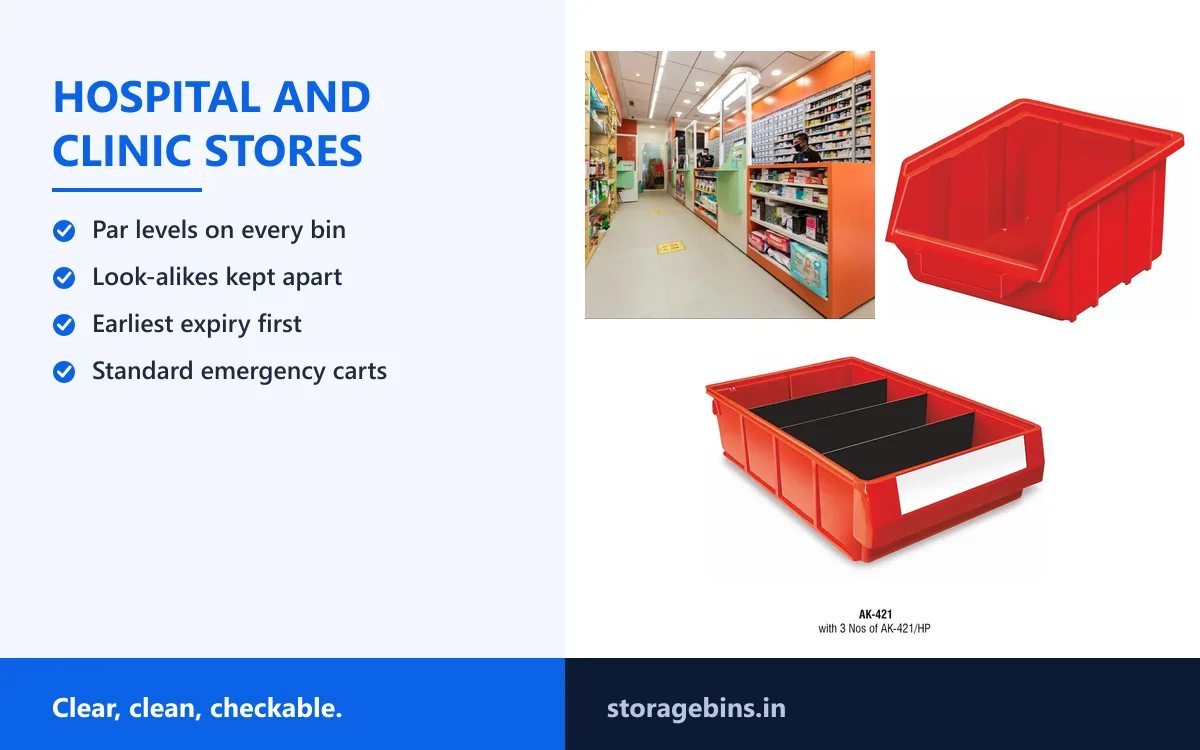
Hospital stores are judged in seconds: a nurse who cannot find a dressing, a pharmacist who picks the wrong strip, an emergency trolley that has to be read at a glance. A practical guide to layout, labelling, par levels, expiry control and cleaning for stores of every size.
Seconds that matter
In most workplaces, a search for the wrong part costs minutes and money. In a hospital, it can cost more. A nurse who needs a particular dressing for a patient waiting on a bed, a pharmacist filling a prescription queue, a theatre technician looking for a size of suture at the start of a case, a ward attendant restocking a trolley before a round: each is working against time, and each depends on a store that gives up what is in it quickly and accurately.
Hospital and clinic stores are also unforgiving of untidiness. A box in the wrong place, a look-alike pack next to the right one, an expired item at the front of a shelf: these are the small errors that careful systems exist to prevent. And they are inspected: by accreditation bodies, by insurers, by licensing authorities and by the hospital's own quality team, all of whom look at the stores as an indicator of the whole organisation.
This article sets out a practical approach to organising stores in hospitals, nursing homes, clinics and diagnostic centres in India. It covers the central store, the ward and department stores, the pharmacy, emergency trolleys, the layout of shelves and bins, labelling, par levels, expiry control and cleaning. It describes storage arrangements and does not touch clinical decisions: what a hospital stocks, in what quantities and where on an emergency trolley is a matter for its clinicians, pharmacists and policies, and the storage products simply give those decisions a clear physical form. Nothing here replaces the standards, regulations or licence conditions that apply to a given facility.
The anatomy of a hospital's storage
A hospital does not have one store but several, each with its own character, and understanding them helps choose the right arrangement.
The central store receives goods from suppliers and holds bulk stock: consumables, linen, stationery, housekeeping supplies, general stores and sometimes equipment spares. It issues to the wards and departments on requisition or on a schedule.
The pharmacy holds medicines, which are subject to specific licensing, storage and record-keeping requirements. It has its own store, often with controlled and cold-chain sections, and a dispensing area.
Ward and department stores, in each ward, theatre, ICU, emergency department, laboratory and radiology unit, hold the working stock that staff use every day: dressings, syringes, needles, gloves, tubing, catheters, swabs, and ward-specific items.
Emergency trolleys and kits are a special case: portable, standardised sets of drugs and equipment, laid out to the hospital's own protocol and checked on a schedule.
The engineering and maintenance store holds spares for building services and medical equipment, and resembles the maintenance stores in factories.
Clinical laboratories and diagnostic centres have stores of reagents, consumables and sample containers, with their own temperature and expiry requirements.
Each of these has different storage needs, but the same principles run through them: a fixed place for each item, a clear label, a layout that makes the most-used items easiest to reach, expiry control and regular counting.
Principles that apply everywhere
Before going through the stores one by one, a few principles are worth stating.
A place for everything. Every item has a fixed, labelled location, so that a person can go straight to it, and a gap shows at once when it is empty.
One item per location. Mixing items in a bin or compartment invites errors and makes counting slow. Where items must share a bin, use partitions and labels.
Keep look-alikes apart. Packs that look alike but differ in name, strength, size or purpose are a known source of error. Separate them physically, with colour or labels, and never place them side by side without a barrier.
The oldest first. Stock with expiry dates must be arranged so that the earliest expiry is used first, which our article on FIFO and FEFO describes in detail.
Clean and cleanable. Surfaces should be smooth, free of crevices and easy to wipe, with materials that tolerate the hospital's cleaning agents. Cardboard and wood, which cannot be wiped, have no place in clinical areas where it can be avoided.
Visible and checkable. A store that can be read at a glance, and checked by a person who does not know it, is safer than one that depends on a particular individual.
Counted and recorded. Regular counts against a record keep stock accurate and expose problems early.
The central store
The central store is the hospital's warehouse, and its layout follows warehouse principles with a clinical flavour.
Receive carefully. Check each delivery against the order, verify batch and expiry dates on items that carry them, inspect for damage and reject or quarantine anything unacceptable. Label at once, and put away to a recorded location.
Use pallet racking for bulk items such as fluids, large cartons and linen bales, and protect the racking from trolley and forklift damage with Visipro protectors and bollards where equipment runs. For smaller items, Panda shelving with shelf bins and pigeon hole compartments gives each line a labelled home, and the open fronts make picking quick. Heavier items go low, within the published loads, and the most-issued items go in the golden zone between knee and shoulder.
Organise by category and by issue frequency. Group items by type, such as dressings, syringes and needles, gloves, catheters and housekeeping, and within each group put the fastest-moving lines at the front. Keep look-alike items apart.
Set up an issue routine. Wards requisition against a list, the store picks into totes labelled by ward, and the totes travel on a trolley. Tote bins, at 400 x 255 mm with partitions and large label holders, suit this, and a Tuff trolley carries a set of totes to the wards. A signed delivery note records the issue.
Count regularly. A few locations a day, with a log, keeps the record true, as our article on cycle counting with storage bins describes.
The pharmacy
The pharmacy store and dispensary face the strictest requirements, and the arrangement should support them. The specific rules, such as licensing, temperature control, controlled drug registers and record-keeping, belong to the pharmacist in charge and the applicable regulations, and what follows concerns only the physical layout.
For the main stock, Panda shelving with shelf bins in a regular grid suits many packs, and transparent bins let the pharmacist see the contents without opening anything. Our page on Panda bins for pharmacy in India and our article on Panda shelving for pharmacy stores describe the arrangements. For boxed items, the pigeon hole system gives each product its own compartment with a fixed address, without decanting, with bin fronts to hold packs in and lockable doors to secure controlled or high-value items.
Arrange the shelves so that the fastest-moving lines are at hand height near the dispensing counter, and the slow movers further away. Within a shelf, arrange alphabetically or by therapeutic group, whichever the pharmacy's system uses, and keep one product per compartment, with the batch and expiry visible.
Separate look-alike and sound-alike products. Place them apart, or separate them with a partition and a distinctive label, so that a pharmacist's hand does not go to the wrong one by habit. A coloured label or a tall-man style of printed name, according to the pharmacy's policy, helps.
Keep a clear place for items awaiting return or disposal: expired, recalled, damaged or returned stock goes into a locked, labelled container or shelf, separate from saleable stock, and is removed on a set schedule.
Count regularly, and record batch and expiry. A cycle count that checks batch and expiry along with quantity finds errors early and gives an audit trail.
Ward and department stores
Ward stores are small, busy and shared by many people, and a tidy, obvious layout matters most there.
Hold only what the ward needs for a short period, with a par level for each item: a minimum and a maximum quantity set from usage and delivery frequency. A par level turns restocking into a routine: when the stock falls to the minimum, it is topped up to the maximum, and nobody has to guess. A two-bin system, in which the second bin is the reserve and the empty first bin is the signal to refill, makes par levels physical, as our article on two-bin kanban explains.
Use open-front bins on louvre panels or trolleys for small items such as syringes, needles, swabs, cannulae, tapes and gloves. The Supra and Hippo bins show contents and let a hand reach in, and a printed label names each. Sizes from the Supra SB 1 at 125 x 100 x 60 mm to the SB 4 at 290 x 178 x 143 mm cover most ward items, and the partitions divide a bin into compartments where several sizes share a place.
Use Panda shelving for the larger items, such as dressing packs, IV sets and bulky consumables, and drawer containers and component organisers for small items kept in cabinets. A mobile trolley with panels and bins brings the working stock to the bedside or the procedure room.
Label every location with the item name and, where useful, the size or code, in a clear font. Keep the layout the same across similar wards, so that staff moving between them find things in the same place. A photograph of the standard layout on the wall helps whoever restocks.
Operating theatres and procedure rooms
Theatres and procedure rooms hold a wide range of small, sterile and often expensive items, and the store has to support quick, accurate picking at the start of a case and orderly restocking afterwards.
Organise by procedure or by item type, according to the theatre's practice. Procedure-based layouts keep the items for a common operation together, in a tote or on a trolley, ready to go. Item-based layouts put all sutures together, all drapes together, and so on, with a labelled location for each size and type.
Use clear, enclosed storage where sterility and cleanliness demand it. Closed drawers and lockable cabinets protect sterile packs, and a drawer system with partitions keeps sizes apart. The sliding and rotary units, described in our article on choosing between sliding, rotary and fixed storage, pack many small items into a compact space when floor is tight.
Keep expiry visible. Sterile packs carry expiry dates, and the layout should put the earliest at the front, with a visible warning for packs near expiry, as described in our article on FIFO and FEFO.
Check and restock after each list. A short routine at the end of each session, topping up to the par level, returning unused items to their places and recording what was used, keeps the next session safe.
Emergency trolleys and kits
An emergency trolley, or crash cart, is a portable set of drawers, trays or shelves that carries emergency medication and equipment to the site of a medical or surgical emergency. Its contents and layout are decided by the hospital's clinicians under its own protocol, and the storage products only give that layout a physical form.
ALKON has supplied components to hospital furniture manufacturers for emergency carts for years, and the catalogue lists combinations of modular drawer systems with Hippo bins and channels, and with Roo tilt bins on crash cart rails. Our page on crash cart components and hospital storage describes them, including the dimensions of the Hippo 612/S bin at 150 x 110 x 75 mm and the crash cart rail at 665 mm wide.
The design principles are simple. Each item has a fixed compartment, with a label or a colour that says what it is. Drawers are organised by use, with the first-needed items in the most accessible drawer. The layout is identical across all carts in the hospital, so that staff can use any cart. A tamper-evident seal on each drawer shows at once whether the cart has been opened. And a checklist, matched to the physical layout, is used at each scheduled check.
Check on a fixed schedule. A cart is checked by a named person at set intervals, against the checklist, with the date, name and findings recorded and the seal replaced. Expiry dates are checked at each check, and items near expiry are replaced.
Layout, labels and colour
How a store looks matters as much as what is in it. A few details make a store readable.
Label every location, with the item name and, where it helps, the code, size or strength, in large, clear type. Printed labels in the holders of ALKON bins are easy to change. Keep the layout of each label identical.
Use colour carefully. A small, consistent scheme, agreed with clinicians, can speed recognition: for example, a colour for each category of item or each ward. Never rely on colour alone, since colour vision varies, and never use the same colour for two meanings. Our article on bin labelling and colour coding describes how to design a scheme.
Light the store well. Good lighting over shelves makes labels readable and reduces errors.
Keep floors clear and aisles wide enough for a trolley. A cluttered store is slower, less safe and harder to clean.
Place heavy items low and light items high. Provide safe steps for upper shelves, and never allow climbing on shelving.
Keep the store tidy as a habit. A five-minute reset at the end of each shift, putting things back, wiping surfaces and discarding packaging, keeps order.
Par levels and replenishment
A par level system is the backbone of ward and department stocking, and it fits bins naturally.
For each item in each store, set a minimum and a maximum. The maximum is the most the location should hold, which fixes the size of the bin or shelf. The minimum is the point at which restocking is triggered, and it covers the usage during the delivery lead time plus a safety margin.
Mark the levels physically. A line on the bin, a label stating the minimum and maximum, or a two-bin arrangement makes the rule visible. A person restocking does not need a computer, only the label.
Restock on a schedule. A daily or alternate-day round, by a named person, tops up each location to the maximum, using a list or a trolley carrying the stock to be restocked. Record what was added, so that usage can be tracked.
Review the levels. Every quarter or so, look at usage and stock-outs, and adjust. An item that is always at the maximum is overstocked, and one that often runs out needs a higher level or a more frequent round.
Expiry control and quarantine
Many hospital supplies carry expiry dates, and managing them is a core safety task.
Record the batch and expiry on receipt, and make them visible on the shelf. Arrange stock so that the earliest expiry is picked first, with new stock behind old, as our article on FEFO explains. Mark items approaching expiry, for example within three months, with a coloured label, and review them on a regular schedule.
Remove expired items at once. A locked, labelled container or shelf for expired, recalled or damaged stock, separate from saleable and usable stock, prevents accidental use. Dispose of it by the hospital's procedure, with a record.
Handle recalls. When a supplier or regulator recalls a batch, the batch numbers on labels let staff find affected stock quickly. A store that keeps one batch per compartment and records batches can respond in minutes.
Count with expiry in mind. A cycle count that checks batch and expiry catches problems that a quantity count would miss.
Cleaning and infection control
A hospital store must be cleanable, and its design should help. The details of cleaning and infection control belong to the hospital's infection control team, and what follows addresses only the physical side.
Choose surfaces that wipe clean. Polypropylene bins and totes have smooth surfaces and, in the case of the totes, a smooth internal wall, and they do not rust, shed fibres or absorb liquids. Powder-coated steel shelving wipes clean, and open bins and shelves are easier to wipe than closed boxes with crevices.
Check compatibility with the cleaning agents in use. Disinfectants differ, and the manufacturer's information is the authority. Ask us for material information to support your review.
Set a cleaning schedule. Wipe shelves, bins and trolleys on a fixed routine, with deeper cleaning periodically, and record it. Keep spare bins so a soiled one can be swapped for a clean one without delay.
Keep stock off the floor, and keep cardboard out of clinical areas where possible, since it cannot be wiped and can harbour dust and pests.
Separate clean and dirty. Keep waste, used items and returns away from clean stock.
Small clinics, nursing homes and diagnostic centres
Smaller facilities have the same needs on a smaller scale, and a few simple steps give them a good store.
A clinic can organise its supplies on a single wall panel with bins for small items, a Panda shelving unit for the larger packs and a drawer system for sterile and sensitive items. A labelled, fixed place for each item, a par level and a monthly expiry check are enough to keep it safe.
A nursing home benefits from a ward-style store with par levels and a trolley for rounds, and a separate, locked store for medicines under the licensed person's control.
A diagnostic centre holds reagents and consumables with expiry and temperature requirements. Use labelled bins and shelves, with one batch per location, a refrigerator organised with labelled trays and a count and expiry check on a fixed schedule.
For all small facilities, the first step is to empty, sort and label, and the second is to give each item a fixed home. The rest is routine.
A worked example with invented numbers
The following example is invented, with round numbers. A hospital of about a hundred and fifty beds has a central store, a pharmacy, six wards, two theatres and an emergency department. Audits have found untidy ward stores, expired items found by accident and an emergency trolley whose layout differs from ward to ward.
The stores officer, with the nursing superintendent and the pharmacist, sets a plan over four months. The central store gets Panda shelving with shelf bins and pigeon hole shelves, with labelled locations, a fast-mover zone near the issue counter and a locked area for expired stock. Wards get a standard layout of Supra bins on panels and a Tuff trolley for each, with par levels marked on the labels and a daily restock round. The pharmacy gets transparent shelf bins, separated look-alike products and a pigeon hole unit with lockable doors for controlled items. Emergency trolleys are rebuilt to one standard layout by the hospital's furniture supplier, using modular drawers, Hippo bins and Roo tilt bins on crash cart rails, with seals and a checklist.
An expiry walk each month, a cycle count each day and a one-page standard for each store keep the system alive. At the next accreditation visit, the stores are noted for order. The numbers are invented, and the clinical content of each layout belongs to the hospital's own clinicians and pharmacists, but the pattern, fixed locations, par levels, a standard layout, expiry control and routine checks, is the one to follow.
Housekeeping, linen and general stores
Beyond clinical supplies, a hospital runs large general stores: housekeeping chemicals and consumables, linen, stationery, kitchen supplies and maintenance items. These are less critical than clinical stock but just as large, and an orderly layout saves time and money.
Linen is bulky and moves in volume. Keep clean and used linen strictly apart, on separate shelves or trolleys in separate rooms, with clear labels. Open shelving with fixed positions per ward or per item type lets linen be counted at issue and return, and a trolley carries the daily allocation to each ward. A tote or a bin holds smaller linen items, such as towels and gowns, in labelled compartments.
Housekeeping supplies, such as cleaning agents, mops, bags and dispensers, are best kept in a dedicated, ventilated store, with chemicals in their original labelled containers on the lowest shelves, separated by type according to the safety data sheets. Storage bins are for consumables like cloths, gloves and bags, and are not a substitute for approved chemical storage.
Stationery and forms suit pigeon hole shelves, with a compartment for each form and a minimum quantity marked, so reordering is routine. Kitchen supplies follow food-safety rules, with washable containers and a clear first-in first-out layout.
Maintenance spares for building services and medical equipment benefit from the approach in our article on organising a maintenance spares store, with critical spares, such as those for life-support equipment, labelled, locked and checked on a schedule.
Working with clinicians on the layout
The best hospital storage is designed with the people who use it. A store manager can arrange shelves beautifully, and still get it wrong if the layout does not match how nurses and pharmacists work.
Start by watching. Spend an hour in a ward store during a busy period and note what is taken, in what order, how long it takes and where people hesitate. The pattern shows which items need the best positions and which cause confusion.
Ask the staff. A nurse in charge knows which items run out, which are hard to find and which are confused with others. A short conversation yields a list of improvements that no consultant would think of.
Agree the standard layout with the clinical leads. For emergency trolleys, theatre kits and pharmacy arrangements, clinical sign-off is essential, and the storage team's job is to give the agreed layout a clear physical form and keep it that way.
Trial before rolling out. Set up one ward or one cart in the new layout, run it for a few weeks, collect comments and adjust. Then copy it across the hospital, with the same labels and the same positions.
Train and communicate. A short briefing for each ward on the new layout, the par levels and the restocking routine prevents the slide back to old habits, and a one-page guide on the store wall reminds everyone.
Questions hospital store managers ask
Can bins be disinfected? Polypropylene bins and totes can be wiped or washed. Check the compatibility of your disinfectant with the material, and ask us for material information for your infection control team.
Are the bins approved for medical use? ALKON bins are general-purpose storage containers, and carry no medical or regulatory approval. Your hospital's quality and infection control teams decide whether a container fits your procedures.
How do I store items that need refrigeration? In a pharmacy refrigerator organised with labelled trays and bins, with a record of temperature checks. Bins on trays keep items apart and speed counts, within the rated temperature range of the plastic.
Can I get a layout for a small clinic? Yes. Send a sketch and an item list, and we will suggest a simple, economical arrangement.
How do I keep control of high-value items? In a locked drawer system or lockable cabinets, with a register and a regular count by two people.
Common mistakes
A few mistakes recur in hospital stores.
Letting ward stores stock too much is the first. Overstock expires, hides stock and clutters shelves.
Mixing items in a bin is the second. It invites picking errors.
Placing look-alikes side by side is the third. Separate them.
Ignoring expiry until it is too late is the fourth. A routine review prevents it.
Using cardboard in clinical areas is the fifth. It cannot be wiped.
Layouts that differ ward to ward are the sixth. Staff who move between wards lose time and make errors.
Leaving emergency trolleys to chance is the seventh. Standardise and check them.
Skipping counts is the eighth. Without counts, the records drift.
A checklist you can print
- Every item has a fixed, labelled place, one item per location, look-alikes apart.
- Layouts are standard across similar wards, with a photograph on the wall.
- Par levels are set and marked, with a daily or alternate-day restock round.
- Batch and expiry are recorded, visible, and checked on a schedule, with a locked place for expired stock.
- Surfaces are cleanable, compatible with the cleaning agents and wiped on a schedule.
- Emergency trolleys follow one layout, sealed and checked by a named person.
- Counts are done a few locations a day, with a log.
- A one-page standard exists for each store, and is reviewed each year.
Where to go from here
If you would like help laying out a hospital, clinic or pharmacy store, send us your item list, a sketch of the room and a description of how items are used, and we will suggest bins, shelving, drawers, trolleys and a labelling scheme from the catalogue. Shreeram Metafusion Engineers supplies the full ALKON range from Vashi, Navi Mumbai, as authorised stockist of ALKON Plastics Pvt. Ltd. for over thirty years, and the product pages on this website list the dimensions, packing and accessories for every item mentioned here. Clinical and regulatory decisions remain with your own clinicians, pharmacists and quality team.
Read next