Line-side supply with trolleys: how to design a small-parts milk run
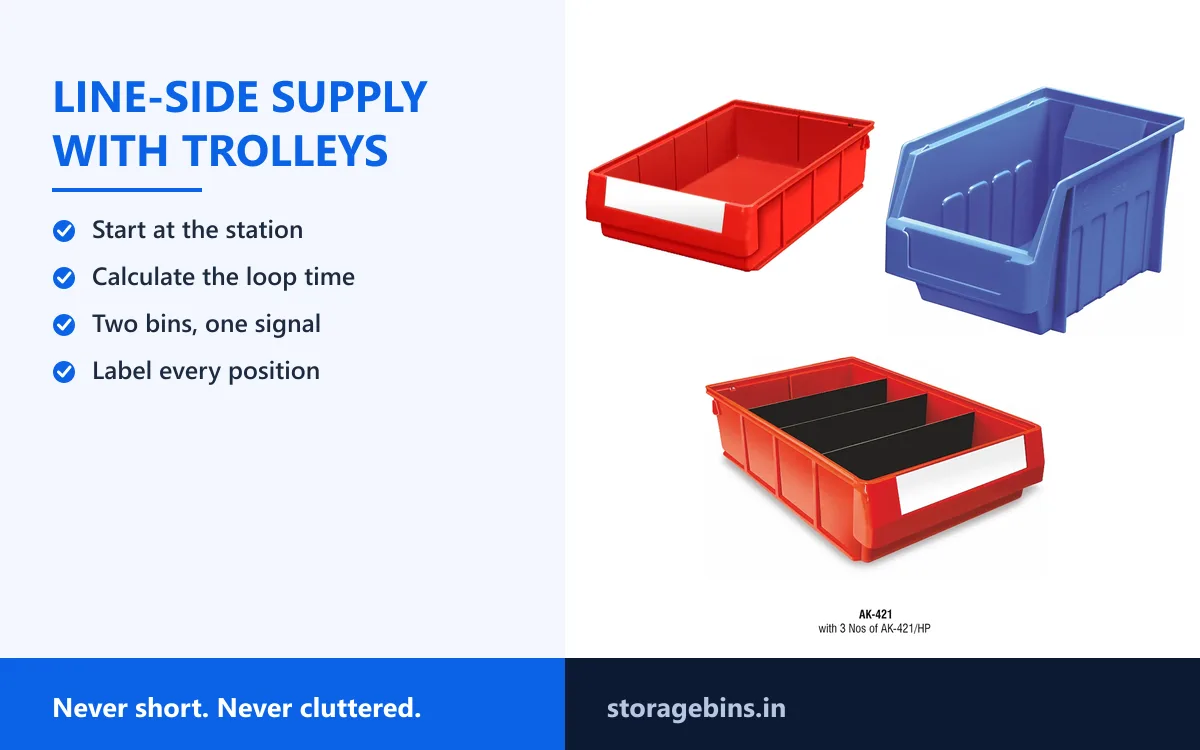
Small parts reach an assembly line one of two ways: the operator fetches them, or someone brings them on a schedule. How to size bins, build trolleys, set a route and work out the loop arithmetic so the line is never short and never cluttered.
The line that is always almost out of something
Walk down an assembly line and look at the stations. At some of them everything is neat: bins in a row, labels facing the operator, a gap where one bin is being replaced. At others there is a cardboard box on the floor, a polythene bag taped to the bench, a handful of screws in a lid and an operator who stops every few minutes to go and fetch something. The first kind of station is not luckier or better staffed than the second. It is supplied by a different system, and the difference is in how the parts arrive.
Small parts are the cause of most of the trouble. Large parts, such as a casting or a motor, are few, visible and tracked. Small parts, such as clips, screws, washers, grommets, seals, connectors and labels, are many, similar and cheap, and the cost of running out of one is far greater than its price. A line that stops for want of a twenty-paise clip loses minutes that cost real money, and a line that avoids the risk by stocking boxes of everything at every station ends up cluttered, slow to change and full of mixed-up parts.
Line-side supply with trolleys is the discipline that sits between those two failures. Parts are brought to the point of use on a schedule, in a defined container, in a defined quantity, by a person on a defined route, and the empty container goes back the way it came. The pattern is often called a milk run, after the dairy round that delivers full bottles and takes away the empties, and the person who drives it is sometimes called a water spider or a mizusumashi in the lean literature. This article sets out how to design one for small parts, using the kinds of trolleys, bins and totes that ALKON makes, and the arithmetic that turns a good idea into a loop that works.
What line-side supply is, and what it is not
The phrase line-side supply covers a set of ideas that are worth separating.
Point-of-use storage means that a part lives at the station where it is fitted, within reach of the operator's hand, not in a store down the corridor. The quantity there is small, enough for a defined period, and it is replenished from the store.
Scheduled replenishment means that the replenishment happens at set times on a set route, not when an operator notices a shortage and goes to find someone. The schedule is what makes the system predictable.
Standard containers mean that each part is delivered in a defined bin or tote, holding a defined quantity, and no part is delivered loose or in a carton that has to be opened and decanted at the line.
Signals mean that the system knows when to replenish, whether from an empty bin, a card, a marked level or a time interval.
What line-side supply is not is the same as a store. The line does not hold stock beyond the buffer that covers the loop. It is also not the same as kitting, although the two are related: a kit assembles all the parts for a job into one container, while line-side supply replenishes a fixed set of parts at a fixed place. Many plants use both, a kit for the parts that vary by job and a replenishment bin for the parts that are common to all.
Why trolleys
A trolley is the natural vehicle for a milk run, for three reasons. It carries many containers in one trip, so the person making the round is not limited by what hands and arms can hold. It holds the containers in fixed positions, so that the right part is always in the right place and the person can see at once what is missing. And it makes the exchange simple: a full trolley arrives, an empty one leaves, or a full bin goes in and an empty one comes out.
ALKON makes two families of trolley that suit the job. The Shop Floor Trolley SFT measures 970 by 600 by 1100 mm, carries louvre panels on a top frame and has an aluminium checkered plate on its base for a carton or a tote. The Tuff Trolley ATTB measures 995 by 700 by 1430 mm, is built from heavier section, and has ergonomic plastic handles and swivel castors, two of them braked. Both take the standard bin families, and both are described in more detail on our page on shop floor trolleys and Tuff stands.
A trolley has one more virtue: it can be designed. Because the bins hang on panels in fixed positions, the layout of a trolley is a drawing that can be improved, copied and checked. When a part changes, the drawing changes, and the trolleys follow. That is much easier than managing the positions of boxes on the floor.
Start with the station: what does the operator need?
The design of a milk run starts at the station, not the store. Go to each station and list the small parts that the operator uses, with the quantity per product and the number of products per hour. This gives the consumption rate of each part, which is the number that drives everything else.
Group the parts by use. Some are used at every cycle, such as the standard screw that goes into every unit. Some are used on some cycles, such as an option-specific clip. Some are used rarely, such as a service part for a variant that is only built once a week. The first group needs a steady, reliable supply, and the third can be handled by a different method, perhaps a kit.
Note the physical constraints. How much room is there at the station for bins? How far can the operator reach without leaving the working position? Is there a bench, a fixture or a conveyor that limits where bins can go? The answers determine whether the parts will be held in bins on a panel, in totes on a shelf or on a trolley parked at the station.
Finally, observe the operator. Watch a few cycles and note where the hand goes. The parts used most should be closest, at the height and angle where the hand goes naturally. This observation is the foundation of the layout, and it is easy to skip.
Choosing the container for each part
Every part needs a container, and the choice affects the whole system. The factors are the part's size, the quantity per container and how the operator will take it.
For small parts taken by hand, one at a time, an open-front bin is ideal. The ALKON Supra bins in sizes from the small SB 1, 125 x 100 x 60 mm outside, to the SB 6, 440 x 180 x 145 mm outside, hang from the rear lip on louvre panels, stack and carry identification card holders. The Hippo and Bull ranges offer other proportions. Choose a size from the part dimensions and the quantity wanted, using the inside dimensions. Our guide to choosing the right storage bin size gives the method.
For parts taken in handfuls or delivered in batches, a tote is better. The AK-421 tote, 400 x 255 x 100 mm outside, and the AK-422, 400 x 255 x 200 mm, with large label holders and an anti-skid base, sit on a trolley's flat surface or on a shelf and can be exchanged as a unit. Our page on Alkon tote bins describes them.
For parts that need protection or separation, such as cosmetic parts, partitions inside the bin or tote keep pieces apart. For tiny parts in several variants, component organisers or a bin with partitions may serve.
Whatever the choice, standardise. A line with three bin sizes is easier to supply than one with ten, since the trolley layout, the labels and the replenishment routine all depend on it.
Setting the quantity: how much goes in a container
The quantity in a container is the most important single parameter, and it should be calculated, not guessed. It is the quantity the station will consume between visits, plus a safety margin.
Start with the consumption rate: pieces per hour. Multiply by the interval between replenishment visits, which is the cycle time of the milk run. A part consumed at 120 an hour on a run that visits every 30 minutes needs 60 pieces to cover one interval. Add a safety margin for variation, perhaps a quarter to a half of an interval, so that a delayed run does not stop the line. The container holds this quantity, filled to a marked line.
Then check that the quantity fits the container. A Supra SB 1 has inside dimensions of 117 by 80 by 52 mm, and the number of small parts it holds depends on the part. If the quantity is too big, use a larger bin or a tote. If it is too small, the bin is oversized, and a smaller one would waste less space.
Fix the quantity. A container that holds a defined number is easy to count by eye, easy to reorder and easy to audit. Mark the fill line on the bin or write the quantity on the label.
The two-bin principle on a trolley
The two-bin kanban method, described in our article on two-bin kanban, works naturally on a trolley. Each part has two containers of the same size and quantity. The operator takes from the front one. When it is empty, the operator pulls it out and takes from the second. The empty one is the signal to replenish and travels back to the store with the trolley.
On a trolley, the arrangement is simple. Each part has two positions on the panel, front and back or left and right, and a label shows which is which. The full bin sits in the first position, and the reserve in the second. When the first is empty, it goes into a return tote or a marked area, and the reserve moves forward or stays put while the replenisher brings a full replacement.
The advantage is that there is no counting and no paperwork. The empty bin is the order. The disadvantage is that two containers take twice the space, so the trolley has half the parts it would otherwise. For fast-moving parts, the trade is usually worth it. For slow-moving parts, a single bin with a level mark may be enough.
Designing the trolley layout
With the parts, containers and quantities fixed, the trolley layout can be drawn. The aim is a trolley that carries every part for its stations, in positions that are easy to read and to restock.
Start with the panels. A Shop Floor Trolley carries four LP 2 panels, two on each side, and a Tuff trolley carries two or four ATSLP panels of 914 by 610 mm. Count the bins that each panel can take, using the bin dimensions and the louvre spacing, and compare with the number needed. If there are too many, add a second trolley, or use totes on the base.
Place the bins in order of use. The most frequently used parts go at the height and position that suit the operator, and the rest above and below. Group related parts together, and keep similar-looking parts apart, to reduce picking errors.
Think about the exchange. If the whole trolley is swapped, the layout must be identical on both. If bins are exchanged individually, the positions must be labelled clearly. If the replenisher refills the bins at the station, the trolley must give access to the empty bins and a place for the full ones.
Draw the layout, number the positions and keep the drawing with the trolley. A drawing turns a trolley into a standard, and anyone can restock it from the drawing.
The route: designing the loop
The milk run is a loop, and its design determines how often each station is visited and how much time the replenisher needs. A good route has four properties.
It is fixed. The replenisher follows the same path in the same order, so that every station knows when to expect a visit and the replenisher knows what to do at each stop. A route that changes every day cannot be relied on.
It is short. The shorter the route, the more often each station can be visited, and the less stock the line needs to carry. Look at the layout and see whether stations can be grouped so that the loop is compact.
It is timed. The replenisher completes the loop in a set time, say thirty minutes, and starts the next one at once. If one loop takes longer, the schedule slips, so the time should be measured and adjusted.
It is safe. The route avoids crossing busy traffic, keeps to marked aisles and has room to turn. A loaded trolley is heavier than it looks, and it needs space to move and to stop.
Measure the route by walking it with a trolley. Note the time at each stop, the distance and any obstacles. A trial run will reveal problems that a drawing hides, such as a doorway that is too narrow, a threshold that jolts the load or a corner that blocks the view.
The loop arithmetic
A milk run works only if the numbers add up, and the arithmetic is simple. The key quantity is the loop time: the time from one visit to a station to the next.
Loop time is the sum of the travel time between stops, the exchange time at each stop, the time at the store to restock and any waiting. For example, a loop with ten stations, each needing about a minute for the exchange, and two minutes of travel between stops, takes about thirty minutes of exchange and travel, plus ten minutes at the store, so about forty minutes in all. Each station is visited every forty minutes.
The stock at each station must cover the loop time plus a margin. A part used at 120 an hour needs 80 pieces to cover forty minutes, plus a margin of perhaps 20, so 100 pieces in the container. If the container is too small, shorten the loop or use a bigger container.
The number of trolleys depends on the exchange method. If the replenisher refills bins at the station from a single trolley, one trolley is enough, plus a spare. If whole trolleys are swapped, two or more per station group are needed, one at the station and one being restocked, plus a spare.
The replenisher's workload follows. If the loop takes forty minutes and the replenisher is busy for all of it, one person can run one loop. If there are several loops, there will be several replenishers, or a longer loop interval. Calculate the workload before assigning staff, so that no one is overloaded.
Kit trolleys and replenishment trolleys
Two kinds of trolley serve different needs, and a plant often uses both.
A replenishment trolley carries the common small parts for a group of stations, in fixed bins, and is used to top up bins at the line or to exchange full bins for empty ones. It carries the same parts every time, in the same positions. It suits parts that are used at every cycle, such as standard fasteners and clips.
A kit trolley carries the parts for specific jobs or products, in totes or bins labelled for each job. It is delivered to a station, consumed and returned. It suits parts that vary by product or option, and it avoids the clutter of holding every variant at the line.
The choice depends on how the product varies. A line that builds one product all day suits replenishment, since the parts do not change. A line that builds many variants suits kitting for the variant-specific parts and replenishment for the common ones. Many plants combine them, with a replenishment trolley for the common parts and a kit tote for each job.
The same frames serve both. A Tuff trolley with bins on its panels is a replenishment trolley, and the same trolley with totes on its base is a kit trolley. The standard bins and totes make it easy to switch.
Signals: how the system knows what to bring
Replenishment needs a trigger, and the trigger should be as simple as possible. Several signals work.
The empty bin is the simplest. In a two-bin system, an empty bin means a part is needed. The replenisher sees the empty bin on the trolley or at the station and brings a full one.
A card or tag can travel with the bin. When the bin is emptied, the card goes back to the store, and is the order. This is the classic kanban card, and it suits parts that are not replenished from a nearby supermarket.
A fixed time is the simplest of all. The replenisher visits every station on the loop, whatever has happened, and tops up each bin to its fill line. This is a pull-free system that suits parts with steady consumption.
A level mark on the bin, with a line that shows the reorder point, tells the replenisher at a glance which bins need attention. Combined with a visible bin, it gives a quick, cheap signal.
Choose the simplest signal that works. A complicated signal system adds paperwork, and the more steps there are, the more chances there are for something to go wrong.
Labelling and error-proofing
A trolley carrying hundreds of small parts needs labels that make mistakes difficult. A few principles guide the design.
Label the position, not just the part. Each position on the trolley has an address, and the label on the bin shows the part and the address. If a bin is in the wrong position, the label does not match the address, and the error is visible.
Make the labels readable from a distance. Use large type, high contrast and a consistent layout. The ALKON bins have identification card holders, so a printed label can be slipped in and changed as needed. Our article on bin labelling and colour coding covers the details.
Use colour to separate parts that look alike. If two parts are similar, such as two screws that differ only in length, put them in different coloured bins, or in different areas of the panel, so that picking the wrong one is unlikely.
Use physical error-proofing where possible. Partitions and bin sizes that fit only the right part make a wrong placement difficult. A bin too small for a wrong part will not take it, and a partition shaped for one part will not hold another.
Check at the exchange. When the replenisher fills a bin, a quick check of the label against the part, and of the quantity against the fill line, catches most errors. Where the cost of a mistake is high, add a second check, by a scan or by a second person.
Safety and ergonomics on the route
A milk run puts people and loaded trolleys in the same space, and safety has to be designed in.
Keep the load low and balanced. Heavy bins at the bottom, light at the top, and an even weight from side to side, so the trolley does not tip. The Tuff trolley's heavy duty castors and two brakes help, but they do not replace good loading.
Limit the weight to what one person can push comfortably. A fully loaded trolley may be heavy, and the force needed to start and stop it rises with the load. If a trolley is too heavy, reduce the load or split it across two.
Provide clear aisles. Mark the route on the floor, keep it free of obstacles and make sure there is room to turn. Where the route crosses a pedestrian way, mark the crossing and set a rule for who gives way.
Train the replenisher. Show how to load, how to push, how to turn and how to park. Cover the rules on speed and priority, and make sure the replenisher knows to report damage.
Protect the replenisher's body. The exchange at each station involves lifting and bending, so keep the bins at a comfortable height, avoid heavy single bins and rotate tasks if the work is repetitive.
Measuring and improving the system
A milk run improves with measurement, and a few indicators show how it is performing.
Line stoppages caused by shortages are the most important. A system that works should reduce these to near zero. Count each occurrence, note the part and the cause, and look for patterns.
Loop time shows whether the route is keeping to schedule. Record the actual time for each loop, and compare with the plan. A loop that takes longer than planned is a warning that the workload or the route needs attention.
Stock at the line shows whether the quantities are right. If bins are always full at the next visit, they are too big. If they are often empty, they are too small. Adjust the quantity to match the consumption.
Errors, such as wrong parts or wrong quantities, show how well the labelling and the checks are working. Record them, find the cause and fix it.
Review the numbers regularly, weekly at first, then monthly. Small changes, a larger bin here, a shorter route there, a clearer label, add up to a smoother system.
Rolling it out
A milk run is best introduced one area at a time. Choose a line or a cell where the shortages are most painful, and design the system for that area. Run it for a few weeks, measuring and adjusting, and use the experience to improve the design before extending.
A suitable sequence runs as follows.
Involve the operators. They know where the hand goes and what goes wrong, and a system that reflects their experience is accepted far more readily. A short briefing before the start, explaining the new routine and why, saves much friction.
- Map the stations and list the parts, with consumption rates.
- Choose the containers and fix the quantities.
- Design the trolley layout and the route.
- Build a trial trolley, label it and test it on the route.
- Train the replenisher and the operators, and run a pilot.
- Measure, adjust and, when stable, extend to the next area.
Common mistakes
Several mistakes recur in line-side supply projects.
Starting with the trolley, not the station, is the most common. A trolley designed without watching the operator may be a good trolley that does not fit the job.
Guessing quantities is the next. A container that holds too much clutters the line, and one that holds too little causes stoppages. Calculate the quantity from consumption and loop time.
Letting the route vary defeats the purpose. A replenisher who visits stations in a different order each day cannot be relied on, and the stations cannot plan.
Mixing parts in a bin undermines everything. One part, one bin, one position, is the rule that keeps the system accurate.
Neglecting the return flow leaves empty bins and trolleys piling up. Plan the return path and the cleaning and refilling, as carefully as the delivery.
Skipping the audit lets the system drift. A short weekly check of trolleys against their drawings catches changes early.
Overloading the replenisher is the last. A route that takes longer than the interval cannot work, so calculate the workload before assigning staff.
A worked example with invented numbers
To make the arithmetic concrete, consider an invented line that assembles a small electrical enclosure. Eight stations run in a row along a conveyor, and each fits a handful of small parts: screws, washers, cable clips, grommets, terminal blocks, labels and a few seals. Altogether there are about sixty small part numbers on the line, of which twenty-five are used on every unit.
The line builds sixty units an hour. A timing and consumption study gives, for the twenty-five common parts, an average of about two pieces per unit for most of them, so around 120 pieces an hour, with a few higher and a few lower. The planner decides on a replenishment loop of forty minutes, covering the eight stations in about twenty-five minutes of travel and exchange and fifteen at the store.
For a part used at 120 an hour, the line needs 80 pieces to cover the forty-minute loop. The planner adds a margin of half a loop, 40 pieces, and sets the container quantity at 120. A bin of that quantity is chosen from the inside dimensions of the part, say a Supra SB 2 at 157 by 80 by 75 mm inside, filled to a marked line. A second identical bin sits behind it, so that the empty one is the signal.
The planner designs one replenishment trolley per two stations, a Shop Floor Trolley with LP 2 panels carrying the bins for the common parts at those stations. Each trolley holds the common parts at fixed positions, with the layout drawn and numbered. The variant-specific parts, such as option labels, go in kit totes, an AK-421 for each build order, delivered to the station with the work order.
The replenisher walks the loop with a spare trolley carrying full bins. At each station, the empty bins go into a return tote on the trolley, and full ones go into their positions. At the store, the empty bins are refilled, and the cycle begins again. The workload comes to about forty minutes per loop, which fits the replenisher's shift with room for a short check at the end.
After the first week, the planner reviews the numbers. Two parts were short twice, because consumption was higher than the study suggested, so their quantities are raised. One bin was always full at the next visit, so a smaller one is fitted. The route is trimmed by two minutes by reordering two stops. After a month, line stoppages for shortages have fallen from several a week to one or none, and the operators report that they no longer leave their stations to fetch parts.
The figures are invented, and a real line will differ. What carries over is the method: measure the consumption, set the loop, calculate the quantities, fit the containers, draw the trolley and review the first weeks with the data.
Whole-trolley swap or bin exchange
A design decision that shapes the whole system is how the exchange is made. There are two main approaches, each with its own strengths.
In a whole-trolley swap, a full trolley arrives at the station and the empty one leaves. The exchange is quick, since the replenisher only has to dock one trolley and undock another, and the operator's parts are changed in one move. The trolleys are loaded and checked at the store, away from the line, where there is time and space for careful work. The drawback is that each station group needs two or more trolleys, and the layouts must be identical so that the operator finds every part in the same place.
In a bin exchange, the replenisher carries a trolley of full bins along the route and replaces each empty bin at the station. The station keeps its own fixed storage, a panel or a stand, and only the bins move. The advantage is that fewer trolleys are needed, and the station's layout can differ from trolley to trolley. The disadvantage is that the exchange takes longer at each stop, since each bin is handled separately.
The choice depends on the number of parts, the time available at each stop and the space at the station. For a few fast-moving parts at a crowded station, a trolley swap is often best. For many parts at a station with its own storage, a bin exchange suits. Some plants combine the two, swapping a trolley for the fast movers and exchanging bins for the rest.
Handling variants and changeovers
Real lines build more than one product, and a milk run must cope with changes. Several techniques help.
Separate the common parts from the variant parts. The common parts, used on every unit, are supplied by replenishment and stay in fixed positions. The variant parts, used only on some products, are supplied by kit, so they appear only when needed.
Prepare for changeover. When the line switches from one product to another, the variant parts change, and the kit totes for the new product replace those for the old. If the changeover is scheduled, the replenisher can bring the new kits in advance and remove the old ones at the switch.
Use a visual cue. A coloured label or a marker on the tote shows which product it belongs to, so that an operator or replenisher can see at once whether the right kit is at the station.
Keep a buffer for the unexpected. A rush order or a change in the schedule may need a part that is not on the trolley. A small stock of the most likely extras, in labelled bins at the store, lets the replenisher respond without stopping the line.
Review the common and variant lists periodically. A part that began as a variant but is now used on most units should move to the replenishment list, and one that has fallen into disuse should come off the trolley.
Returns, cleaning and the closing of the loop
A milk run is a loop, and the return half deserves as much attention as the delivery. What comes back from the line includes empty bins, empty totes, packaging and sometimes leftover parts.
Empty bins and totes should go back in a defined place on the trolley, so that they do not mix with full ones. A return tote or a marked shelf on the trolley keeps them separate. At the store, they are checked, cleaned if needed, refilled and returned to the trolley.
Leftover parts, such as a partly used bin at a changeover, need a rule. The best practice is to return the leftovers to the store, count them and put them back in their stock location, not to leave them at the line where they may be lost or mixed.
Packaging should not accumulate at the line. A bin that is delivered in a bag or carton means someone has to unpack and dispose of it. Where possible, parts should be delivered in their final containers, with packaging removed at the store.
Cleaning keeps the system working. Bins that carry oily parts need wiping, and totes need periodic washing. A smooth internal wall, as on the ALKON totes, makes cleaning easy. Keep a spare stock of bins and totes so that a dirty one can be swapped for a clean one without delay.
Bringing it together
A small-parts milk run is a modest system made of ordinary things: bins in fixed positions, trolleys on a fixed route, quantities calculated from consumption and a replenisher on a fixed loop. Its strength is in the discipline, not the equipment. When every part has a defined container, a defined quantity, a defined position and a defined schedule, the line is supplied without fuss, the stations are tidy and the shortages that used to be daily events become rare.
If you are planning a line-side supply system, start at the station, calculate the quantities and the loop, and design the trolley from the drawing. Shreeram Metafusion Engineers can help with the bins, totes, trolleys and panels, from Vashi, Navi Mumbai, as authorised stockist of ALKON Plastics Pvt. Ltd. for over thirty years, and the product pages on this website list the dimensions and article numbers for every item mentioned here.
Read next