Small parts storage for service workshops and garages
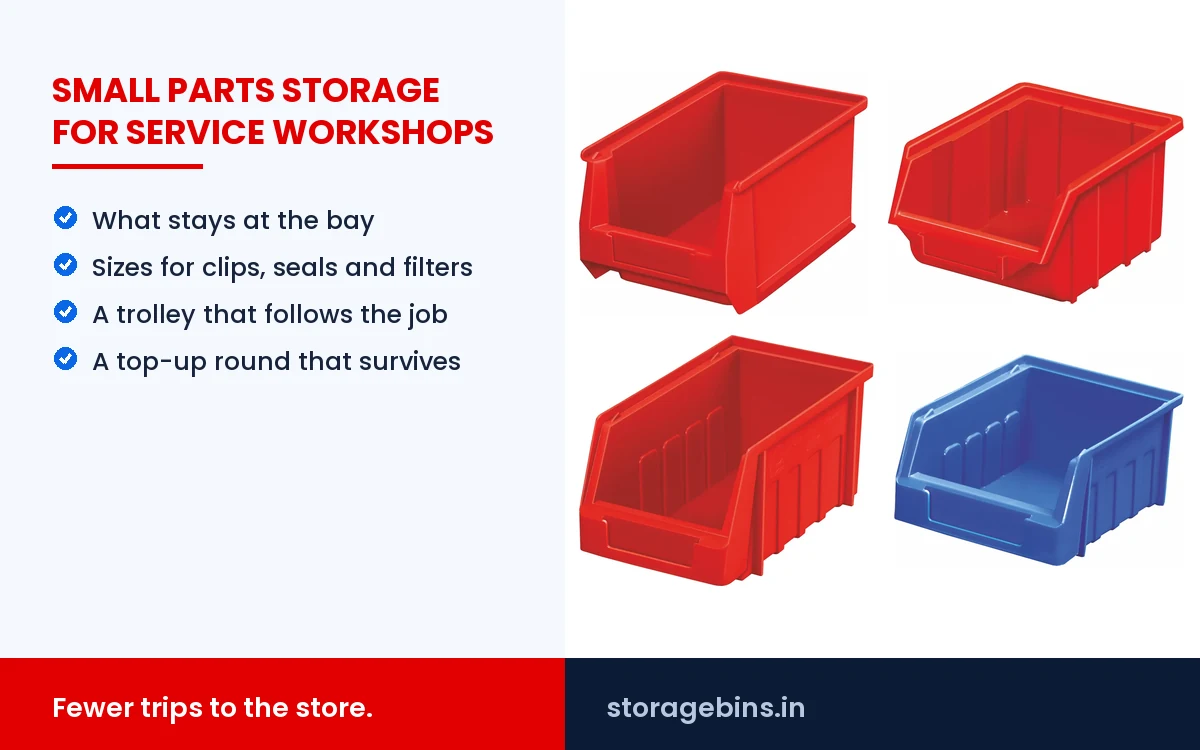
A service workshop is not a factory store. The same technician fetches, fits and returns parts all day, and jobs arrive unplanned. Here is what belongs at the bay, what belongs in the store, and how to keep both stocked.
A service workshop is not a factory store
A factory store and a service workshop look similar from the outside. Both hold thousands of small parts in bins, both have a counter of some kind, and both worry about stock. Underneath they behave nothing alike. A factory store issues against a plan that somebody wrote last week, and a storekeeper stands between the stock and the person who will use it. In a service workshop the technician is his own storekeeper. He walks to the bin, takes what he needs, fits it, and walks back with whatever is left over, twenty or thirty times in a shift, usually with oily gloves and usually while a customer waits in the reception. Every storage decision in a workshop has to survive that pattern.
The second difference is that the work is not planned. A general repair order arrives at eight in the morning and has become a different job by ten, when the technician finds that the mounting bolts are seized and two clips have snapped on removal. A factory can hold the parts a schedule calls for, because the schedule is known. A workshop has to hold the parts that a job might turn into, which is a much wider and shallower list: a hundred sizes of clip, a dozen grades and lengths of fastener, a drawer of bulbs and fuses, several sealants and adhesives, and one of everything that tends to break the moment it is disturbed.
The third difference is the shape of the stock itself. In a typical multi-brand garage or an authorised service centre, a small group of consumables accounts for almost all of the movement and almost none of the money, while a long tail of vehicle-specific parts accounts for most of the money and hardly moves at all. Fasteners, clips, washers, split pins, cable ties, bulbs, fuses, sealant, grease, brake cleaner and rags are taken dozens of times a day. A wheel bearing for one particular variant may sit untouched for months. No single storage rule works across that spread, and trying to apply one is why so many workshops end up with everything loose in cartons on the floor.
So a workshop needs two storage systems that talk to each other: an open, fast, forgiving system at the bay for consumables, and a controlled, addressed, counted system in the store for everything else. What follows sets out how to split the stock between the two, how to size bins for each family of parts, whether to put a bin wall at every bay or run one central rack, how to handle oil and grease, where to keep the parts that come off a vehicle, and a top-up routine that a busy shop will actually follow. The method is the same whether the shop has three bays or thirty, and most of it can be done in stages.
What belongs at the bay and what belongs in the store
There is a simple three-part test for whether a part belongs at the bay. Is it used on most jobs regardless of which vehicle is on the lift? Is it cheap enough that one piece dropped into the drain pit is not an event? Is a week or two of usage small enough to sit in a bin at arm's length without dominating the wall? If the answer to all three is yes, the part belongs at the bay, on an open bin that nobody has to ask for. If the answer to any one of them is no, it belongs in the store behind a counter, with an address and a record. Write the test down, because the argument about where something lives will otherwise be reopened every month.
Everything that fails the test fails it for one of three reasons, and each reason has its own consequence. Vehicle-specific parts fail because they are used on one job in fifty, so putting them at the bay only fills the wall with stock nobody reaches for and pushes the true fast movers out to the edges. Expensive small items fail because an open bin has no memory, and a sensor, a relay or a key blank that walks out cannot be traced to anybody. Bulky items fail on space alone: a stack of filter cartons at the bay will end up on the floor within a week, and once one thing is on the floor the rest follows.
Consider a six-bay garage doing general repair and periodic servicing as a worked example. The bay list comes out at roughly thirty to forty lines: three or four common nut and bolt sizes with matching washers, spring and mudguard washers, four or five clip and retainer types, cable ties in two lengths, split pins, hose clips in two ranges, sump plug washers, a few common bulbs, blade fuses in three ratings, PTFE tape, insulation tape, emery, thread lock, a tube of silicone and a can each of brake cleaner and penetrating oil. Everything else, including filters, belts, brake pads, seals and all electrical assemblies, sits in the store. Thirty to forty lines is the right order of magnitude, and a bay list that has grown to a hundred has stopped being a bay list.
Review the boundary once a quarter and expect it to move in both directions. A clip that turned out to be needed on almost every job should be promoted to the bay. A sealant that somebody insisted on and has been used twice should go back to the store. Watch particularly for the drawer of everything: the one container at the bay that has no label, holds a mixture of recovered fasteners, offcuts and parts nobody could identify, and quietly absorbs the discipline of the whole wall. That drawer is not storage, it is a symptom, and the fix is almost always a missing bin somewhere else on the wall.
- Used on most jobs regardless of vehicle, cheap, and small: it belongs at the bay
- Vehicle-specific, expensive, or bulky: it belongs in the store with an address
- Anything that must be counted or issued against a job card: store, not bay
- Aim for thirty to forty lines at the bay; a hundred lines means the test is not being applied
- One unlabelled mixed container at the bay is a symptom, not a storage decision
- Review the bay list once a quarter and allow parts to move both ways
Sizing bins for fasteners, clips, washers and pins
Size a bay bin from the top-up interval, not from the part. The arithmetic is short. Decide how often somebody will walk the wall and refill it, take the worst realistic consumption between two of those walks, add a margin for the week when three gearbox jobs land together, and that is the bin quantity. Only then go looking for a bin that holds it. A shop that tops up once a week and gets through roughly forty flange nuts of one size in a normal week should be holding at least a hundred at the bay, so that a heavy week and a missed walk together still do not empty the bin. A bin sized for an average week will run dry in the week that matters.
Then do a fill test rather than trusting a volume calculation, because small parts with heads, wings or legs pack far worse than their own volume suggests. Take one sample bin, fill it with the actual part to a level a technician can still scoop from without tipping it, and count. Working sizes at the small end are the Supra SB 1 at 125 by 100 by 60 mm outside and 117 by 80 by 52 mm inside, the Rhino Tuff ARTB-05 at 109 by 104 by 49 mm, the Hippo 612 slash T at 100 by 110 by 53 mm, and the Bull Bin 5 at 168 by 102 by 74 mm where the same frontage has to hold more. For a first bay, the Poly Bins and Rails set PBR-205 gives twenty bins of 125 by 100 by 75 mm with five wall-mounting rails in one order.
Resist partitions in bay bins. A partition looks like a way to get two part numbers into one bin, and in a store that is often true, but at the bay it fails for a specific reason: a technician picking with oily gloves in poor light takes by feel and shape, and parts hop the divider when a bin is pushed back in hard. Two fastener lengths one step apart, or two grades of the same size, need two bins and two labels. Partitions earn their place in the store, where the slots are used deliberately: the Supra SB 4 at 290 by 178 by 143 mm takes three horizontal partitions or one vertical, and the SB 6 at 440 by 180 by 145 mm takes up to seven horizontal partitions, which suits a drawer of graded shims or keys.
For the step up in size, the useful sequence runs Supra SB 2 at 170 by 100 by 85 mm, SB 3 at 220 by 130 by 125 mm, then SB 4, with the Hippo 612 slash M at 250 by 165 by 125 mm covering the same band where a rounded, deeper bin suits the part better. Inside the store, drawer containers give the tidiest answer for a nut and bolt drawer, and they come in six sizes from the A-75 at 150 by 150 by 75 mm down to the C-45 at 75 by 75 by 45 mm, each with its own label holder, so a standard tool cabinet drawer can be divided into defined compartments instead of becoming a tray of mixed hardware.
- Bin quantity equals worst-case usage between two top-up walks, plus a stated margin
- Fill test with the real part in a real bin; never size from calculated volume
- One part number per bay bin, no partitions, no exceptions for look-alikes
- Keep partitioned bins in the store, where slot layouts are set deliberately
- Print the top-up quantity on the label so any person can refill without asking
- Hold a few spare bins of each size so a cracked bin is replaced the same day
Seal kits, O-rings and the part-used kit
In a service workshop the unit of stock for sealing parts is usually the kit, not the individual ring. A brake caliper kit, a water pump kit, a fork seal set or an injector seal set arrives as a pouch or a small box with the maker's number printed on it, and the sensible rule is to store the pouch unopened and never decant it. Decanting looks tidy and destroys identity: an O-ring out of its bag is a black ring of a size nobody can confirm, and the technician who needs it in an hour will not gamble on it. Keep kits in a shallow bin or a drawer where the printed face can be read without pulling every item out, and keep the printed number facing the aisle.
The part-used kit is the real problem, and almost every workshop handles it badly. A kit is opened to take one seal, the remaining four go back into the box, the box goes back on the shelf looking full, and three months later somebody opens it for the seal that is missing. Give part-used kits a defined home rather than letting them go back among the new stock: one clearly marked bin, with a card in the label holder recording the kit number and what is actually left inside. Add one line to the routine, that this bin is checked before a new kit is opened, and the same bin that was a liability becomes a small saving every month.
Environment matters more in a workshop than people expect, because the shop floor is a harsher place than a store room. Rubber parts age with heat, sunlight and ozone whether or not anybody touches them, so a bin of seal kits should not sit above a welding bay, beside a battery charger, next to the exhaust of a vehicle left running for a diagnostic check, or under a skylight. Keep them off the wall nearest the wash bay as well, because spray finds its way into open bins and a wet pouch loses its printing. In coastal cities such as Mumbai, Navi Mumbai and Chennai, a closed drawer is worth the small extra cost for anything held for months.
Bulbs, fuses, relays and other small electrical items
Electrical small parts are the opposite problem to fasteners: very high part-number counts, tiny quantities of each, fragile, and full of items that look identical until they are fitted. Bins are the wrong medium here, and compartments are the right one. A component organiser such as the ACO 18, a cabinet of 457 mm high by 424 mm wide by 164 mm deep holding eighteen drawers of 153 by 127 by 58 mm, gives one drawer per part number in a footprint that fits a wall above a bench. Each drawer takes a removable horizontal partition, which doubles the compartment count, the drawers are transparent so the contents can be identified without opening them, and there is a stopper on the drawer base so a drawer pulled out quickly does not spill.
For the fuse and relay wall specifically, the ACO 12PTL is worth a look: a cabinet of 460 by 426 by 166 mm with twelve open pockets closed by clear polycarbonate lids, the side pockets 125 by 100 by 70 mm inside and the centre pockets 125 by 123 by 68 mm. Lids matter for this family because blade fuses and small terminals migrate between open compartments every time the shop is swept. Where a mix of loose items and packaged ones is needed, the ACO 9B9D combines nine bins with nine drawers in a cabinet of 457 by 424 by 164 mm. All of them screw straight to a wall through holes in the rear, or clip to a louvre panel of 38 mm pitch using the four ACO clips supplied.
Two habits save most of the trouble in this family. Keep bulbs in their original sleeves inside the drawer rather than loose, because a bulb rolling against its neighbours is a bulb with an invisible crack in the glass, and it will fail a week after the vehicle is handed back. And separate voltages physically if the shop handles both cars and commercial vehicles, since a 24 volt lamp in a 12 volt drawer is a comeback nobody will trace. Electronic control modules and sensor assemblies are a different matter again and should stay in the antistatic packaging they arrive in, on the ESD-safe medium your own coordinator approves, rather than in an ordinary plastic drawer.
- One drawer per part number for bulbs, fuses, relays and terminals
- Lidded pockets for anything small enough to migrate when the shop is swept
- Bulbs kept in their original sleeves inside the drawer, never loose
- 12 volt and 24 volt items in physically separate cabinets or drawers
- Control modules and sensors left in their antistatic packaging until fitting
- Cabinets screwed to the wall or clipped to a louvre panel, never left standing on a bench
Filters, belts and hoses: the bulky fast movers
Filters are fast moving and bulky at the same time, which is an awkward combination. The important point is that the storage unit is the carton, not the element: a filter taken out of its box in a working shop has already started its life before it reaches the housing, and a carton that has been crushed under three others hides an element that looks perfectly fine until it is fitted. So give filters a deep open bin or a shelf pocket that holds the cartons upright, and cap the stack height in writing. At the larger end of the Supra range the SB 7 at 435 by 425 by 215 mm and the SB 8 at 600 by 425 by 300 mm, with 530 by 375 by 290 mm inside, take oil and air filter cartons without the cartons having to be laid flat.
Belts and hoses should hang rather than sit in bins, and they should hang on something wide. A V-belt draped over a thin rod is crimped at one point and will fail at that point, so the hook matters as much as the location. Louvre panel spigots cover this directly, and ALKON describes them as suited to hanging items such as fan belts, gaskets, hoses and automotive parts. The range runs from the SP1 single prong at 200 mm long on a 6 mm rod and the SP2 double prong of the same size, through pipe hooks of 150, 250 and 300 mm as the SP3, SP4 and SP5, to the SP6 steel hook at 200 mm on a heavier 9.5 mm rod, the SP7 euro hook at 200 mm on a 6 mm rod and the SP8 chrome wire hook at 150 mm. Use the pipe hooks for belts, where the flat section spreads the load.
Larger items that will not hang and will not fit a shelf bin need a container in the tens of litres. The Mammoth bins at 820 by 315 by 300 mm outside and 740 by 250 by 290 mm inside cover this band, and they come with a solid base as the AM83S or a mesh base as the AM83M. ALKON states that the solid base suits liquid-based contents or items small enough to need containing, while the mesh base lets water pass through, and that the bins nest to save more than seventy per cent of the space during transport. ALKON also states a maximum of three high when stacked on risers, with 15 kg uniformly distributed load per bin when double stacked and 10 kg when three are stacked, so plan the fill weight before the rack is loaded.
Lubricants, grease and anything that drips
Oils and greases do not live in bins, and trying to make them do so is how a bin wall becomes a mess. Bulk oil belongs in its drums or cans in a bunded area away from the bays, and what belongs at the bay is only the working quantity: a grease gun in a holder, a small can of brake cleaner, a bottle of coolant concentrate, a tube of silicone, a bottle of thread lock. Put those on a tray fixed to the wall rather than in a bin among dry parts, because a can that has been wiped with an oily rag will transfer oil to every clip in the bin beside it. A multi-purpose tool tray from the other products range, screwed to the wall or onto a louvre panel, does this job and also stops screwdrivers and pliers migrating into bins.
Anything that can drip needs a solid base under it and a defined catch point. This is exactly the distinction between the solid-base and mesh-base containers: a mesh base is right when you want fluid to drain away and wrong when the fluid is the thing you are trying to keep off the floor. A removed sump plug, a filter still holding oil, a wet gasket or a dismantled hydraulic part all need a solid container standing on a drip tray, not a bin on a shelf over a walkway. Decide the catch point at each bay, mark it, and keep an absorbent pad there, because the alternative is a floor that is slippery in exactly the place where somebody is carrying a wheel.
Heat is the limit that catches people out. The moulded polypropylene copolymer bins across these ranges have a service range of minus 10 to plus 70 degrees Celsius, which covers every normal workshop condition and does not cover a part that has just come off a hot engine or a drain pan of freshly drained oil. Let hot items cool on a metal tray first; repeated hot contact distorts a bin base and the bin then sits badly for the rest of its life. The same caution applies to the shop itself. A dark bin sitting on a steel bench in direct sun under a shed roof in Ahmedabad, Rajkot or Hyderabad in summer is not experiencing shop air temperature, and the sensible answer is to move the bin rather than argue about the rating.
A bin wall at every bay, or one central rack?
This is the decision that most affects how the shop feels to work in, and it should be settled with a tape measure rather than an opinion. Walk the route a technician actually takes from the lift to wherever the fasteners are kept, count the paces, and multiply by the number of trips in a shift. A twelve metre walk taken twenty-five times, there and back, is six hundred metres of walking per technician per day, most of it interrupting a job that is already open. Against that, a wall at every bay means the same part number is stocked in several places, which is more bins, more top-up work and more places for stock to hide. Put both numbers on paper for your own shop before deciding, because the answer genuinely differs between a three-bay shop and a twelve-bay one.
The practical middle path is a small panel at each bay holding only the true common consumables, with everything else on one deeper rack. Louvre panels make this easy to size because the capacities are published. The panels are made from 1.5 mm CRCA steel powder coated in light grey RAL 7035 and come as the LP1 at 457 by 457 mm, the LP2 at 457 by 610 mm, the LP3 at 457 by 914 mm and the LP6 at 457 by 1829 mm. ALKON's load chart gives 72 lips and 180 kg for the LP1, 96 lips and 240 kg for the LP2, 144 lips and 360 kg for the LP3, and 288 lips and 780 kg for the LP6, with a maximum of 12 kg per lip. In bin terms an LP1 carries up to 24 Supra SB 1 bins, an LP2 up to 32, an LP3 up to 48 and an LP6 up to 96.
Where a full panel will not fit, the universal rail AUR-1 at 915 by 60 mm does the same job in a strip. It mounts on walls, benches, slotted angle systems, stands and trolleys, which makes it the right answer above a bench, along the back of a parts counter or on a slotted-angle upright that already exists. Capacities per rail are 9 bins for the SB 1 and SB 2, 7 for the SB 3, 5 for the SB 4 and SB 6, and 2 for the SB 5, with 8 per rail for the small Hippo sizes and 5 for the 612 slash M. Two rails one above the other give a two-level pick face on a wall that could not take a panel, and the page on louvre panels, rails and stands sets out the mounting options in more detail.
For bays that face each other, a free-standing island is often better than two walls. The FSS slash C stand at 457 mm wide by 630 mm deep by 1560 mm high is made from 25 mm mild steel square pipe, powder coated in the same light grey, and fitted with plastic shoes for stability. It takes two LP1 or two LP2 panels on one side, or four on both sides, so a single stand between two lifts presents consumables to both without duplicating a single bin. Where the shop has the height, the FSS slash LP6 stand at 457 by 905 by 2160 mm carries the tall LP6 panel and turns a corner of the shop into the consumables point for the whole floor.
- Measure the real walk: paces from lift to bin, multiplied by trips per shift
- Duplicate only genuine common consumables at each bay; keep the rest central
- Size panels from the published bin counts, not by eye, before ordering
- Use the AUR-1 rail where a full panel will not fit, such as above a bench
- Consider one double-sided stand between two facing bays instead of two walls
- Keep the same bin size and label layout at every bay so any technician can work anywhere
The trolley and the tray that follow the technician
A technician who moves between bays, or who works on a vehicle parked away from the lifts, needs the consumables to travel with him. The shop floor trolley SFT is built for this: 970 mm wide by 600 mm deep by 1100 mm high, made from mild steel rectangular pipe powder coated in light grey RAL 7035, with an aluminium chequered top plate over the base, castors underneath and handles on both sides. Two LP2 louvre panels fit on each side, ordered separately, which means two panels for single-sided use and four for double-sided. The chequered top plate is the part people underestimate: it becomes the work surface for the small assembly work, so parts stop being laid on the floor or on the wing of the vehicle.
Where the trolley has to carry a genuinely large set of bins, the Alkon Tuff trolley ATTB is the heavier option at 995 mm wide by 700 mm deep by 1430 mm high including the castor extension and handles. It takes ATSLP panels of 914 by 610 mm, two for single-sided use and four for double-sided, comes with ergonomic plastic handles and heavy duty swivel castors of which two are braked, and carries up to 144 Supra SB 1 bins single-sided or 288 double-sided, or 40 and 80 of the larger SB 4. The braked castors matter in a workshop with a sloping wash-bay floor. For a fixed point where floor space is tight, a rotary stand for Roo Tilt Bins puts bins on a turntable instead, the RTBRS 425 at 520 by 1680 by 470 mm with a permissible uniformly distributed load of 100 kg, and the RTBRS 636 at 730 by 1680 by 680 mm rated at 150 kg.
The lightest option is often the best one, and it is the hand-carried cabinet. A component organiser taken to the vehicle means the technician carries thirty part numbers in one hand rather than walking back for the second clip. If that becomes the habit, give the cabinets a home so they are not left on the floor: the ACO wall mounting stands take two cabinets at 425 by 910 mm, three at 425 by 1365 mm and four at 425 by 1810 mm, so a column of cabinets lives on the wall and comes down only for the job. Add a tool tray beside them for the screwdrivers, files, pliers and spanners that would otherwise end up in bins, and the wall stays readable.
Keeping oily parts away from clean ones
The cheapest reliability improvement in most workshops is two bin populations instead of one. Bins that have held oily, greasy or degreased parts never come to the clean bench, never hold fasteners, and never hold anything that will be fitted to a sealing face. Mark the split so it cannot be argued with, either by colour or by keeping the two populations in physically separate places, and write the rule where the bins live. ALKON states that these bins are resistant to most industrial solvents, which covers the usual workshop chemicals, but your own degreaser is still worth a check: leave one sample bin standing in it at shop temperature for a month and look for softening, crazing or colour change before committing a hundred bins.
Oil changes handling as much as it changes cleanliness. A bin with a film inside is slippery, a stack of oily bins slides, labels lift at the corners, and the technician's gloves carry the film to the next surface he touches. The practical fixes are ordinary. Drain the part before it goes in the bin, on a mesh tray or a tilted rack, rather than letting the bin become a sump. Avoid partitions in bins that will hold wet parts, because fluid sits in the blind corner behind a divider and never comes out in a rinse. And choose containers you can actually clean: the Tote AK-421 is described with a smooth internal wall for easy cleaning and an anti-skid bottom, which is exactly the combination that makes a wash routine realistic.
A garage does not have a wash line, it has a sink, a bucket and a busy Saturday, so the wash routine has to be built around that. Fix a day, fix a number, and hold a spare set so the wash never stops a bay: for example ten bins pulled, degreased, rinsed and dried each week on a rotation that covers the whole oily population over a quarter. Dry them fully before they go back, because a wet bin defeats whatever rust preventive is on the next part and lifts the label adhesive, and in monsoon weeks in Mumbai, Navi Mumbai, Kolkata or Chennai a bin put back damp will stay damp. An unlabelled bin is how the wrong part reaches the wrong vehicle, so the label is part of the wash.
A place for the parts that come off the vehicle
Every workshop needs a defined home for removed parts, and most do not have one, which is why old brake pads sit on the floor under the lift and a removed sensor ends up on the workbench next to a new one. Three things make this worth solving properly. Customers increasingly ask to see what was replaced, and being able to produce it ends an argument before it starts. If the new part turns out to be wrong or faulty, the old one may have to go back on so the vehicle can be moved. And in insurance and fleet work the removed part is sometimes evidence that the job was done, which means it has to survive until somebody has looked at it.
The mechanism is one container per job, labelled with the job card number, kept at the bay until the vehicle is handed over. A Tote AK-421 at 400 by 255 by 100 mm outside and 365 by 230 by 90 mm inside suits most jobs and carries a large label holder on the front, which is what makes the job number visible from the aisle rather than written on masking tape that falls off. Larger removed items need a larger container, and the Supra SB 7 at 435 by 425 by 215 mm or SB 8 at 600 by 425 by 300 mm covers most of them, with a Mammoth AM83S for the awkward bulky ones. After handover the container goes one of two ways only: to the customer, or to a scrap cage with the job number still on it until the scrap is cleared.
Fasteners removed from a vehicle need their own small home within that container, or a magnetic tray dedicated to the job, and they must never be tipped into a bay bin. Two reasons: the recovered fastener may be a grade or length that does not match anything on the wall, and a self-locking nut that has been used once should not be presented to the next job as new stock. Give the job container a small compartment, or use a C-45 drawer container of 75 by 75 by 45 mm inside it, and put the same rule on the label as on the wall. It takes one line to write and it removes a category of mistake that is otherwise impossible to trace.
Warranty returns, cores and exchange units
Three different piles get mixed in almost every workshop, and separating them is worth more than it costs. Warranty returns are parts that a manufacturer or supplier will want to inspect, so they have to keep their packaging, their paperwork and their identity intact. Cores and exchange units are parts going back for credit, which means their condition matters commercially even though nobody will inspect them for a defect. Scrap is scrap. If all three live in the same corner, the pile behaves as scrap, because that is the lowest common denominator, and the credit and the claim both quietly disappear into it.
The storage answer is small and cheap: a locked or caged shelf with one defined location per category, and a container per claim with the claim or credit note number in the label holder. Keep the new part's carton when the claim requires it, because a claim rejected for missing packaging is a complete loss rather than a partial one. A labelled tote works for most items, and a component organiser drawer is right for small electrical returns that would otherwise be damaged further while waiting. Keep the area inside the controlled part of the store rather than at the bay, because an open pile of parts that look new will be raided on a busy evening by somebody who genuinely believes he is being resourceful.
Then put one line on the calendar, because this area fails through time rather than through space. Returns sit past the claim window and become scrap. Cores are scrapped by mistake during a clear-out. And the worst case, a claim part is picked and fitted to another vehicle because it looked like stock, which turns one problem into two. A fixed review on a named day each week, walking the shelf with the claim list, catches all three. Keep the list short and visible: claim number, part, date raised, and what is waiting on it. Ten lines on a sheet at the counter is enough for most shops and works better than a system nobody opens.
A top-up routine a busy workshop will actually follow
The two-bin loop used in factories is elegant and it usually does not survive a garage. In an assembly plant each station has an owner, a material handler passes on a fixed route, and the empty container itself is the signal, as set out in the article on line-side storage in an assembly plant. In a workshop the bins are shared between technicians, nobody owns the wall, the route is whoever is free, and within a fortnight somebody will pour a new packet into the half-full front bin because it is quicker. Once that happens the signal is gone and the system is blamed rather than the habit. A workshop needs something cruder and more forgiving.
What works is a marked low line and a named walk. Mark a line inside every bay bin at the level that represents the top-up quantity, with a paint mark or a moulded feature that cannot rub off. Name one person as responsible, give them a fixed slot each week, and give them a printed walk list in the same order as the bins on the wall so the walk is a straight line and not a search. Anything at or below the line gets written on the list. Twenty minutes for a six-bay shop is realistic, and because the list is already in bin order it doubles as the order sheet for the store or the supplier.
Consolidate what comes out of the walk rather than raising five small orders across the week. One order per cycle is cheaper to place, cheaper to receive and far easier to check in, and it also removes the most common cause of a bin running empty, which is not a shortage but four separate part-orders each waiting on somebody's approval. Put the top-up quantity on the bin label alongside the description, so that the person doing the walk does not have to ask, and so a substitute can do the walk when the named person is on leave. Confirm normal availability of the sizes you depend on with your supplier once, so that the order cycle is built around what is actually held rather than what is hoped for.
Then measure one number and let everything else go: how many bins were at or below the line at each walk. If that number is stable and small, the quantities are right. If the same bin is below the line every single week, the quantity is wrong, not the person, and it should be raised rather than discussed. If the number jumps, something changed in the work mix and the bay list needs a look. This is the whole management system for the bay wall, it fits on one sheet of paper, and it is the part that decides whether the wall still works a year after it was installed.
- Mark a permanent low line inside every bay bin at the top-up quantity
- One named person, one fixed weekly slot, one printed walk list in bin order
- Walk list doubles as the order sheet; one consolidated order per cycle
- Top-up quantity printed on the label so a substitute can run the walk
- Track only one number: bins at or below the line at each walk
- A bin below the line every week means the quantity is wrong, not the routine
Counting, shrinkage and the true cost of consumables
Consumables at the bay are free to take and they are not free. A shop that does not recover their cost is absorbing a real monthly spend into labour margin, and a shop that tries to book every clip against a job card spends more in time than the clips are worth. Pick one method and apply it consistently: either a stated shop-supplies line on the job card, or a small number of consumable groups charged per job type. What matters is that somebody knows what the wall costs per month. Once that number exists, the argument about whether to fit a locked drawer or to standardise a fastener range stops being a matter of opinion.
Counting follows the same principle of proportion. Do not count clips. Count bins, and only some of them: a monthly spot count of ten bay bins against the printed quantity is enough to tell whether the wall is behaving, and it takes a few minutes. The high-value small items get the opposite treatment and should be counted in full every month, because that is where the money is. In practice that short list is things like sensors, relays, injector seals, tyre valve assemblies, key blanks and diagnostic adaptors, and all of them belong in a locked drawer or cabinet in the store, issued against a job card, rather than anywhere on an open wall.
When a count disagrees with the record, resist the urge to adjust and move on. The honest causes are worth knowing because each has a different fix. Over-fitting, where two clips are used because one was dropped, points at a bin that is too deep or badly placed. A part fitted and never booked points at the job card process rather than the store. A part taken for a personal job points at an open bin holding something that should have been behind a lock. And a genuine supplier short-supply points at the goods-inward check. Write the cause next to the adjustment. A shop that does this for one quarter usually finds that two or three fixes account for most of the loss.
- Decide once how consumables are recovered, and apply it to every job
- Spot count ten bay bins a month against the printed quantity; do not count clips
- Count the high-value small items in full every month, without exception
- Sensors, relays, key blanks and diagnostic adaptors belong behind a lock, issued on a job card
- Record the cause beside every stock adjustment, not just the new number
- Review the causes quarterly; two or three fixes usually cover most of the loss
Three shops, three stores
A multi-brand garage has the widest variety and the least structure. Parts are bought locally as jobs demand, often without a manufacturer's part number, and stock is recognised by physical description rather than by code. The storage implications follow directly. Organise by shape and size rather than by part number, and label by description in the words the technicians actually use, because a code nobody can decode will be ignored. The single biggest win in this kind of shop, and it can be fitted in stages in Delhi NCR, Ahmedabad, Hyderabad or anywhere else, is a proper wall of generic fasteners, clips and washers on louvre panels at each bay, which removes most of the daily trips to the market.
An authorised service centre works the other way. Jobs are menu-driven, parts carry the manufacturer's numbers, quantities are audited and the stock is expected to reconcile. Here a controlled store with a counter is worth the discipline: fixed locations mapped to part numbers, one primary location per number, and a walk order that matches the printed pick list. Because service bookings are known the previous evening, this is the one workshop type where kitting pays: pick each booked job into a labelled tote the night before, so a shortage is a purchase problem at six in the evening rather than a stopped bay at nine in the morning. Warranty returns need their own controlled area, since the manufacturer will inspect them.
An electrical, pump or motor repair shop is a different animal again, and the clusters around Coimbatore, Peenya in Bengaluru, Rajkot and the industrial belts of Pune and Nashik are full of them. The stock is bearings, seals, carbon brushes, terminals, capacitors, winding wire, fasteners and shims, and the work is dismantling and rebuilding rather than replacing assemblies. That adds a requirement the other two do not have: the shop must store work in progress belonging to a specific job for days at a time, alongside its new stock. A labelled job tray per unit, with a small compartment for the hardware that came off it, is the whole answer, and it prevents the most common failure in a rewinding shop, which is two similar units mixed on the same bench.
What all three share is more than what divides them. The bay wall is the same wall, the trolley is the same trolley, and the weekly top-up walk works identically in each. The difference is how tightly the store behind the counter is addressed and counted, and that scales with the value and the traceability the shop is accountable for. If you want the fully controlled version of the store, the method for organising a maintenance spares store in a plant sets out classification, zoning, minimum and maximum levels and cycle counting in detail. A workshop usually needs a lighter version of the same idea: the zoning and the fixed locations matter, the full criticality analysis generally does not.
Specifying and buying it once
Buy the assembly, not the bins. The most common procurement mistake in this whole exercise is ordering a large number of bins and discovering that the mounting hardware is a separate item on a separate timeline, at which point the bins sit in a corner and the shop carries on with cartons. Panels, stands and trolleys are supplied without bins, and the trolleys are supplied without panels: the SFT needs two LP2 panels for single-sided use or four for double-sided, and the ATTB needs two ATSLP panels of 914 by 610 mm for single-sided use or four for double-sided. Write one requisition line per complete unit, listing the bins, the panel or rail, the stand or trolley and the partitions together.
Sample before standardising. Take one bin of each shortlisted size to the actual bay, fill it with the actual clip or nut, and leave it in service for a week with the actual gloves. In that week you will learn what no catalogue can tell you: whether a glove catches the front lip, whether the bin is stable at a quarter full, whether the label survives an oil mist, and whether the technician can pick from it one-handed while the other hand holds a tool. Only then fix the quantity and order the volume. Fifteen minutes with a real sample at a real bay is worth more than an hour of comparing internal dimensions on paper.
Standardise on a small number of sizes and write the art numbers down. Three or four bay sizes and three or four store sizes will cover almost any workshop, and every size beyond that multiplies through panel layouts, spare stock, labels and the training of whoever does the top-up walk. Hold five to ten per cent spare of each size, because the day there is no spare is the day a cracked bin is replaced by a cut oil can. Record exact codes rather than descriptions in the shop's own standard sheet, so that an order placed by somebody else later brings the same item. The Supra bins range page gives the full size ladder and partition options, the page on louvre panels, rails and stands covers the mounting hardware, and tool trays and poly bin and rail sets sit in the other products category.
Shreeram Metafusion Engineers Pvt. Ltd. has been an authorised stockist and supplier of ALKON Plastics products for over thirty years, and ALKON describes itself as the manufacturer of the largest range of material handling bins in India. The catalogue on this site runs to 476 products across nine categories, which is what makes it possible to cover a bay wall, a store rack, a trolley, a component organiser and the removed-parts containers from one source on one set of accessories. Confirm availability and dispatch timing for the sizes you intend to standardise on before you fix an installation date. The office is at Shop-1, Gagangiri Chs, Sector 17, Vashi, Navi Mumbai, Maharashtra 400703, open Monday to Saturday from 10:00 to 19:00, on 93266 29967 or 98201 01937, with enquiries by email at enquiry@shreeram-metafusion.com.
- Order bins, panel or rail, stand or trolley and partitions as one requisition line
- Trial one sample of each shortlisted size at a real bay for a full week
- Standardise on three or four bay sizes and three or four store sizes
- Hold five to ten per cent spare of each size so improvisation never starts
- Record exact art numbers in the shop's own standard sheet, not descriptions
- Confirm availability of your chosen sizes before fixing an installation date
Read next