Setting up an ESD workbench: PCB carriers, conductive bins and a layout that works
Static damage is quiet, cumulative and expensive. A practical guide to building an electronics bench where boards and components are carried, stored and handled in the right containers, from workstation features to PCB carrier choice and daily routines.
The damage you cannot see
Most workplace damage announces itself. A dropped part cracks, a crushed carton is flattened and a spilled bin is on the floor. Electrostatic discharge does none of these things. A technician walks across a floor, picks up a board and a spark too small to feel passes into a device that is rated to withstand a fraction of it. The board goes into the product, passes the test and ships. Some weeks later it fails in the field, and the failure is blamed on a bad batch, a hot climate or a careless customer. The cost is real, and the cause is almost never found.
This is why static control is organised as a system rather than a purchase. A conductive bin on its own does not protect a board, if the technician touching it is not grounded, the bench surface is not dissipative and the floor is a good insulator. Protection comes from keeping everything that touches a sensitive device at the same electrical potential, and from keeping insulating materials, which cannot be grounded, away from the work area. The containers in which boards and components are stored and carried are part of that system, and they have to be chosen as part of it.
This article is a practical guide to building an electrostatic discharge safe workbench using the kinds of products that ALKON makes, namely workstations, PCB carriers, conductive bins and component organisers. It does not replace the standards and the training that an ESD control programme requires, and the reader should follow their own organisation's programme and relevant standards such as the IEC 61340-5-1 series. What it offers is the physical layer: how the bench, the carriers and the bins fit together, and how to set them up so that the routine is easy to follow.
How static damage happens, in brief
A short refresher helps to explain why the details matter. Static charge builds up when two materials touch and separate, a process called triboelectric charging. A person walking, a plastic bag being pulled from a board, a roll of tape being unrolled and a board sliding along a bench all generate charge. The amount depends on the materials and on humidity, and dry air makes it worse.
A charged object that touches a grounded or differently charged one discharges, and the discharge current flows through whatever sensitive circuit is in its path. Many modern devices are sensitive to levels far below what a person can feel, so damage can occur with no sensation and no visible spark. Damage may be catastrophic, killing the device at once, or latent, weakening it so that it fails later. The latent kind is the more insidious, because it passes inspection.
Control rests on three ideas. Ground everything conductive, including people, so that charge cannot build up. Use dissipative and conductive materials for surfaces and containers, so that charge leaks away safely and slowly instead of discharging suddenly. And keep ordinary insulators, such as plastic cups, paper and clothing, away from sensitive devices, or neutralise their charge. A workbench is a small area in which these ideas are put into practice.
The ALKON ESD range at a glance
The ALKON catalogue includes a group of products for static-sensitive work, and they fit together as a system.
The conductive products are moulded in black, from conductive polystyrene or conductive polypropylene, and the non-conductive equivalents in grey from high impact polystyrene. The colour difference is deliberate: black says conductive, grey says not, and a technician can see the difference at a glance. We cover the overall ESD range on our ESD safe storage products page, and the general reasoning for conductive bins in our guide to ESD safe storage.
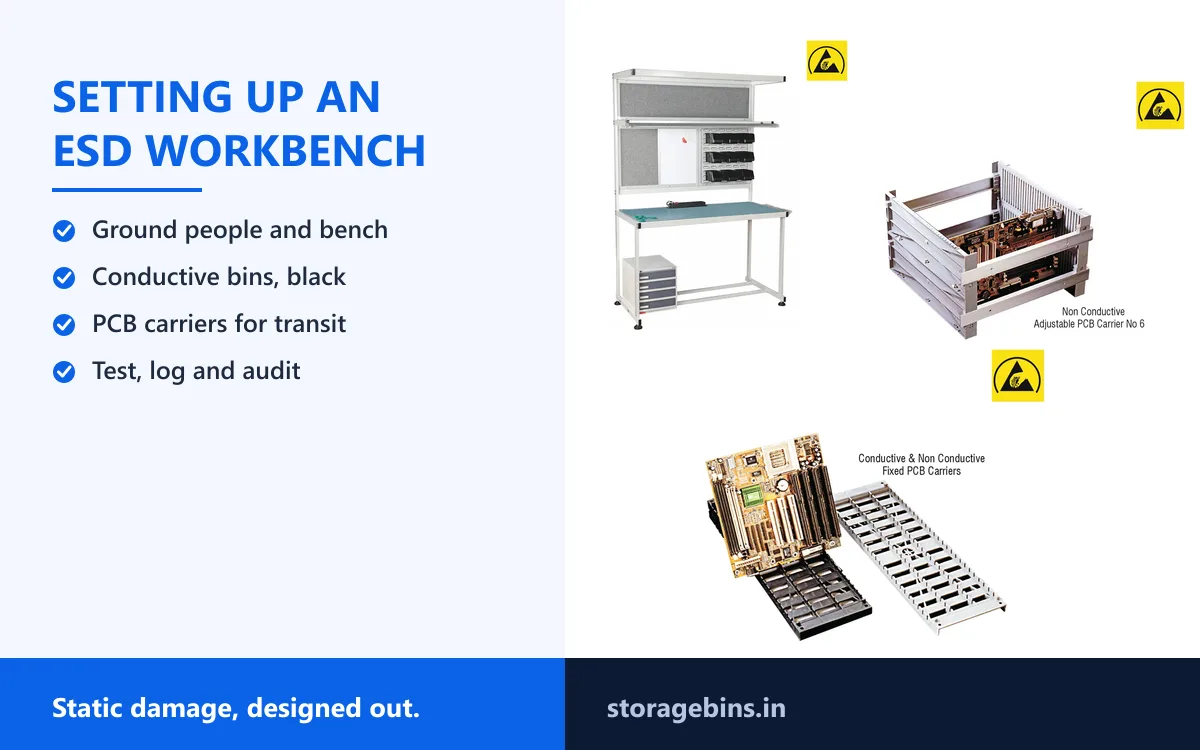
- The workstations AWS 12060 and AWS 12060 SP, ergonomic benches with an ESD mat, grounding cord, spike protector and lighting.
- PCB carriers, adjustable and fixed, in conductive and non-conductive forms.
- Conductive Supra bins and the conductive component organiser, for components and small parts.
- The ESD Panda shelf bins with shelving systems, and the conductive modular system, for larger storage.
The workstation: the heart of the bench
The workstation is where the technician works, and its features are listed in the catalogue for the AWS 12060. The structure is made from 20 by 40 mm rectangular pipe of 18 gauge, powder coated in light grey RAL 7035. The table top is covered with an ESD mat with a grounding cord. A universal spike protector, rated 230 V, 50 Hz, 15 A, with four sockets, protects the equipment from supply surges. Four conductive levelling screws on the base allow height adjustment and provide a conductive path to the floor. A footrest adds comfort. An 18 W slim LED light illuminates the work. A louvre panel carries conductive bins as required, and a tool tray can be fitted on the left or right side. An ALKON modular system with lock provides secure drawer storage, and a writing and felt board is supplied with the AWS 12060.
The two models differ in height. The AWS 12060 has a table top of 1200 mm by 600 mm and an overall height of 1800 mm. The AWS 12060 SP has the same table top and an overall height of 1500 mm, a shorter version without the upper board, which suits a low ceiling or a bench where the louvre panel is not needed at full height.
The design reflects what a repair or assembly technician needs: a stable, level working surface that is grounded, good light, power with surge protection, tools and parts within reach and a drawer that locks. In the catalogue's words, it is a workstation designed to provide an ergonomic working platform where essential tools and spares are available at ease, helping to get the repair job completed in a hassle-free manner.
Grounding: the connection that makes it work
The ESD mat and the grounding cord are the visible part of the grounding system, and getting the grounding right is the most important single step in setting up the bench.
The mat on the table top is a dissipative surface. It allows charge on objects placed on it to drain slowly, at a controlled rate, to ground through the cord. The grounding cord connects the mat to a designated ground point, usually the earth bonding point of the facility's ESD ground, through a resistor for safety. It should not be connected directly to the mains earth in a way that bypasses the resistor, and it should follow the guidance of the facility's ESD coordinator.
The technician is grounded, too, through a wrist strap connected to the same ground point, or through footwear and a dissipative floor. The wrist strap is the most reliable personal grounding method at a bench, and it should be worn snug against the skin, tested regularly and connected before sitting down. A wrist strap that is not worn, or is worn loose over a sleeve, gives no protection.
Check the grounding path regularly. A cord can break inside its insulation, a clip can corrode and a mat can become dirty and lose its dissipative property. A simple test with a resistance meter, done at the start of each shift or on a fixed schedule, confirms that the path is intact. Keep a log of the checks, because auditors and customers will ask for it.
The conductive levelling screws on the workstation base provide an additional path from the frame to the floor, which helps if the floor is itself dissipative. They also allow the bench to be levelled on an uneven floor. Do not rely on them as the only ground, since the floor's properties vary.
PCB carriers: moving boards safely
Boards move. They travel from the stores to the line, from one station to the next, between machines and into test. Each move is a chance for damage, mechanical as well as electrical, and the carrier is the container that protects them. ALKON makes a family of PCB carriers for the purpose.
The adjustable PCB carriers are designed to protect boards during storage or transport on the assembly line, or to be integrated with automatic component insertion machines. They can be stacked. Each carrier has 31 distinct slots, holding up to 31 boards. Special aluminium guides, which sit flush with the carrier, are adjustable to the width of the boards. The guides come in three lengths, 253, 353 and 553 mm, sold in sets of two, with the article numbers APCRG-2, APCRG-3 and APCRG-5.
Two sizes are listed. The Adjustable PCB Carrier No. 5 suits small to medium boards, with sides measuring 350 mm long by 105 mm high. The No. 6 suits medium-sized boards, with sides measuring 350 mm by 210 mm, and needs two sets of aluminium guides. Each is supplied as a set of two pieces, in a conductive version in black, made from conductive polystyrene, and a non-conductive version in grey, made from high impact polystyrene. The guides are ordered separately.
The fixed PCB carriers are the economical alternative. The fixed carrier measures 458 mm long by 140 mm wide, has 25 slots with tapered slots that keep the boards in a taper position, and is described as economical for handling clinched SMDs, soldered or bare boards of any size. It is packed five to a box, and comes in conductive black and non-conductive grey. The L-type fixed carrier is a two-side support carrier, for stronger card holding, measuring 207 mm deep by 273 mm wide by 95 mm high, with 25 grooves at a 9 mm pitch and 3 mm width, which holds boards on two contiguous edges. It is nestable when not in use, and the conductive version is noted as excellent for work benches.
Choosing between conductive and non-conductive carriers
The catalogue offers both conductive and non-conductive PCB carriers, and choosing correctly matters.
A conductive carrier, in black, is made from conductive polystyrene. It provides a conductive path around the board, which equalises potential and protects against discharge. Use it wherever the boards carry static-sensitive devices, at any stage from bare boards with sensitive components to finished assemblies. For static-sensitive work, the conductive version is the default.
A non-conductive carrier, in grey, is made from high impact polystyrene. It protects the boards mechanically but not electrically. Use it for boards that are not static-sensitive, or in processes where a conductive carrier would cause a problem, such as a stage where conductivity is undesirable. Do not let non-conductive carriers into the ESD protected area with sensitive items, and keep them visibly separate. The colour code helps, but it must be enforced.
A good practice is to decide, for each process step, which carrier type is allowed, and to write it down. A board that is sensitive should never be carried in a grey carrier in a protected area. If the plant has a mix of sensitive and non-sensitive products, keep the carriers physically separated and clearly labelled.
Remember that a conductive carrier only works if it is part of the system. A conductive carrier on an insulating surface, handled by an ungrounded person, gives little protection. Carriers are one link in the chain.
Selecting the right carrier for the boards
Within each type, the choice of size and style depends on the boards. A few questions help.
How large are the boards? Measure the length and width, and check the guides and slots. The adjustable carriers accommodate a range of sizes by moving the aluminium guides, and the three guide lengths of 253, 353 and 553 mm cover small to larger boards. The fixed carriers suit boards of a standard size, and the tapered slots hold them without adjustment.
How many boards per carrier? The adjustable carriers hold up to 31 boards, and the fixed carriers 25. If you need to carry more, stack carriers, as the adjustable ones can be stacked.
How will the boards be handled? If boards go into an automatic insertion machine, the adjustable carriers are designed to be integrated with it, and the catalogue says so. If they are carried by hand from station to station, either type works. If boards need support on two edges, the L-type holds them on two contiguous edges.
How are the carriers to be stored? Nestable carriers, such as the L-type, save space when empty. Stackable ones, such as the adjustable type, save space when full.
Try a sample with your real boards before ordering a fleet. A board that is slightly too thick for the slot, or a connector that fouls the guide, is easier to discover with a sample than with a hundred carriers.
Conductive bins and component organisers
Boards are one half of the picture. Components, whether on reels, in tubes or loose, need protection too, and the conductive bins and organisers do the job.
The conductive Supra bins in the catalogue follow the Supra range in the standard sizes, in conductive material and black colour, with partitions available in conductive form. They hang on louvre panels, stack and carry label holders, just as the standard bins do, so a workstation's louvre panel can carry conductive bins within reach of the technician. Our Supra bins page lists the sizes.
The conductive component organiser is a cabinet with 25 small drawers, made from conductive polystyrene, measuring 397 mm wide, 238 mm high and 160 mm deep, with drawers of 155 by 71 by 35 mm. It provides systematic storage of electrostatic sensitive devices, with each drawer holding a different type. It suits small components, such as integrated circuits, transistors, diodes, connectors and fine hardware, and it sits on the bench or on a shelf.
The modular system in conductive form gives a larger drawer cabinet for components and tools, and the ESD Panda shelf bins with shelving systems provide higher-capacity storage for the stores. Together, the family covers the range from a bench drawer to a stores shelf.
Choose each container by what it holds, as for any bin. The inside dimensions of the part, the quantity and the access pattern decide the size, and the conductive property is a requirement on top. Do not mix conductive and non-conductive bins on the same panel without clear labelling, since a technician reaching for a part should know at once which kind of container it is in.
Laying out the bench
A well-designed bench makes the right behaviour easy. The layout should follow how the technician works, and keep sensitive items within the protected area.
Place the working zone, the area of the ESD mat, directly in front of the technician, with enough room for the board, the tools and a few components. Keep the zone clear of anything that is not needed, and especially of insulators such as plastic cups, paper, packaging and personal items. A tidy mat is both safer and quicker to work on.
Position the louvre panel with conductive bins at the back or side, within easy reach. Put the most-used components at the height and angle where the hand goes naturally. The tool tray, which can be fitted on the left or right, goes on the side of the dominant hand, so tools are picked up without crossing the work.
Place the lighting to illuminate the work without glare. The 18 W LED light on the workstation is positioned over the mat, and should be adjusted so that the technician does not cast a shadow on the board.
Keep carriers at the side, in a marked place, with a clear rule for incoming and outgoing boards. A tray of incoming boards on one side and a tray of completed boards on the other make the flow visible, and stop boards from piling up in the work zone.
Provide a place for the wrist strap and cord, so that it is not left on the floor or tangled. A hook on the side of the workstation works well.
Organising small components
A bench holds many small parts, and the way they are organised affects both speed and safety. Several principles apply.
Group components by type and by use. Resistors together, capacitors together, connectors together, and the ones used most often within the easiest reach. A drawer or a bin per type, labelled with the value or the part number, makes picking fast.
Use the drawers for the very small items. The conductive component organiser's 25 small drawers suit the many values and types of small components that a repair bench needs. Label each drawer with a printed label, and keep a list of the contents inside the lid or on the side.
Keep components in their original packaging, where it is conductive or shielding, until they are needed. A moisture or static protective bag protects the part in storage. Once a part is removed, it should go straight into a conductive container or onto the mat.
Avoid loose parts on the bench. A part lying loose on a plastic surface can pick up charge, or be lost. A conductive tray or a small bin on the bench holds the parts being worked on.
Count and control stock. A small stock at the bench, replenished from the stores, avoids running out and avoids hoarding. Our article on cycle counting with storage bins describes how to count and control small stock, and the same methods apply.
Daily routines that keep the bench safe
Equipment is only half the system. The other half is behaviour, and a set of simple routines keeps the bench in good order.
At the start of each shift, check the grounding. Test the wrist strap and the mat's ground cord, using a tester, and record the result. Wipe the mat clean. Check that the carriers on the bench are the right type and are in good condition.
At the bench, wear the wrist strap, snug and connected, before touching any sensitive item. Handle boards by the edges, avoid touching component leads and contacts, and place boards on the mat or in conductive carriers, never on plain plastic or paper. Keep insulators away, and if one is needed, use an ionizer to neutralise it.
When moving boards, use conductive carriers or shielding bags, and keep them closed in transit. Do not carry bare boards in the hand across the room, and do not stack boards without a carrier.
At the end of each shift, clear the bench, return components to their containers, put boards away in carriers and leave the mat clear. A clean bench in the morning sets the tone for the day.
Train everyone who works in or enters the area, including visitors and maintenance staff. A short briefing on why static matters, how the bench works and what to avoid prevents most mistakes. Display a simple sign at the entrance reminding people of the rules.
Auditing the bench
A system that is not checked drifts. Regular audits keep it honest and give evidence of control to customers and auditors.
A simple weekly audit covers the main points. Is the mat clean and the ground cord intact? Do the wrist straps test within limits? Are there insulating items in the work zone? Are conductive and non-conductive carriers kept separate and labelled? Are the bins in good condition, with labels legible? Is the log of checks up to date?
A monthly or quarterly audit, by someone from outside the area, digs deeper. It checks the resistance of the mat and the surfaces, the condition of the floor and the footwear, the state of the ground connections and the training records. Record the results, correct any failures and keep the records.
Use the audit to improve. If the same fault appears repeatedly, such as a worn wrist strap, a mat that gets dirty or carriers that are mixed up, the cause is in the system and a change is needed. A better storage place, a clearer label or a simple tool at the bench may solve it.
Customers in electronics supply chains often require evidence of an ESD control programme, and a well-kept bench with a log and an audit trail makes the case convincingly.
Handling returns, repairs and unknown boards
A repair bench has special risks. Boards that arrive for repair may be damaged, contaminated or of unknown sensitivity, and they arrive in packaging that may be insulating.
Treat every board as sensitive. Open the packaging at the bench, in the protected area, with the wrist strap on, and transfer the board to a conductive carrier or the mat. Do not open it elsewhere and carry it in.
Keep incoming and outgoing boards separate. A tray or carrier marked for incoming, awaiting repair, and another for repaired, awaiting test, keeps the flow clear. Mark boards with a tag showing their status.
Log what comes in and out. A simple record, with the board's identity, date and status, helps trace problems and avoid loss. A carrier slot per board gives each board a place, and the 31 slots of the adjustable carrier give plenty of room for a small repair queue.
Keep spares and replacement parts in conductive containers, labelled and controlled. A repair bench is often a place where many different parts are needed in small numbers, so organisers with many drawers are particularly useful.
Planning and buying
When you are ready to equip a bench or an area, a clear list helps.
Think about the whole flow, from receipt of components to dispatch of boards, and make sure each stage has the right container. A gap in the chain, such as a stage where boards are carried in an ordinary tray, breaks the protection.
Shreeram Metafusion Engineers supplies the ALKON ESD range from Vashi, Navi Mumbai, as authorised stockist of ALKON Plastics Pvt. Ltd. for over thirty years. Tell us about your boards, your process and your area, and we will suggest a layout and a quotation. The product pages on this website give dimensions, article numbers and packing for every item mentioned here.
- The number of benches and the type: the AWS 12060 for a full-height bench with louvre panel and board, or the AWS 12060 SP for a lower one.
- The carriers: the type, adjustable or fixed, the size, the conductive or non-conductive version and the number, with aluminium guides for the adjustable ones.
- The bins and organisers: conductive Supra bins in the sizes needed, conductive component organisers and partitions.
- Louvre panels and stands, if extra storage is needed near the bench.
- Larger storage for the stores: ESD Panda shelf bins with shelving, or the conductive modular system.
- Accessories: wrist straps, testers, labels and signs, which are part of the programme but not part of the storage range.
The environment around the bench
A bench does not stand alone, and the room it sits in affects how hard the static problem is. Three factors matter most: humidity, floors and the people who walk through.
Humidity changes how much charge builds up. In dry air, below roughly thirty per cent relative humidity, materials charge more readily and hold charge longer, while in humid air a thin film of moisture on surfaces lets charge leak away. Many electronics areas control humidity within a range for this reason, though a controlled climate is not a substitute for grounding. Monsoon-season humidity in coastal cities such as Mumbai helps, and winter air in the north can be very dry, so check conditions at the bench and not only by the calendar.
Floors matter because people and trolleys move over them. A dissipative or conductive floor, together with suitable footwear, gives a path for charge to leave a person who is walking, and floor coverings differ greatly in how they behave. A bench in a room with an ordinary insulating floor relies on the wrist strap for personal grounding, which is why wearing it is not optional. Where the floor is part of the control programme, test it and keep the records.
People matter because clothing, tools and habits carry charge. Ordinary synthetic clothing can generate charge, and an ESD smock or coat worn over it helps contain it. Keep personal items such as plastic bottles, paper cups, files and mobile phones away from the work zone, since they are common insulators. Visitors and colleagues walking through should be made aware of the area, with a sign and a clear marked boundary.
Cleanliness helps too. Dust and grease on a mat or a carrier change its surface properties, and dirt on the grounding clip raises resistance. Wipe surfaces with a cleaner recommended by the mat or carrier supplier, and avoid products that leave an insulating film.
Storing components and reels in the stores
The bench is the end of a longer chain, and the stores that supply it need the same care. Components arrive in static-protective packaging, and should stay in it until they are needed at the bench. The stores should be organised so that sensitive stock is separated from ordinary stock and held in appropriate containers.
ALKON's ESD Panda shelf bins and shelving systems, listed in the catalogue as standard combinations of ESD Panda shelf bins with shelving systems, provide conductive bins on a shelving frame, giving a stores layout for static-sensitive parts. The conductive Supra bins hang on louvre panels for smaller items. The conductive modular system is described in the catalogue as an ideal storage system for electrostatic sensitive devices, based on standard modules that can be interlocked and stacked, with four drawer sizes interchangeable in the ratio 1:2:3:4, central locking on every cabinet and construction from conductive polystyrene.
Treat the stores like a small bench. Keep sensitive items in conductive containers, label them clearly and mark the shelves or area so that staff know the rules. Handle containers with grounded hands when removing parts, and keep the area free of insulators. When parts move from stores to bench, carry them in conductive totes or shielding bags, not in ordinary boxes.
Count the stock carefully, since sensitive components are often expensive and are easy to lose in small quantities. The techniques of cycle counting apply, with the added rule that counting is done at a grounded station, with the same care as any other handling.
Troubleshooting common faults
Even a well-designed bench develops problems, and a short list of common faults and their fixes saves time.
A wrist strap that fails the test is usually a worn cord, a dirty or loose clip or a strap that has stretched. Replace it, and keep a spare at each bench so that no one works without one. Record the failure, since a run of failures points to a bad batch or a habit of rough handling.
A mat that tests out of range is often dirty or worn. Clean it with the recommended cleaner and test again. If it still fails, replace it, since a mat that has lost its properties gives false comfort. Check the ground connection too, since a loose snap is a frequent cause.
A carrier mix-up, in which a non-conductive carrier is found in the protected area, is a sign that the colour coding is not being followed. Remove the carrier, remind the team, and consider a clearer system, such as a separate shelf and sign for non-conductive items. The difference between black and grey is easy to see, but only if people look.
Boards that do not fit the carrier are a design or selection problem. Check that the guide length and the slot spacing suit the boards, and adjust the aluminium guides if the carrier is the adjustable type. A board forced into a slot that is too narrow may be damaged, mechanically if not electrically.
A bench with no louvre space for the bins in use needs a better layout. Add a stand or panel, or move rarely used bins to a secondary position. A cluttered bench is a sign that the storage has not kept up with the work.
Repeated latent failures in the field, with no obvious cause, may point to a gap in the chain. Walk the whole process from receipt to dispatch, looking for a point where boards or components are handled without protection, such as a carton opened outside the area, a trolley with insulating shelves or an unmarked tray.
A worked example: a small repair bench
To make the ideas concrete, consider an invented small electronics repair shop with three technicians. They repair boards from industrial controllers, and each keeps a small stock of common components.
The owner installs three AWS 12060 workstations, each with its ESD mat, grounding cord, spike protector and LED light. The louvre panel on each carries a set of conductive Supra bins for the commonly used small parts, such as fuses, connectors and hardware, and a conductive component organiser on the bench holds ICs and transistors in its 25 drawers. The modular system with lock, in each workstation, keeps test equipment and expensive parts secure.
For boards, the shop buys a set of adjustable PCB carriers No. 5 in conductive black, with the 353 mm guides, which suit the usual board size. Each technician has a carrier for work in progress, and the shop keeps a few extra carriers for the queue of boards waiting for repair. Non-conductive grey carriers are bought for a different job, for storing boards of a non-sensitive kind, and are kept on a separate shelf with a clear label.
Each morning, the technician puts on a wrist strap, tests it, and logs the result on a sheet clipped to the bench. The mat is wiped, the work zone is cleared and the carriers are checked. At the end of the day, boards go back into carriers, components return to their drawers and the bench is cleared. Once a month, the owner walks through with a checklist and signs it off.
The investment is modest, and the shop can show customers a controlled environment, with records. Repeat failures from latent damage, which had been a worry, become rarer. The numbers are invented, but the pattern, equipment, routine and audit, is the one that works.
Bringing it together
A static-safe bench is not a single product but a small system. The workstation gives a grounded, ergonomic work surface. The carriers protect boards in transit and storage. The conductive bins and organisers hold components within reach. The routines keep the people grounded and the area clear of insulators. And the audits keep it all working.
ALKON's ESD range is designed to fit together, with consistent colours, the same louvre panel system as the standard bins and carriers sized for typical boards. A store or workshop that builds its bench from these parts gets a system that is easy to understand and easy to keep up. For advice on setting one up, contact our team at Vashi, Navi Mumbai.
Read next