How to buy industrial storage bins in India: a specification checklist and RFQ template
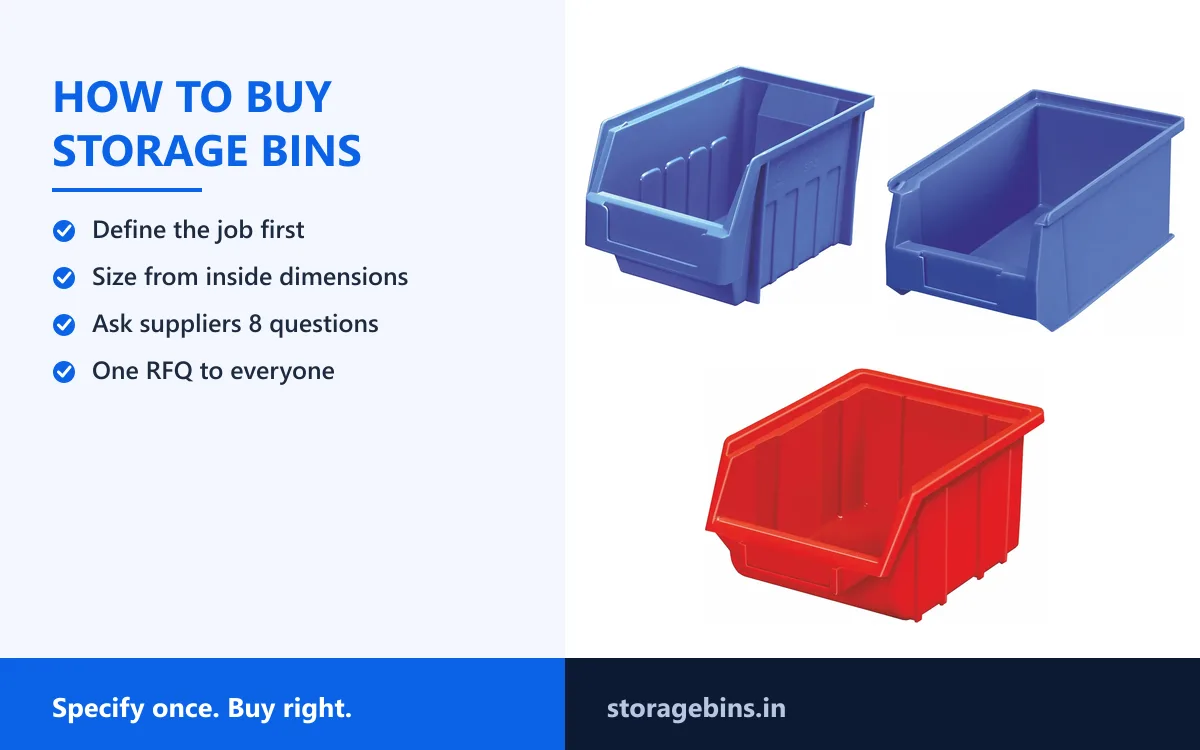
Most bin purchases go wrong in the specification, not the price. A buyer's checklist covering sizes, material, loads, accessories, packing and supplier questions, with an RFQ template you can copy and send.
Why bin purchases go wrong
A purchase manager who is asked to buy "two hundred storage bins" is being asked a question that cannot be answered. Which size? Which material? Which colour? With a lip for a louvre panel or without? For a shelf, a panel, a trolley or a floor? Stacking or not? With label holders or without? Partitions? Each answer changes the product, the supplier, the price and, above all, whether the bin will work.
The usual outcome is a quotation for the cheapest thing that fits the words in the request, a delivery of bins that look right and prove wrong, and a stores department that spends a year working around the mistake. A bin that is a few millimetres too shallow, a lip that does not match the panel, a colour that cannot be repeated, a size that is discontinued after six months: none of these shows up on the invoice, and all of them show up on the shop floor.
The remedy is a proper specification. It does not have to be long, and it does not require engineering knowledge. It requires answering a short list of questions, in writing, before any quotation is requested. This article gives that list, explains what each item means in practice and ends with a request-for-quotation template that you can adapt and send.
Step one: define the job, not the product
The most useful sentence in a specification is not about the bin at all. It describes the job. A bin that holds fasteners at a line-side station, a bin that carries kits from the stores to the line, a bin that holds reserve stock on pallet racking and a bin that holds pharmacy packs on a shelf are four different products, even if all of them are plastic boxes.
Write down, for each use: what is being stored, in what quantity, how it will be accessed, where the bin will sit, how often it will be moved and by whom. Include the unusual conditions: heat, cold, damp, dust, oil, washing, static sensitivity, food contact or a clean-room environment.
For example: "Bins to hold M6 to M10 fasteners at assembly stations, hung on louvre panels at chest height, accessed with one hand, filled from the stores in batches of 200, in a plant with ambient temperatures up to 45 degrees Celsius." That sentence tells a supplier, and you, nearly everything that matters.
Step two: size the bin from the part
Size is the heart of the specification, and it comes from the part. Measure the longest, widest and tallest dimension of the part as it lies in the bin, decide how many pieces you want to hold between refills, and match against the inside dimensions of the bin, not the outside.
The difference between inside and outside is not trivial. A Supra SB 2, for example, measures 170 x 100 x 85 mm outside and 157 x 80 x 75 mm inside, a loss of some 13 mm in length, 20 mm in width and 10 mm in height to walls and rim. A buyer who matches the outside dimension to the shelf and the inside dimension to the part gets both right, and one who mixes them up gets neither.
Leave a margin for a hand. A bin whose inside width is exactly the width of the part makes the part hard to remove, particularly with gloves. Allow ten to twenty millimetres, more for larger parts. And leave a margin below the brim, since nobody fills a bin to the top, and a bin filled that way spills.
Choose a small number of sizes. Three or four sizes in a family cover most of a store, and each additional size adds spare stock, labels and confusion. Our guide to choosing the right storage bin size sets out the method with worked examples.
Step three: choose the family and the mounting
A bin family is a set of sizes that share a design, a material and a set of accessories. ALKON, for example, makes Supra, Hippo, Bull, Rhino Tuff, Mammoth and Tote bins, Koala pick bins, Panda shelf bins and Roo tilt bins, each with its own proportions and uses. Choosing a family is a decision about mounting and access.
Ask how the bin will be held. A bin that hangs on a louvre panel or rail needs a rear lip made for it, and the product description says whether it has one. A bin that sits on a shelf needs a base that suits the shelf, and a stopper or safety stop if the shelf is angled or the bin is stacked. A bin that is carried needs a grip, a label holder and a stable base. A bin that stacks needs a stacking rim and, ideally, a stopper that stops stacked bins shifting forward.
Ask how the bin will be accessed. An open-front bin lets a hand reach in from the front, a tilted bin shows its contents from above and an open-top tote is filled and emptied from the top. A closed container with a lid protects contents but slows access.
Ask whether accessories exist. Partitions, label holders, panels, rails, stands, trolleys and shelving are what turn a bin into a system, and they have to fit. A family whose accessories are published and available is a sound basis, and a bin with no accessories is a dead end.
Step four: specify the material and the environment
Industrial storage bins are most commonly moulded from polypropylene, polyethylene or polystyrene, in virgin or recycled grades, and the material determines what the bin can take.
ALKON bins are moulded from polypropylene copolymer, which the catalogue describes as resistant to most industrial solvents and which carries the resin identification code 05, with a stated service range of -10 degrees Celsius to +70 degrees Celsius. That is a good general-purpose answer for most Indian plants, including those with hot sheds and monsoon humidity. For static-sensitive work, conductive versions in black are available. For food-related areas, the bins carry food-safe and recyclable marks, but suitability for direct food contact depends on the process and the rules that apply, so confirm with the supplier and your quality team.
Whatever the supplier, ask for the material by name, the temperature range, the chemical resistance and, if the application is unusual, a sample to test. A bin that cracks in the cold, fades in the sun or softens near heat is a bad buy at any price. Our article on plastic versus metal storage bins compares the materials and the situations where each is right.
State the environment in the specification: temperature range, humidity, dust, washing, chemicals, oils, static and clean-room needs. A supplier can only answer what they have been asked.
Step five: load, stacking and handling
Bins carry weight, and weight has limits. Ask for the load a bin can take, how many can be stacked and what the mounting can carry.
For a hanging bin, the limit is set by the louvre lips and the panel. ALKON publishes a load bearing chart for its Tuff louvre panels, giving the capacity of each panel and the maximum load per lip. For a bin on a shelf, the limit is the shelf, and the catalogue gives the permissible load for each Panda shelf size, from 70 to 90 kg depending on depth, with a bay limit of 1000 kg. For a stack, the limit is the bottom bin's rim.
Do the arithmetic for the heaviest case. Estimate the weight of the contents of a full bin, multiply by the number of bins on a panel, shelf or trolley, and compare with the published limit. Heavy items belong low, and a bin that one person cannot lift when full is too big for the job.
Handling matters too. A tote that will be carried needs grips and a weight a person can manage. A bin that will be washed needs a smooth interior. A bin that will go through a conveyor needs a flat, stable base.
Step six: labelling, colour and identification
A bin that cannot be identified is a box. Specify how each bin will be labelled and whether the bin has a holder for it. Most ALKON bins carry identification card holders as standard, which sounds minor and saves the cost and unreliability of stick-on labels.
Specify colours and what they will mean. Many industrial bins come in red and blue, some ranges in other colours and conductive bins in black. A colour should mean one thing: a part family, a supplier, a priority, a line or a status. State the colours you need and check that the supplier can repeat them, since a store that adds bins in a slightly different shade next year has a visible mismatch.
Specify the label format too. A printed label with the part code in large type, a short name and a location address, kept the same on every bin, is worth far more than the label holder alone. Our article on bin labelling and colour coding describes formats that work.
Step seven: packing, quantities and delivery
Packing affects cost and handling. Every ALKON bin has a published standard packing, for example 60 pieces to a carton for the Supra SB 1 and five for the larger SB 5 and SB 8, and a volume per carton. Check the carton quantities against your order, since ordering in whole cartons avoids part-carton premiums and damage.
Ask about freight. Bulky bins cost more to move than their weight suggests, and nesting designs, such as the Koala pick bins, which the catalogue says nest to cut transportation cost by almost 70 per cent, can change the delivered price. Compare delivered cost, not ex-works price.
Specify the delivery: the address, the schedule, whether phased deliveries are acceptable and who unloads. For a large order, phase it so that the store is not buried in cartons.
Specify what is supplied assembled and what is supplied in parts. Panels, stands, shelving and trolleys are typically supplied for assembly on site, with fittings included for standard kits. Check what is included and what you must supply, such as anchor bolts or tools.
Step eight: supplier questions that separate good from poor
A short list of questions, asked of every supplier, produces a good deal of information.
The answers reveal the supplier's seriousness. A supplier who gives dimensions, material and range without hesitation, offers a sample and has stocked the range for decades is a better partner than one who quotes a price and cannot say what the bin is made of. Shreeram Metafusion has been an authorised stockist of ALKON Plastics Pvt. Ltd. for over thirty years, and every product page on storagebins.in lists dimensions, packing and accessories.
- What is the bin made from, and what is its temperature range?
- What are the outside and inside dimensions, and the volume per carton?
- What accessories are available, and do they fit the whole range?
- Will the same bin be available in a year, and in five years?
- What are the packing quantities and the minimum order?
- Can I see and test a sample under my conditions?
- Who stands behind the product, and how long has the supplier been in the business?
- Can you give references from similar users?
Step nine: the sample and the trial
No specification survives contact with reality unchanged, and a sample finds the errors cheaply. Order a few bins of each size, hang or place them in the real position, fill them with real parts and use them for a week or two.
Look for the obvious: does the part fit, does the bin hang securely, does the label holder take your label, does the stack stand? And for the less obvious: can a gloved hand reach in, does the bin survive being dropped, does it stay in position when a trolley is pushed, how does it look after a week of dust and oil?
Test the extremes. Put a heavy load in one and check that the mounting holds. Leave one near a hot surface and one in the sun for a few days. Wipe one with the cleaner you use. A bin that passes these tests is one you can order in volume.
Record the results and adjust the specification before placing the main order. A trial costs little and saves a great deal.
Step ten: write the request for quotation
With the answers collected, the request for quotation writes itself. A good RFQ is short, specific and comparable: it tells every supplier the same thing, so that the quotations can be laid side by side.
A template that works for most purchases follows. Replace the bracketed text with your own details.
Ask each supplier to quote against the same list, with unit price, carton quantity, delivered cost and lead time, and to state anything they cannot meet. Compare the quotations on cost per usable location, not price per piece, as our article on the true cost of storage bins explains.
- Purpose: [what the bins will hold, where they will be used and how they will be mounted].
- Environment: [temperature range, humidity, dust, chemicals, washing, static, food contact].
- Items: for each line, [family and article number or size, inside dimensions required, quantity, colour].
- Accessories: [partitions, label holders, panels, rails, stands, trolleys, shelving, with quantities].
- Material and standards: [material, temperature range, any marks or certificates required].
- Loads: [heaviest filled bin, panel or shelf loading].
- Packing and delivery: [carton quantities acceptable, delivery address, schedule, phased or single delivery, unloading arrangements].
- Samples: [number of samples required before the main order and the timetable].
- Commercial terms: [validity of the quotation, payment terms, taxes, freight, warranty].
- Documents: [datasheets, dimension drawings, material information].
A filled-in example
Templates are easier to follow with an example. The following is an invented request for a small plant that wants to set up line-side storage for an assembly line, written in the form that suppliers find easiest to quote against.
Purpose: line-side storage of fasteners, clips and fittings at six assembly stations, hung on louvre panels at chest height, replenished from the stores every thirty minutes.
Environment: indoor, ambient up to 45 degrees Celsius in summer, dusty, no chemicals, no washing.
Items: Supra bins, hung on panels, in three sizes chosen from inside dimensions: SB 1 (inside 117 x 80 x 52 mm), 120 pieces; SB 2 (inside 157 x 80 x 75 mm), 120 pieces; SB 3 (inside 200 x 115 x 115 mm), 60 pieces. Colour: blue for common parts, red for variant-specific parts.
Accessories: twelve louvre panels in the size matching the stand, six stands, partitions for twelve SB 3 bins, and a Shop Floor Trolley with its panels for replenishment.
Material: polypropylene copolymer, stated service range at least -10 to +70 degrees Celsius; datasheet requested.
Loads: heaviest filled bin about 2 kg; total per panel to be checked against the published load chart.
Packing and delivery: whole cartons acceptable; delivery to the plant in two lots, three weeks apart; unloading by the plant.
Samples: three of each size and one panel, before the main order, within a week.
Commercial: quotation valid for thirty days; delivered price per unit, with carton quantity and lead time.
A supplier receiving that request can quote accurately, and a buyer receiving three such quotations can compare them in minutes. The same structure works for a store of ten thousand bins or a bench of fifty.
How to read a catalogue and a datasheet
A catalogue page is a compressed specification, and reading it carefully saves mistakes. A few items repay attention.
Dimensions come in two sets, outside and inside, written as length by width by height. The orientation matters: the length is the long side as seen from the front, and the height is measured from the base to the rim. The ALKON product pages also give an effective height for some bins, which is the usable height inside, and the volume per carton, which tells you how much space a delivery will take.
Standard packing is the carton quantity. It decides the minimum useful order and the freight.
Slots for partitions, where listed, tell you how many partitions the bin takes and in which direction. The Tote AK-421, for example, has three slots for horizontal partitions or one for a vertical partition, which limits how a tote can be divided.
Descriptions list features: a rear lip for panels, a stacking rim, a stopper, a safety stop at the back for shelf use, label holders and so on. Exceptions are noted, such as the bins in a range that lack the rear lip. Read them, because a bin without a lip will not hang on a panel.
Colour options and notes appear at the bottom, and the note that colours shown are similar but not exact to the actual product is worth remembering when a colour match matters.
If any of these is missing for a product you are considering, ask for it. A product with no published dimensions is a risk, and a supplier who cannot supply them is a warning.
Scoring a sample trial
A sample trial gives better answers when it is scored. A simple sheet with a row for each criterion and a column for each product turns impressions into numbers.
Criteria worth scoring include fit of the part, ease of removing the part with a gloved hand, security on the mounting, readability of the label, stability of a stack, resistance to a drop, appearance after a week of use, ease of cleaning and compatibility with the accessories. Score each from one to five, note anything unexpected and add a line for the supplier's responsiveness during the trial.
Run the trial in the real place with real parts and, where possible, real users. An operator who picks from a bin eight hours a day will notice what a manager does not. Ask them what they like and what annoys them, and write it down.
The trial also tests the supplier. Did the samples arrive when promised? Was the packing sound? Were questions answered promptly? A supplier who is slow and vague with a sample will be slower with an order.
Receiving and inspecting the delivery
The purchase is not finished until the goods are received and checked. A short inspection on arrival catches problems while they can still be fixed.
Count the cartons against the delivery note and the order. Open a sample from each size and each colour. Check the article numbers on the carton against the order. Measure a few bins against the published dimensions, and check the colour against the sample. Look for damage, such as cracks, warping or scuffing. Hang a bin on a panel and stack a few, to confirm that the lips and the stacking rims work.
Record the results, with photographs of any problem, and report it to the supplier at once. A claim made the same day is much easier to settle than one made a month later.
Store the cartons properly until use: in a dry place, away from heat and sunlight, stacked within the carton limits. Keep a small reserve of each size for replacements, labelled and in a known place.
Negotiating without losing the point
Price matters, and negotiating it is reasonable, but a few principles keep the negotiation useful.
Negotiate on the same specification. If one supplier offers a different bin at a lower price, they are not offering the same thing, and the comparison is not a discount. Ask each supplier to quote against the same list.
Negotiate on the whole package: price, carton quantity, delivery, payment terms, samples, support and continuity of supply. A small difference in unit price can be outweighed by freight, by the cost of a failed bin or by a supplier who disappears.
Volume and repeat business are legitimate levers. A standing order with phased deliveries gives the supplier predictability and may earn a better price than a one-off. A supplier who has stocked the range for thirty years is in a position to offer continuity, which is worth something.
Do not pay for what you do not need. A bin with features you will not use costs more. But do not strip out the label holder, the stacking rim or the partitions to save a little, since you will pay far more later to restore them.
Common mistakes buyers make
A handful of mistakes account for most bad purchases.
Buying by outside dimension is the first. The bin fits the shelf and not the part.
Buying by price alone is the second. The cheapest quotation is often a different, lesser product, and a comparison that stops at price per piece misses everything that matters over the bin's life.
Buying too many sizes is the third. A store with fourteen sizes from five suppliers cannot standardise labels, panels or spares.
Ignoring accessories is the fourth. A bin without partitions, panels or labels that fit is half a system.
Skipping the sample is the fifth. A week of testing finds the problem that a datasheet does not show.
Forgetting continuity is the sixth. A bin that is discontinued in a year leaves a store with mismatched replacements.
Neglecting the label is the seventh. A beautiful bin without a readable label is a hidden stockroom.
After the order: keeping the standard alive
A purchase is the start of a standard, not the end of a task. Within a year, bins crack, labels fade, new parts arrive and people change, and the standard decays unless someone keeps it.
Write the standard on a single page: the bin families and sizes chosen, the article numbers, the colours and their meanings, the label format, the location code and the count routine. Keep a copy in the stores, a copy in the purchase file and a copy with the person who trains new staff.
Reorder by article number from a list, not from memory. A list of the codes in use, with the typical monthly usage and a reorder quantity, turns replacement into a routine task and keeps the sizes consistent.
Review once a year. Look at what has changed, such as new parts, discontinued parts and new areas, and decide which sizes are still needed. Drop sizes that are rarely used, and add new ones deliberately, not by accident.
Keep a small reserve of each size, plus partitions and labels, so a damaged bin is replaced the same day. A store that has to reorder to replace one bin soon starts using odd containers, and the standard erodes one exception at a time.
A one-page checklist
Before you send the RFQ, tick each of these.
- The job is described in a sentence, including the environment.
- Each size is chosen from the part, using inside dimensions, with a margin for a hand.
- The family, the mounting and the access method are chosen and consistent.
- The material, temperature range and any special properties are stated.
- Loads are estimated for the heaviest case and checked against published limits.
- Labels, colours and their meanings are decided.
- Packing, carton quantities, freight and delivery are specified.
- Accessories are listed with quantities.
- A sample trial is planned before the main order.
- Supplier questions are ready, and the same RFQ goes to every supplier.
Where to go from here
If you would like a second pair of eyes on a specification, send us your parts list, your mounting arrangement and your conditions, and we will check sizes, suggest a family and list the accessories. Shreeram Metafusion Engineers supplies the full ALKON range from Vashi, Navi Mumbai, as authorised stockist of ALKON Plastics Pvt. Ltd. for over thirty years, and the product pages on this website list the dimensions, packing and accessories for every item mentioned here.
Read next