The true cost of storage bins: how to compare quotes and build a payback case
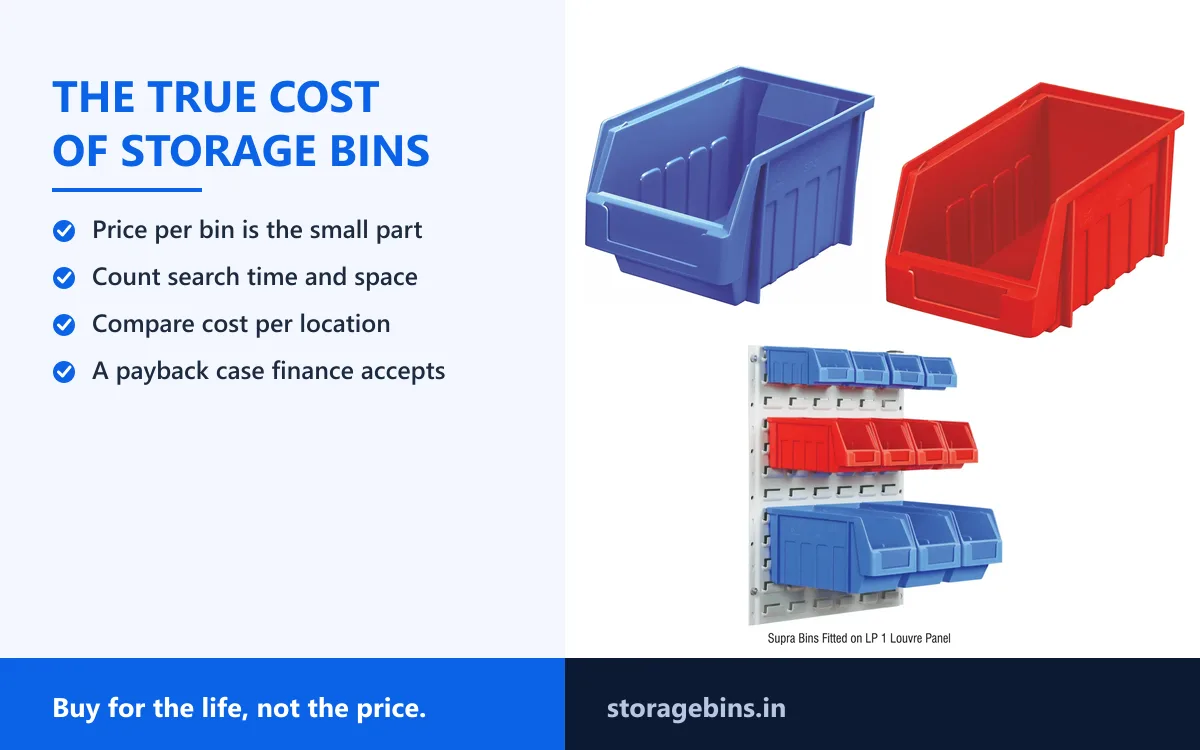
The price on the quotation is the smallest number in the decision. A practical method for comparing bin quotes on a like-for-like basis and for putting search time, floor space and stock errors into a payback case a finance head will accept.
Why the quotation is the wrong place to start
When a purchase manager receives three quotations for storage bins, the comparison usually happens in a single column: price per piece. The cheapest is shortlisted, the next is used to negotiate, and the third is quietly dropped. It is a reasonable way to buy a commodity whose pieces are interchangeable, such as a bag of cement or a standard fastener. It is a poor way to buy something that will sit on a shelf for ten years, shape how fast people find their parts and decide whether the store can be expanded without being rebuilt.
A storage bin is not a commodity in that sense, because its cost over its life depends on factors the quotation never mentions. How much floor and rack space does it use per litre of useful volume? How long does a person take to find a part in it, and to put one back? Will it still be available in the same size five years from now, so that new bins match old ones? Does it crack at the stacking rim after eighteen months, or does it keep going? How many different bin types does the store have to stock as spares? None of these shows up in a price per piece, and together they usually add up to many times the purchase cost.
This article sets out a way of thinking about the cost of a bin programme that is practical enough for a stores or purchase manager to use and rigorous enough to put in front of a finance head. It does not give prices, because those depend on quantity, colour and the day, but it does give the structure for comparing quotations on a like-for-like basis, the categories of cost that sit behind them and a template for a payback case. All figures in the worked examples are illustrative, chosen to make the arithmetic clear, and you should substitute your own.
The cost categories behind a bin
A useful way to organise the discussion is to list every cost a bin causes, from the day it is ordered to the day it is thrown away. There are seven families, and the purchase price is only the first.
Some of these are easy to put a number to and some are not, and part of the skill is knowing how much precision each deserves. Acquisition, space and durability can be estimated closely. Labour needs a measured sample. Errors and complexity are the hardest to quantify and the most often neglected, which is a good reason to treat them as upside in a business case instead of putting them in the central estimate.
- Acquisition: the price, freight, taxes, handling on arrival and any labels or fittings.
- Space: the floor and rack volume the bin occupies, whether it is full or empty.
- Labour: time to find, pick, put away, count and replenish parts in the bin.
- Errors: the cost of wrong picks, wrong counts and stock-outs that better containers would have prevented.
- Durability: the replacement cost caused by cracks, deformation, fading and loss.
- Complexity: the cost of managing many sizes, many suppliers and many spare parts.
- End of life: disposal, recycling or resale value at the end of use.
Acquisition cost: compare like with like
Before comparing quotations, make sure they describe the same thing. Several details commonly differ between bins that look alike in a photograph, and each changes the effective price.
Put the quotations into a table with a row for each of these and a column for each supplier. Most of the apparent price differences narrow or even reverse once the effective volume, the material and the features are normalised. A useful normalised measure is the cost per litre of inside volume, or the cost per usable location, which makes bins of different sizes comparable.
- Dimensions. Outside and inside dimensions differ, sometimes by a lot. A bin sold by its outside dimensions may have a smaller internal volume than a competitor's, because of thicker walls, a deeper rim or a sloped front. What a bin can hold is set by its inside dimensions, and the inside dimensions are what a fair comparison uses. ALKON publishes both for every bin, for example the Supra SB 2 at 170 x 100 x 85 mm outside and 157 x 80 x 75 mm inside, along with the standard carton quantity and the volume per carton.
- Material. Virgin polypropylene copolymer, recycled polypropylene and filled compounds behave differently under impact, cold and ultraviolet light. ALKON bins are moulded from polypropylene copolymer and carry the resin identification code 05. A quotation that does not name the material should be questioned.
- Weight. A heavier bin generally uses more material and often lasts longer, although weight alone does not prove quality. A bin that is noticeably lighter than its competitor for the same dimensions is using less plastic somewhere, and it is worth asking where.
- Features. A moulded rear lip for louvre panels, a stacking rim, label holders, partition slots and an anti-skid base are all things that either come with the bin or have to be added. A label holder that costs a few rupees each is not free if it has to be glued on 5,000 bins.
- Packing and carton quantities. A quotation by the piece and a quotation by the carton are not comparable until the carton size is known. A bin that nests or stacks compactly saves freight, and ALKON's Koala pick bins are designed to nest, which the catalogue says reduces transportation cost by almost 70 per cent compared with non-nesting bins.
- Terms. Delivery, payment terms, minimum order quantities and the ability to reorder identical bins later all carry value that the unit price hides.
Cost per location, not cost per bin
The number that matters in a store is not what a bin costs but what it costs to give one part number a safe, findable home. A part with a location has a bin, a share of a shelf or panel, a label and an address. Divide the whole cost of that set-up by the number of locations it creates and you have a cost per location, which is a far better figure for comparing two designs.
Consider two ways of holding a hundred small hardware items. The first uses a hundred loose cartons on slotted angle racks, at a very low cost per carton. The second uses a hundred Supra SB 2 bins on louvre panels with stands and labels. The second costs more per location up front. But the cartons need replacing when they soften, cannot be stacked or mounted vertically, have no label holder and hide their contents, so a person searching for an item must open several. The bins stack, mount, keep their shape and show their contents at a glance. Over several years, the cost per location of the bins usually falls well below that of the cartons once replacement and labour are included, even though it started higher.
The lesson is to compute over a time horizon. Choose a period that reflects the real life of the installation, perhaps five or seven years, and calculate every cost over that period for each option. A bin that costs 30 per cent more and lasts twice as long is cheaper, as long as the extra durability is real.
Space: the cost nobody invoices
Floor space is one of the most expensive resources in a plant or warehouse, and bins affect how well it is used. Space cost is easy to ignore because nobody pays a monthly bill labelled for it, but it is real whether the building is owned, leased or simply too small.
To estimate it, start with the cost of a square metre of covered space in your area, using your rent, or the notional rent of owned space, plus the cost of services such as lighting, cleaning and security. Divide by the usable shelf or rack volume per square metre to get a cost per cubic metre of storage per year. Then compare how many parts each option holds per cubic metre.
A store that uses well-fitted bins holds more per cubic metre than one that uses mismatched boxes. Bins sized to the part reduce dead air, bins that stack or mount on panels use vertical space that loose cartons waste, and a standardised family packs tightly on shelves with predictable pitch. ALKON's Panda shelf bins, for example, are made in a series of sizes sharing a common 315 mm or 415 mm length with a range of widths and depths, so a shelf can be filled in a regular grid.
Working through an illustrative case, suppose a store occupies 200 square metres and, by switching to a fitted bin system on tall shelving, releases 40 of them for other use, either as production space or to avoid hiring more. At a notional cost of a few hundred rupees per square metre per month, the saving runs to lakhs of rupees a year. The figure is illustrative, and yours will differ, but the shape of the argument holds. Space is often the largest single benefit of a bin programme and the one most readily overlooked.
Labour: the cost of a search
The second large benefit is time. People spend a surprising share of their working day looking for things, and a store layout built on fixed locations and visible bins cuts that time.
You do not have to guess. Time a sample. Pick twenty representative picks in the current store, from the moment a person starts looking to the moment the part is in their hand, and record the average. Do the same in a trial area set up with bins. A common outcome is that a pick which took two to three minutes in a cluttered store takes under one in an organised one, although the actual numbers depend on the store, and you should measure them rather than quote anyone else's.
Once you have a measured saving per pick, the rest is multiplication. If a store handles 150 picks a day and saves ninety seconds on each, that is about 225 minutes, nearly four hours a day. Multiply by the fully loaded hourly cost of the person, by the working days in a year, and you have an annual labour saving. For a store with two or three pickers the figure will usually dwarf the cost of the bins in the first year.
Be conservative. Count only the saving you can defend, such as the time actually measured, and ignore the more speculative effects. Also count the other direction: a good layout makes putaway, counting and replenishment faster too, but the benefit is smaller and harder to measure, so put it in the upside.
Remember to count the time of the people who are not in the store. A production operator who walks to the stores for a missing part, a maintenance planner who waits for an answer on stock availability and a purchase officer who chases an urgent order all lose time when the store is disorganised. These costs are real but diffuse, and they belong in the narrative of the business case even when they are not in the arithmetic.
Errors and stock-outs
Wrong picks, miscounts and stock-outs cost money in ways that are hard to trace to their cause. A line stops because a part was supposed to be in the store and was not. A wrong variant is fitted, and the rework takes a shift. An urgent purchase is made at a premium because the record said there were plenty. Each case has a real cost, and each is more likely in a store where parts are mixed, unlabelled or out of sight.
A bin programme reduces errors by giving each part one home, labelling it and making its contents visible. The effect is hard to forecast but easy to track after the fact. Keep a simple count of stock-out incidents, wrong picks and urgent purchases over a six-month baseline, and compare after the change. Attach a plausible cost to each, such as the cost of the stoppage per hour or the premium paid for urgent purchases, and use the difference as supporting evidence.
Cycle counting amplifies this effect. A store with labelled, fixed-location bins can count a few locations a day, catch discrepancies early and keep records trustworthy, as discussed in our guide to cycle counting with storage bins. Better records mean fewer emergency buys and less safety stock held against uncertainty. Reducing the safety stock held for a hundred parts by even a small percentage frees working capital, and that is a real financial benefit.
Durability and the cost of replacement
A bin that fails early is an expensive bin however low its price. The failures that matter are cracks at the rim or corners, warping under load or heat, fading and embrittlement from sunlight, and loss of the label holder. All are driven by material, wall thickness, design and the quality of moulding.
ALKON bins are moulded from polypropylene copolymer with a stated service range of -10 degrees Celsius to +70 degrees Celsius, reinforced bases, sides and stacking rims, and resistance to most industrial solvents. Those are facts about a specific product family and they are worth comparing against whatever else is on the table. Ask each supplier for the material, the temperature range, the load rating for stacking and a sample you can drop, stack and load for a week.
To bring durability into the arithmetic, estimate a replacement rate. If bin type A needs about 5 per cent replaced each year and bin type B needs 15 per cent, then over seven years type A needs roughly a third of its initial quantity replaced and type B needs a full complement. At equal starting prices, B is nearly twice as costly. The estimate is rough, but the order of magnitude is what matters.
Remember that replacement is not just the price of a new bin. It is the time to find the failed bin, move the contents, relabel the replacement, and, if the model has been discontinued, the cost of a mismatched bin that no longer fits the panel or the stack. That last point leads into the next category.
Complexity: the cost of many types
Every extra bin type a store holds adds cost in ways that rarely appear in a budget. Each needs its own spare stock, its own labels, its own entry in the buying system and its own place in the training of new staff. A store with four sizes from one supplier is easier to run than one with fourteen sizes from five.
Standardisation is therefore a financial strategy. Choose a family, such as the Supra range for small hardware, Panda shelf bins for shelving, and Mammoth or Tote bins for larger and reserve items, and keep to it. Parts that fit a standard bin family can move between locations without changing the container. Accessories such as partitions, louvre panels, rails, stands and trolleys are shared across the family, so a spare panel serves any bin in the range.
Standardisation also protects against supply risk. A supplier who has been in the business for decades and who stocks the full range is a safer partner than a trader who sells whatever is in the warehouse that month. ALKON describes itself as the manufacturer of the largest range of material handling bins in India, and Shreeram Metafusion has been an authorised stockist for over thirty years. Continuity of supply means that the bin you buy today can be matched five years from now, which is worth more than a small discount on a size that may be discontinued.
Freight, handling and the nesting advantage
Freight is a larger share of the cost of a bin than many buyers realise, because bins are bulky relative to their weight. A carton of sixty small bins occupies space that is mostly air. Freight is charged by volume or weight, so the more compactly a bin packs, the cheaper it is to move.
Two features change that. Stackable bins, which stack in use, usually pack no more efficiently in transit than they do in service. Nesting bins, which slot one inside another for transport and storage, pack far more tightly, and the saving shows up in the delivered price for orders shipped over distance and in the space they take while waiting for use. ALKON's Koala pick bins nest for exactly this reason. Our article on stackable versus nesting bins discusses where each type is the better choice.
Look at the standard carton quantity and the volume per carton, published for each ALKON bin, when comparing delivered cost. A bin with a lower unit price but a much larger carton volume may be the more expensive option once freight to your site is included. This is particularly relevant for multi-site buyers, who ship to several places and for whom freight can be the second largest element of the delivered price.
End of life: the part people forget
At the end of its life, a plastic bin has a value that a cardboard carton or a painted steel tray does not. Polypropylene is recyclable, and ALKON bins carry the recycling mark. A bin that has served for years can be sold by weight to a recycler. The sum is small, but it offsets part of the replacement cost and avoids disposal charges.
Bins that can be washed and reused also have a second life. A bin that has held oily parts for years can be cleaned and moved to a different job, whereas a cardboard carton is discarded. In a plant that reorganises regularly, the redeployment value is real. The bin is an asset that can be moved, not an expense that is consumed.
A template for the payback calculation
With the categories understood, the payback case can be built in a few lines. Use a spreadsheet with one column per option and one row per cost or benefit, over a fixed horizon.
Add the savings, subtract the running cost, and divide the initial cost by the net annual benefit to give a simple payback period. Add a column for a sensitivity case, for example with every saving cut by half, and see whether the project still pays back inside the horizon. A case that survives a fifty per cent haircut is one that finance will accept.
Present the figures in a single page. A finance head will ask three questions: what does it cost, what do we get and what could go wrong? Put the answers in that order, list the assumptions in a box at the bottom and show where each number came from. A measured pilot is the strongest evidence you can offer, so run one before you ask for the full budget.
- Initial cost: bins, panels, racks, labels, installation and training.
- Annual running cost: replacements, label reprints and spare stock.
- Annual labour saving: measured time saved per pick, multiplied by picks per year and the hourly cost.
- Annual space saving: square metres released multiplied by the cost per square metre.
- Annual error saving: the reduction in stock-outs, wrong picks and urgent purchases, multiplied by their cost.
- Working capital release: the reduction in safety stock, multiplied by the carrying cost.
- End-of-life value: the resale or recycling value at the end of the horizon.
Running a pilot that proves the case
A pilot makes the business case credible and gives you real numbers. Choose one zone of the store that is representative, such as the fast-moving small parts or a single production line's stores, and set it up properly with fitted bins, labels and a layout following the principles of 5S and of good bin sizing.
Measure before and after, using the same method both times. Pick time, stock-out incidents, wrong picks, space used and the time to count a location are all measurable. Run the pilot for four to six weeks so that the novelty wears off and the result reflects normal operation. Take photographs, because management is persuaded by a clean, labelled panel next to the old cluttered shelf more often than by a spreadsheet.
Use the pilot to test the bins as well. Fill a few to their stacking limit, mount them on panels under real loads, drop an empty one and see whether it survives, and leave a sample near a window for a few weeks. These tests cost almost nothing and tell you more about durability than any datasheet.
A worked illustration with round numbers
To see how the pieces fit, take a deliberately simple, invented case. A stores team of three handles about 120 picks a day from 600 small-parts locations. Today the parts sit in mixed cartons on slotted angle racks. The team proposes to move them into fitted bins on louvre panels and shelving, and asks for a budget.
A timing exercise on twenty picks shows an average of two minutes and forty seconds in the existing layout. A trial panel gives an average of one minute and ten seconds, a saving of ninety seconds a pick. At 120 picks a day that is 180 minutes, or three hours a day, over some 300 working days a year, which is 900 hours. Valued at a fully loaded hourly cost that the finance department can supply, that is the first line of the benefit.
The team also notes that the racks occupy 60 square metres and that the new layout would fit the same parts into about 40, releasing 20. They value that at the notional rent for the space. They count last year's incidents, which include eleven stock-outs that stopped a line for part of a shift and a handful of urgent purchases, and assume, conservatively, that the new layout prevents a third of them.
On the cost side they list the bins, panels, stands, labels, installation time and a year-one replacement allowance of a few per cent. They run the sum three ways: as measured, with the benefits halved, and with the benefits halved and the bin cost raised by a fifth. If the project still pays back inside three years in the harshest case, the decision is easy. If it pays back only in the optimistic case, the team knows it needs a smaller first phase or a better pilot.
None of the numbers above is a benchmark, and your results will differ. What matters is the method: measure, count, value, test the result against a pessimistic case and show your working.
Common objections and honest answers
Several objections come up regularly, and it helps to have considered them in advance.
- "The cheaper bin is the same thing." Sometimes it is. Test it. Compare inside dimensions, material, weight and a sample under load, and let the data decide. If the cheaper bin matches on all counts, buy it.
- "We have always used cartons." Cartons are cheap and have a place for transport and temporary storage. For permanent locations with frequent access, they cost more in the long run, and the evidence is in the time and space figures above.
- "We cannot afford to replace everything at once." Nobody should. Start with the busiest or most valuable zone, prove the benefit and extend. A phased programme also spreads the cost across budget periods.
- "Our parts keep changing." That is a case for modular systems, not against them. Bins on louvre panels and rails can be rearranged as the part range changes, which cartons and fixed shelving cannot.
- "How do we know the bins will last?" Ask for the material, the temperature range and the load rating, test a sample and look at the supplier's track record. A supplier that has stocked the same range for thirty years has an incentive to stand behind it.
What to ask a supplier before you order
A short list of questions separates a serious supplier from an opportunistic one, and the answers feed straight into the cost comparison.
A supplier who answers these directly, with published dimensions and a long record of supply, is one you can build a standard on. At storagebins.in every product page lists dimensions and packing, which is the information needed to complete the cost comparison without waiting for a quotation.
- What material is the bin moulded from, and what is its temperature range?
- What are the outside and inside dimensions, and the volume per carton?
- Is the bin available in the same size and colour in a year, and in five years?
- What accessories are available, such as partitions, label holders, louvre panels, rails and stands, and do they fit the whole range?
- Can I see a sample, and can I test it under my own conditions?
- What are the minimum order quantity, the delivery time and the terms for reordering?
- Who stands behind the product if there is a problem?
Putting the whole picture together
The purchase price of a bin is a small and visible part of a much larger cost picture. The bigger numbers sit in labour, space, errors, durability and complexity, and they tend to favour well-made, standardised, properly mounted bins over cheap, mismatched ones. A comparison that stops at the unit price systematically undervalues the better option, and a payback case that includes the other categories usually makes the argument for itself.
Start with a table that makes the quotations comparable. Compute the cost per location over a realistic horizon. Measure the time and space effects in a pilot. Build the payback case conservatively and show the sensitivity. And when you choose, choose a family you can stay with, from a supplier who will still be there when you need to add to it.
If you would like help comparing options for your store, Shreeram Metafusion Engineers can provide dimensions, packing details and layout suggestions from Vashi, Navi Mumbai. We have been an authorised stockist of ALKON Plastics Pvt. Ltd. for over thirty years, and the full catalogue of 476-plus products is described on the product pages of this website.
Read next