How to choose shelving for a stores room
Slotted angle is the right answer more often than suppliers admit, and the wrong answer in ways nobody warns you about. Here is how to decide between angle, boltless and moulded bin shelving.
The shelving nobody actually chose
Walk into almost any stores room in an Indian plant and you will find shelving that was never really selected. A run of slotted angle a fabricator put up when the shed was commissioned, two boltless bays bought in a hurry when the angle filled up, a steel almirah holding things nobody can name, and cartons on the floor because the last three items that arrived did not fit anywhere. A series of small urgent decisions added up to a room that is difficult to work in.
The cost shows up in places that are not obviously about shelving. A stores assistant hunts for a seal kit because it sits behind two cartons on a 600 mm deep shelf. A count runs long because half the items have no defined position. A fitter helps himself at night and leaves no record, because there is no single address the item belongs to. The instinct is to blame discipline; the real cause is usually that the storage was never matched to what is being stored.
This article is about choosing between the three things you will actually be quoted for: slotted angle, boltless or rivet shelving, and purpose-built moulded-bin shelving of the kind the Panda system is. Slotted angle is genuinely right for some jobs and you should buy it without apology when it is. Boltless is right for others. Bin shelving earns its place in a narrower band than its catalogue suggests, but inside that band it is hard to beat.
What slotted angle actually is, and how it is made
Slotted angle is the oldest and most adaptable of the three. It is an L-section steel angle with slots punched along both faces at a regular pitch, cut to length. Four verticals, horizontal braces, diagonal bracing at the back and sides, and a deck of your choosing make a bay, all held together with nuts and bolts through the slots. Because the slots run the full length of the member, a shelf can go more or less anywhere and a bay can be any height, width or depth.
Its character comes from how it is bought in India. In most towns it is not a packaged system but a commodity: angle from one source, plywood or steel deck from another, assembled by a local fabricator. That is why it is the default for a one-off problem. You need a 2.1 metre bay in an awkward corner with one deep level at the bottom for drums and four shallow levels above, by next Tuesday. No modular system beats that.
The weaknesses follow from the same freedom. There is no published load figure for a bay nobody designed, so capacity is whatever the fabricator suggests. Decks are often plywood or particle board, which sag, absorb moisture and fail at the fastener holes. Every cut end and punched slot is bare steel unless somebody paints it. And the structure depends on its bolts staying tight, which in a stores room with a trolley in the aisle is an assumption rather than a fact. One detail decides much of what follows: the diagonal bracing that carries the racking load usually shares slots with the shelf cross members, so no level can be moved later without touching it.
What boltless or rivet shelving actually is
Boltless shelving, sold in India as rivet shelving, is factory made. The uprights are angle or T-section posts punched with keyhole slots at a fixed pitch. The beams carry rivets at each end which drop into the keyholes and seat under load, so the frame goes up with a rubber mallet and no fasteners at all. A deck sits on the beams, usually a steel panel, plywood or particle board, and the beam forms a lip at the front and back of each level.
What you are buying is speed and repeatability: in our own experience a boltless bay goes up appreciably faster than the equivalent slotted-angle bay, because there is nothing to align and tighten. The geometry is identical bay to bay so labels line up, and the maker publishes a load figure per beam pair for each length. For cartons, drums of consumables and spares that arrive in a box and leave in it, boltless is usually the most sensible money in the room.
Two things are worth knowing before you order. A rivet seats downward and is held by load, so an upward blow can dislodge a beam; most systems offer a locking clip for exactly this reason and it is frequently left out of the first order. And the beam depth that makes the system rigid eats into the clear opening at every level, so you fit fewer levels in a given height than the upright pitch suggests. Ask for the clear opening, not the pitch, and ask for the deck capacity as well as the beam capacity, because the published figure is a pair of beams at a stated length and says nothing about what the board between them will take.
What purpose-built moulded-bin shelving actually is
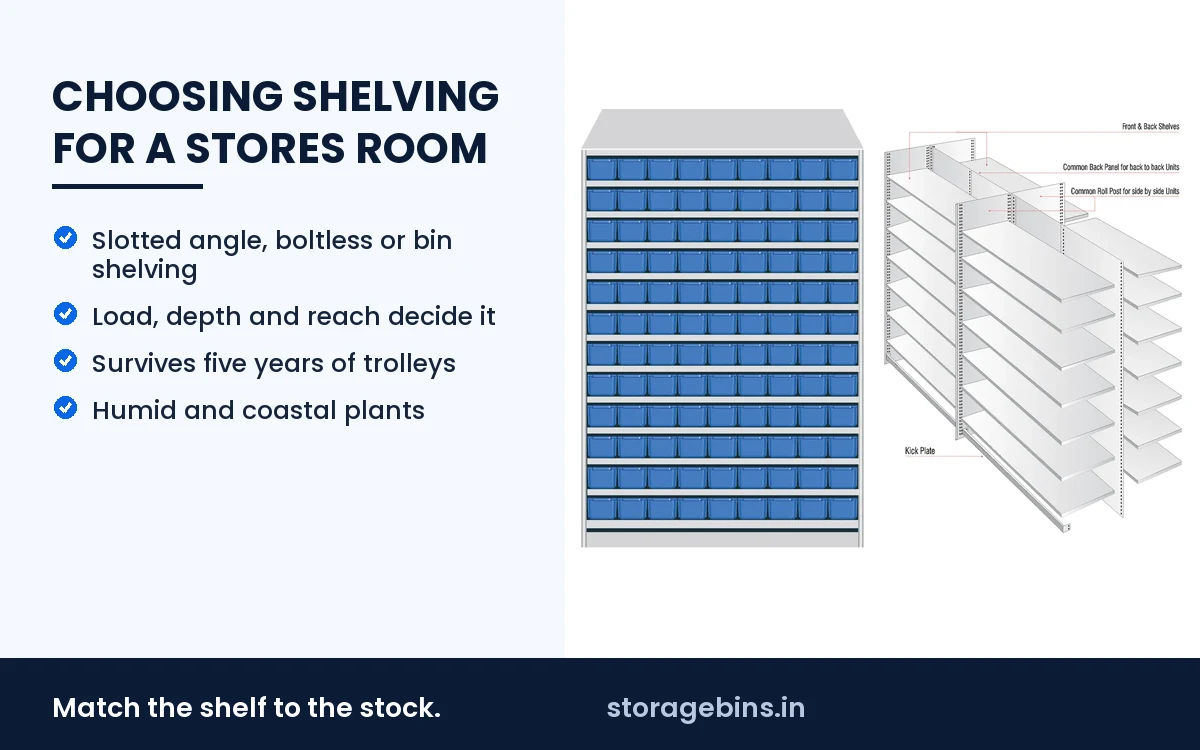
The third option is a shelving body designed from the start to hold moulded plastic bins at a fixed module, with the bins treated as part of the system rather than an afterthought. ALKON's Panda shelving is built this way. The uprights are one-piece roll posts with a rolled front edge of 20 mm diameter for strength, which also removes the sharp corner at the aisle. The shelves, posts, panels and kick plates are 0.8 mm CRCA steel, powder coated in light grey RAL 7035. Width is 900 mm as standard, heights are 1275, 1875, 2175 and 2375 mm, and depths are 300, 400, 450, 500 and 600 mm.
Shelf levels adjust in 25 mm increments and are held either with easy clips or with nuts and bolts. Each bay takes a kick plate 45 mm high at the base, which stops sweepings getting underneath. The back closes either with back panels, which ALKON states provide additional stability and prevent dust intrusion, or with back bracing in 2 mm CRCA steel, art no ASUBB, as the economical alternative; a 1275 mm bay takes one set and the taller heights take two.
The bins are the point of the system. Panda shelf bins are moulded in polypropylene copolymer in thirty standard sizes to suit the five shelf depths, with an integral back stop so contents stay visible, notched partitions that locate positively, and a deliberately small handle so most of the front face is free for a label. A PSB 301 measures 315 by 100 by 60 mm outside and 293 by 86 by 55 mm inside; at the other end a PSB 606 is 615 by 300 by 185 mm outside. The full ladder is on the Panda shelving systems page. The fixed module is the whole trade: you give up making any shelf any size, and in return every position is a defined, labelled, liftable container.
What a stores room is really holding
Before comparing systems, write down what is in the room, because almost every bad shelving purchase comes from sizing the whole room against one impression of it. An Indian engineering stores holds three different populations. Cartons and packaged goods, which want a flat deck. Loose small parts, the fasteners, seals, bushes, terminals and inserts that need a container and a label or they become a heap. And heavy slow movers, a spare gearbox, a motor, a drum of oil, which need load capacity far more than accessibility.
Write the three down with a share against each, measured in running metres of shelf they occupy rather than by part count. The shape that usually emerges is counter-intuitive: loose small parts take a great deal of the frontage and very little of the volume, while the heavy slow movers do the opposite and are touched rarely. Measure your own room rather than trusting that sentence; either way, the arithmetic is what tells you one shelf type cannot serve the whole room.
The fourth population is the one everybody forgets: items with no home at all, the ones on the floor and the window sill. Measure those too, because they are invisible in any walk-round and are the reason first estimates come out low. If you are sizing a maintenance store, the mix skews harder towards slow movers; the guide to organising a maintenance spares store deals with that case directly. Measure with a tape rather than from the stock ledger, which gives you part numbers and quantities but will not tell you that four of them are 1.8 metre lengths of busbar lying across the top of a bay.
Load per shelf, and the three ways it goes wrong
Published shelf capacity is a uniformly distributed load, and the qualifier is not decoration. ALKON states Panda shelf figures as UDL considering an L over 180 deflection, that is 5 mm across the 900 mm span, and they fall as the shelf gets deeper, from 90 kg on an ASUS 300 to 70 kg on an ASUS 600. The figure that decides a layout, and that no quotation carries, is the conversion to area: 90 kg on a 900 by 300 mm shelf is about 333 kg per square metre, while 70 kg on a 900 by 600 mm shelf is about 130 kg. The deep shelf is less than half as strong per square metre of deck, which runs backwards to how a deep shelf gets used.
The first way it goes wrong is reading the bay limit without the condition attached to it. ALKON quotes a maximum bay UDL of 1000 kg and specifies how many shelves must be bolted rather than clipped to reach it: four at 1275 mm, six at 1875 mm, seven at 2175 mm and eight at 2375 mm. A 1875 mm bay with nineteen 300 mm shelves totals 1710 kg of shelf capacity, so the bay figure governs and not the sum; and a run ordered on easy clips throughout has not met the condition the 1000 kg figure is quoted against.
The other two are the user's. The first is treating a distributed figure as a point figure: four castings of 20 kg set down mid-shelf on a 90 kg UDL shelf are a concentrated load over a fraction of the span, and the shelf takes a set it does not recover from. The second is that nobody weighs the load, and small dense items defeat appearance completely. Nine PSB 301 bins on a shelf rated 90 kg gives 10 kg per bin including the bin, ample for fasteners, but the same bin filled with stainless studs is another matter. Weigh one filled bin and multiply. For slotted angle, unless your fabricator states a UDL per level in writing, you do not have a load figure; you have a habit.
Depth and reach: why a deep shelf costs picking time
Deep shelving looks like good value because it buys volume per square metre of floor. For bulk storage it genuinely is. For anything picked more than occasionally it is one of the most expensive decisions in a stores room, and the cost is paid in seconds, every day, by somebody whose time nobody measures. A 600 mm deep shelf at chest height means reaching to the shoulder to touch the back, and one carton at the front makes the back half unreachable without a two-handed lift first.
The deeper problem is addressability. A 900 by 300 mm shelf holding nine PSB 301 bins across its width gives nine positions you can reach into, each with a label at the front. The same frontage at 600 mm deep gives more volume but no more reachable positions. So depth should follow the population: 300 mm and 400 mm for picked small parts, 500 mm and 600 mm for cartons and slow movers. The exception is a part consumed in full cartons, where a deep shelf holding four boxes nose to tail beats four shallow positions, because replenishment is one movement and the picker never searches. Depth also sets what the aisle has to be, which is the cost people forget when they buy depth to save floor, so draw the comparison across the whole aisle and not the single bay.
Adjustability, and what it costs to re-pitch a bay later
Every supplier claims adjustability and the claim is nearly meaningless alone. The real question is what it costs to change the pitch of a bay two years after installation, when it is full, in an aisle people are still using. Slotted angle is theoretically the most adjustable and practically the least. Moving one level means unbolting it, which often means loosening bracing that shares the same holes, which means unloading and partly dismantling the bay.
Boltless sits in the middle: lifting a beam pair off its keyholes is quick, but the pitch is fixed by the punching. Panda shelving adjusts in 25 mm increments, which is fine enough to be useful in practice rather than in principle. The increment matters because bin heights step in defined amounts. Going from a 110 mm bin such as a PSB 303 to a 185 mm bin such as a PSB 306 needs 75 mm more clear height, which is exactly three increments, and going back frees the same.
Because the shelf lifts off its clips and the bins lift out by hand, re-pitching a Panda bay needs no cutting, no drilling and no fabricator on site, and a spanner only for the levels that are bolted. That is the only sense in which adjustability is worth paying for. Whichever system you choose, budget for the re-pitch. Keep spare shelves of the depth you use, keep the clips, and keep the labelling format so a re-pitched bay can be re-addressed without reprinting the run.
Five years of being bumped by a trolley
Nothing in a stores room is treated gently. A pallet truck clips the upright at the aisle end, a trolley is reversed into a bay, a fitter stands on the second level because the step ladder is elsewhere. Choose on the basis that all of it will happen.
Slotted angle ages through its fasteners. Repeated impact works bolts loose, loose bolts let the frame rack out of square, and an out-of-square bay puts load on bracing it was not meant to carry. The failure is almost invisible until somebody notices a bay leaning. The remedy is cheap: walk the run once a quarter with a spanner. We have seen slotted-angle runs in customers' stores still square and in service after twenty years because somebody did exactly that. Plywood decks are the other ageing point. Boltless ages at the rivet seat instead, which is why locking clips are worth the extra line.
Moulded bin shelving ages in two separate materials and that is the honest way to assess it. The steel body dents and the powder coat chips, and the rolled front edge on a Panda roll post is doing real work here, turning the exposed aisle corner into a radius instead of an edge. The bins are a consumable and should be budgeted as one. A polypropylene bin cracked at the lip will fail again and does not belong back in the bay. How the two materials age is set out in the article on plastic against metal storage bins.
Corrosion in coastal and humid plants
If your plant is in Navi Mumbai, Chennai, Kochi or anywhere else within reach of salt-laden air, corrosion is a specification input rather than a maintenance detail, and the same is true inland with a wet process, a cooling tower upwind, or a monsoon roof that drips. Whether a bay is still sound in a decade or rusting at the joints long before that is decided at the quotation stage and never revisited.
Protection fails at edges, cuts and holes, not in the middle of a sheet. That is the argument against buying slotted angle unfinished and cutting it to length on site. Every cut end, punched slot and drilled hole is bare steel, and in a humid stores room rust starts there and creeps under whatever paint was applied afterwards. If slotted angle is right for a job in a coastal plant, specify how the cut ends will be treated and insist it is done before assembly, not touched up after.
Factory-finished systems are better placed because the coating is applied under control. Panda components are powder coated in light grey RAL 7035, the shelves, posts and panels in 0.8 mm CRCA steel and the back bracing in 2 mm, and the posts are one piece, so there are fewer cut faces to begin with. That is a reason to prefer a finished system in a damp plant; it is not a claim that any coating is immune. The part of the stores indifferent to humidity is the bins: Panda shelf bins are polypropylene copolymer, stated to resist most industrial solvents, and they do not rust. In a coastal plant that argues for pushing more of the small-parts population into bins.
Dust, cleaning and where open steel is a problem
Open shelving is the least costly way to store things and the worst way to keep them clean. Next to a grinding bay, a foundry, or at the open end of a shed on a dusty estate, everything on an open shelf acquires a film within days. For cartons that is cosmetic. For an open seal kit, a bearing, a PCB or an unpackaged instrument it is a defect waiting to be fitted into a machine.
The mistake is to treat this as housekeeping and schedule more cleaning, which is slow, is skipped under pressure, and moves items out of position. The better answer is to reduce the number of surfaces needing cleaning. A bin that is lifted out, tipped out, wiped and replaced is cleaned in seconds; a shelf with forty loose items on it is dusted around. Closing the back helps too, which is why panels beat the cheaper bracing in a dusty area.
Where contents must be protected, there are lockable doors for the Panda system in two heights, art no ASUD 1275 and ASUD 1875, powder coated in the same colour as the shelves and supplied with sixteen sets of bolts and nuts. Two constraints matter before you plan a run around them. Doors can only be fitted on every alternate bay, and because they pivot on two lintels, the top in line with the top shelf and the bottom at base level, usable height inside the bay is reduced. And wherever a wash-down is used, board decks and untreated cut edges are finished, dust or no dust.
How bins change the calculation
The biggest variable in this comparison is not the shelving at all. It is whether a shelf holds loose items or holds bins: loose items store volume and nothing else, with no address, no label position and no way to see that something is running out, while bins store addressable positions, which is what a picker and a stock record both work in.
Do the arithmetic on your own parts. Work out pieces per litre for the part you issue most often and read it against the bin's inside volume. A PSB 301 gives 1.39 litres inside, so a part running at 110 to the litre fills it at roughly 150 pieces; a line consuming 25 a day on weekly replenishment needs 175, which puts the 301 one size short and the PSB 302, same 315 by 100 mm footprint at 110 mm high and 2.65 litres, comfortably right. The method behind that step, including the fill line you should never size past, is worked through in the guide on choosing the right storage bin size.
Partitions change the same arithmetic again. A PSB 301 is supplied with three horizontal partitions and has seven slots for them, so a single 315 mm bin can become four narrow compartments for four low-volume part numbers. The honest limit is that bins only help where the items suit them. A 1.5 metre length of channel, a coil of welding cable, a spare pump casing and a drum of oil do not go in a bin, and bin shelving is wasted on that part of the room.
The fourth option, which is not shelving
Bins with a rear lip hang straight onto a louvre panel or a universal rail, and because an AUR-1 rail mounts on walls, benches and slotted angle systems alike, a stores room already full of serviceable slotted angle can buy labelled pick positions by bolting rails to the structure it owns instead of buying a new bay. The panel sizes, lip counts and bins-per-panel tables are on the louvre panels, rails and stands page.
Floor-space arithmetic for one bay
The only fair way to compare these options is per square metre of floor occupied, because that is the resource you cannot buy more of. A standard Panda bay at 900 mm wide and 300 mm deep has a footprint of 0.27 square metres. The aisle is shared and should be apportioned separately, but bay against bay the footprint is the honest unit.
Now count positions. Shelving unit ASU 1 is a 1275 mm body, art no ASUB 123, with thirteen ASUS 300 shelves, a kick plate and nine PSB 301 bins per shelf, and the published total is 108 bins rather than 117, because one level in every configuration carries no bins: nine bins on twelve of the thirteen levels. The same rule holds up the range: ASU 31 on an ASUB 183 body carries nineteen shelves and 162 bins, ASU 61 on an ASUB 213 body twenty-two shelves and 189 bins, and ASU 91 on an ASUB 233 body twenty-four shelves and 207 bins. That is 400, 600, 700 and 767 addressable positions per square metre of floor, in the same 0.27 square metres.
Now do the same bay by volume, because positions and volume pull in opposite directions. A PSB 301 holds 1.39 litres inside, so ASU 31 with 162 of them holds about 225 litres. ASU 33, same 1875 mm body and 300 mm depth, carries thirteen shelves with six PSB 303 bins each, 72 bins at 4.18 litres, about 301 litres. ASU 36 carries nine shelves with three PSB 306 bins each, 24 bins at 14.87 litres, about 357 litres. The same footprint gives you either 162 small positions or 24 large ones with more than half again the volume.
Depth moves the numbers again. ASU 39 at 400 mm deep carries thirteen ASUS 400 shelves with six PSB 403 bins each, 72 bins at 5.61 litres, about 404 litres in 0.36 square metres. ASU 60 at 600 mm deep carries nine ASUS 600 shelves with three PSB 606 bins each, 24 bins at 30.1 litres, about 722 litres in 0.54 square metres. Count your part numbers and your litres, and let the scarcer one decide.
Assembly, relocation and the bay nobody can move
Assembly cost is the line nobody puts in the quotation, and relocation cost is the one nobody thinks about until the layout changes. Slotted angle is slow to erect because every connection is a bolt, and slower still to move because the frame was cut for one place. Boltless is the fastest of the three to erect and to take down, and moulded bin shelving sits between them with a bolt count that depends on how it is specified.
Panda shelves can be held with easy clips, which is quick, or with nuts and bolts, which is slower and is what the 1000 kg bay figure assumes for the specified number of levels. Extending a run tells the same story: an extended back panel comes as a set of two pieces, 482 mm and 457 mm wide, and ASUEBP 1275 needs 28 sets of ASUBN M6 by 12 mm pan head nuts and bolts ordered separately, rising to 42 sets at 1875 mm, 50 at 2175 mm and 56 at 2375 mm. That is a published cost, and the fitting work behind it has to appear in somebody's plan too.
The add-on economics change the unit price as a run grows. To put two Panda bays back to back you buy one standard unit and then only roll posts, shelves and a kick plate for the second, saving the back panels entirely. Side by side, you buy one standard unit and then an extended back panel with a single roll post, shelves and a kick plate, saving one roll post. Price the run you will have in two years, not the bay you need this month. And consider the bay nobody can move: a fabricated run bolted to the floor and the wall is effectively permanent, which is acceptable for a bulk store and poor for a pick face.
A decision table, in words
Put the three systems against the populations you measured and the answers come out plainly. Buy slotted angle when you need an odd size, a one-off bay in an awkward space, a mixed-depth bay, or a quick local answer for heavy slow movers. Specify how cut ends will be treated if the plant is damp, and get a written load figure per level.
Buy boltless or rivet shelving when the population is cartons and packaged goods, when the run is long and repetitive, when bays may be rearranged, and when you want a published load figure without a fabricator on site. Add the locking clips, ask for the clear opening and the beam capacity at the length you are buying, and specify a steel deck rather than board if the room is humid.
Buy purpose-built bin shelving when the population is loose small parts picked regularly, when part numbers outnumber cubic metres, when every item needs a defined address and a label face, and when the floor is scarcer than the money. Keep it to 300 mm and 400 mm depths in a pick face, standardise on three or four bin sizes, and hold a buffer of each.
The common case is all three in one room, and that is not a planning failure. A sensible stores room has a bulk zone of boltless or slotted angle bays at the far end, a pick face of bin shelving near the issue counter, and rails beside the counter for the items issued every hour.
- Odd sizes, mixed-depth bays, one-off corners, heavy slow movers: slotted angle
- Cartons, long repetitive runs, bays that will be rearranged: boltless or rivet
- Loose small parts picked daily, many part numbers, scarce floor: moulded bin shelving
- The fastest-moving items at a bench or counter: louvre panels or rails, no bay at all
- Damp, coastal or wash-down areas: factory-finished steel and plastic bins, never board decks
- Anything that must be locked or kept clean: closed back and doors, planned on alternate bays
What to specify when you ask for a quotation
Most disappointing shelving purchases trace back to an enquiry that asked for a quantity rather than a specification. Send the numbers you measured instead: the clear height under the lowest obstruction, usually a beam, a duct or a light fitting rather than the roof, the aisle width you intend to keep, and the floor condition. Then specify per zone, giving the population, the heaviest item and its weight, the depth and the number of levels, and ask for a UDL per level, a bay total and the clear opening at each level rather than the pitch.
Specify the accessories in the same enquiry, because they are what makes a run hold its shape. For a Panda run that means kick plates at 45 mm, back panels or bracing, free-standing partitions as ASUSFSP 153 and 253 (150 and 250 mm high) for 300 mm shelves and 154 and 254 for 400 mm, and bin fronts at 85 and 135 mm high by 900 mm wide, listed as ASUSBF on the components sheet and ASUBF on the pigeon-hole sheets, so quote the height as well as the code. Add Panda bin stoppers, art no PSBS, which form an integrated rear lip so a bin cannot come out unless tilted up; two on the 304, 305 and 306 in every depth, one on the rest.
Ask what is supplied and what is not, because fasteners for extended back panels are ordered separately and a missing bag of M6 bolts stops a Saturday installation, and ask for a sample of each candidate bin before ordering a carton. For fixed locations without bins, ask about the pigeon hole version: ASUS 300 PH and ASUS 400 PH shelves with fixed partitions 295 mm high, giving a usable 270 mm between shelves.
Shreeram Metafusion Engineers Pvt. Ltd. has been an authorised stockist and supplier of ALKON Plastics Pvt. Ltd. for over thirty years, with 476 products listed across nine categories: material handling bins and accessories, Panda shelf bins and shelving, Roo tilt bins, Visipro rack protectors and deflectors, component organisers, ESD safe products, storage systems, Koala pick bins and other products. The range is stocked in Vashi, Navi Mumbai, and the team can be reached on 93266 29967 or at enquiry@shreeram-metafusion.com. Bring your clear height, your three population figures and a handful of the actual parts.
Read next