ABC-VED analysis for maintenance spares: how to decide what to stock, where and how often to count
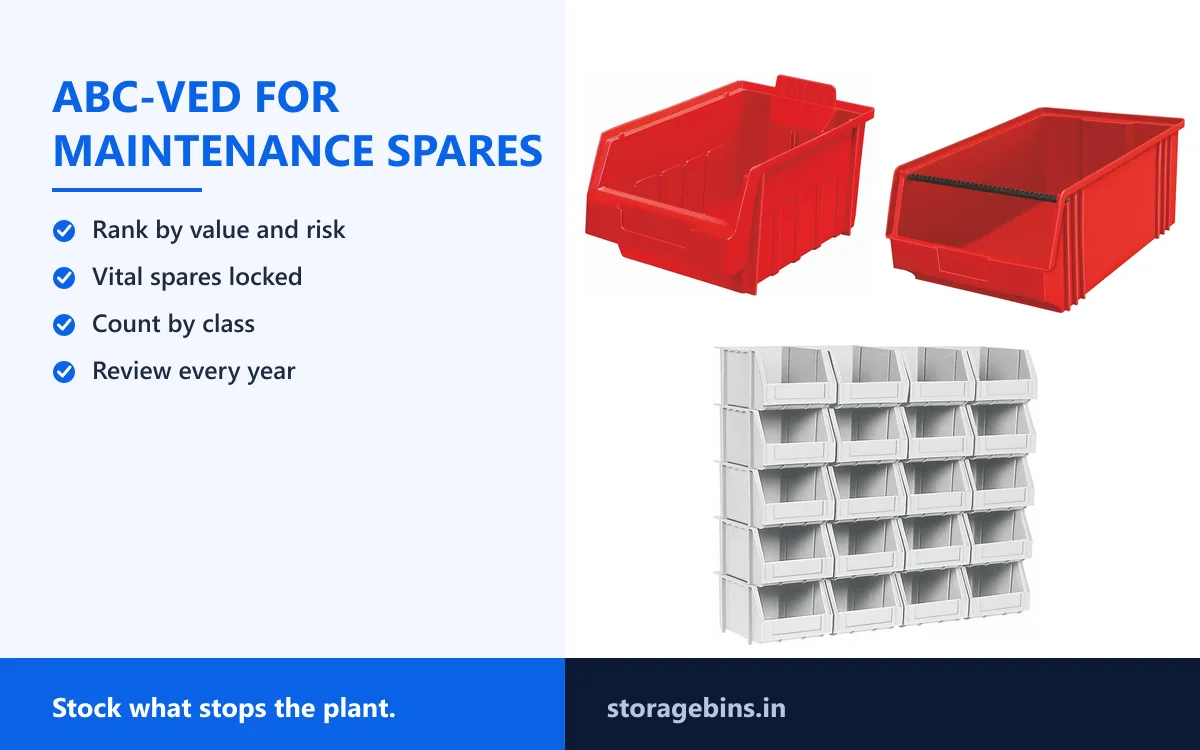
A maintenance store cannot treat every spare alike. ABC-VED analysis ranks parts by value and by how badly a plant needs them, and turns the ranking into rules for stocking, storage and counting, cutting stock-outs of critical parts and dead stock of everything else.
Two kinds of mistake in the same store
Walk through the maintenance store of almost any plant and you can find both. On one shelf, a pile of items that have not moved in years: a box of gaskets for a machine sold in the last decade, forty bearings of a size nobody uses, a spare motor for a line that was reconfigured. On another, a gap where a part should be: the special seal set for the main compressor, the control card for the packaging line, a spare coupling for the largest pump. The first mistake ties up cash and space. The second can stop a plant.
The two mistakes have the same root: the store treats every part the same. A fastener that costs ten paise and a gearbox that costs ten lakh are counted on the same schedule, filed in the same way and ordered on the same rule. A part whose absence would shut the plant is stocked as casually as a part whose absence would inconvenience a fitter.
ABC-VED analysis is the standard way to stop doing that. It classifies spares by two independent questions, how much money they represent and how badly the plant needs them, and then applies different rules to each class. The method is simple enough to do with a spreadsheet and a few conversations, and it gives a maintenance team a defensible answer to the most awkward question a manager can ask: why are we holding this, and why did we not have that?
This article explains the method for Indian plants, with the arithmetic, the decisions and the storage that follows. It describes good practice in general terms and does not replace the judgement of your own maintenance and engineering teams.
ABC: classifying by value
The first dimension, ABC, ranks items by annual consumption value, the money passing through the store in a year for each item. It is the same idea that drives cycle counting, and it uses the Pareto principle: a small number of items account for most of the value.
To do it, list each spare with its annual usage and unit cost, multiply to get the annual consumption value, sort from highest to lowest and calculate the cumulative share of the total. The usual cut-offs are rough: class A is the top items that account for about seventy to eighty per cent of the value, class B the next fifteen to twenty per cent and class C the long tail that accounts for the last five to ten per cent.
In a typical maintenance store, class A is perhaps ten per cent of the lines, class B twenty per cent and class C seventy per cent. Class A deserves close control and frequent counting, since money is concentrated there. Class C deserves light control, since there is little money in it, and a lot of lines.
A weakness of pure ABC is that it ignores criticality. A cheap relay that stops a line is class C, because it is cheap and rarely used, and yet it matters enormously. That is why ABC alone is not enough for maintenance spares, and why VED is added.
VED: classifying by criticality
The second dimension, VED, ranks items by how essential they are: vital, essential and desirable. It is a judgement, not a calculation, and it is made by the maintenance and production people who know the plant.
Vital spares are those whose absence would stop production or create a serious safety, environmental or quality problem, and which cannot be quickly obtained or substituted. A main drive motor's bearing set, a critical valve's seal kit, a control card for a line with no backup, a safety interlock component: these are vital.
Essential spares are those whose absence would cause significant disruption or loss, but not a complete stop, or whose absence could be tolerated for a short time or covered by a workaround. A standard bearing for a common machine, a belt that can be borrowed from another line for a day: these are essential.
Desirable spares are those whose absence would cause little or no disruption, or which are easily available locally at short notice. General fasteners, common consumables, standard fittings and items sold in every hardware market fall here.
The judgement uses a few questions about each part. What happens to production if it is missing? How long can we cope? Is there a substitute? How long does it take to buy, and from where? Is the item standard or special? What are the safety and quality consequences?
Combining the two: the matrix
Put the two classifications together and each spare lands in one of nine cells. The matrix guides stocking decisions.
Items that are vital and class A, expensive and critical, such as a large motor or a specialised gearbox, deserve careful thought. They cannot be ignored, but they cost a great deal to hold. Options include holding one spare, sharing a spare between sites or machines, agreeing a supplier's guaranteed delivery or buying insurance spares only for the most critical machines. Each decision should be made explicitly and reviewed.
Vital items of class B or C, cheap or moderate and critical, such as a special seal kit or a control card, are the easy case: hold them. The cost is small and the benefit is large. These are the items most often missing from stores that count only by value.
Essential items are stocked according to usage and lead time, with minimum and maximum levels set from consumption. Class A essentials need tight control, and class C essentials need little.
Desirable items are the ones to minimise. Class C desirables, the fasteners, washers and standard consumables, can be controlled by a simple two-bin system or by a periodic top-up, with no need for detailed records. Class A desirables, expensive but non-critical, should be bought only when needed, since the market can supply them quickly.
A short matrix, printed on one page and agreed by maintenance, stores and finance, becomes the rule book for the store.
Doing the exercise in practice
The method sounds large, and for a store with eight thousand lines it can be. A practical approach makes it manageable.
Begin with the data. Export the stock list with annual usage, unit cost and lead time. Clean it up: merge duplicate codes, remove items that no longer exist and fill in missing prices. A rough price is better than none.
Do the ABC calculation in a spreadsheet. Sort, accumulate and mark the classes. It takes an afternoon.
Do the VED classification with a small group. Gather the maintenance manager, a few senior technicians, a production representative and the stores officer. Do not go through every line. Begin with class A items, and then take class B, where criticality matters most. For class C, classify by machine or by family rather than by item: for instance, all standard fasteners are desirable, and all seals for the main compressor are vital.
Record the reasoning, not just the letter. A note next to each vital item saying why it is vital, which machine it serves and what the lead time is makes the list defensible and reviewable.
Review with finance. Show the total value held in each cell, and the value of items that look surplus. The picture usually surprises people, and starts useful arguments.
Setting stocking rules for each class
With the matrix filled in, write a rule for each cell. Rules need not be elaborate, but they should be written down.
For vital items, define the holding quantity: usually one set, or more where failure is likely, and where the machine runs in a harsh environment. Define who may issue them, usually with a supervisor's signature, and how replacements are triggered: as soon as a vital spare is used, a purchase request is raised automatically.
For essential items, set minimum and maximum levels from consumption and lead time. A minimum covers the usage during the lead time plus a safety margin, and the maximum is the minimum plus a sensible order quantity. Review annually.
For desirable items, keep stock low. Use a two-bin system for the commonest, as our article on two-bin kanban describes, and buy the rest on demand.
For slow-moving and obsolete items, apply the red-tag rules in our article on dead stock clean-ups: review at least yearly, and decide whether to keep, return, sell or scrap.
Review the whole classification periodically, say annually. Machines are replaced, processes change and suppliers come and go, and an item that was vital last year may be only essential now.
Counting by class
Cycle counting follows the classification, with more attention where it matters.
Class A items are counted most often, monthly or even fortnightly, since a small error is a large sum. Vital items, whatever their value class, are counted with the same frequency, because their absence is the biggest risk, and the count includes a check of condition and shelf life.
Class B items are counted quarterly, and class C items once or twice a year, in bulk, using standard fills and weight where parts are uniform. Our article on cycle counting with storage bins describes the routine: a blind count, a recount rule, a variance log and tolerances by value.
Add event-driven counts. Count a vital spare whenever it is issued or returned, count a location after a stock-out and count items received in large lots.
Record the count date on the location label or in the system, so that an overdue item stands out.
Storing by class
The classification suggests where and how each class should be stored.
Vital spares deserve protected, labelled, dedicated places. A lockable cabinet, a locked drawer system or Panda shelving with lockable doors, labelled with the machine, the part number, the date of the last check and the owner, keeps them safe from casual use. Store sensitive items, such as electronic cards and rubber seals, in their original packaging, in the right conditions, and away from heat, damp and dust. Our article on FIFO and FEFO describes how to look after parts that age.
Fast-moving essentials and desirables belong near the point of use, in bins on panels and shelves that can be reached without a ladder. Supra, Hippo and Bull bins on louvre panels, and Panda shelving with shelf bins in a regular grid, give each its own labelled place, as in our article on organising a maintenance spares store.
Slow movers go in dense, orderly storage, counted but not visited daily: pigeon hole shelves for boxed items, tall shelving bays up to 2375 mm, and the heaviest on the lowest shelves within the published loads of 70 to 90 kg per shelf and 1000 kg per bay.
Heavy spares, such as motors, gearbox parts and large couplings, may need pallet racking, pallet trucks or hoists. Keep them near the maintenance workshop, labelled with the machine, and record their weight on the label.
Colour can reinforce the classification. A coloured label or bin for vital spares, for example red, makes them stand out at a glance, and a different colour for fast-moving essentials helps the picker. Keep the scheme simple, and write the key on the wall, as our article on bin labelling and colour coding explains.
Lead time and the cost of waiting
The VED judgement depends heavily on lead time. A critical item that can be bought tomorrow from a local supplier does not need to be stocked, but one that takes six months to arrive from overseas, or that is made to order, does.
For each vital and essential item, record the lead time and the source. Ask the supplier for a realistic figure, not the quoted one, and check the history: how long did the last order actually take? Note where the item is single-sourced, imported or made to order, since those are the ones that bite.
Compare the cost of holding with the cost of waiting. A spare worth five lakh that is held for ten years carries holding costs, in capital, space and risk of deterioration. A stoppage of two days at a line that earns a few lakh a day costs more. The decision to hold depends on the probability of failure and the cost of downtime, and the maintenance team's records of past failures are the best evidence.
Consider alternatives to holding. Some suppliers offer consignment stock, guaranteed delivery times or exchange schemes. Some spares can be shared between plants of the same group. Some can be repaired, not replaced. Each can reduce the need to hold, and the matrix should record the chosen approach.
Insurance spares, shared spares and rotating stock
Some of the hardest decisions in a maintenance store concern the spares that are expensive and vital: the insurance spares. A few approaches help.
Insurance spares are kept not to be used but to be available if a rare failure occurs. Their holding cost is the premium, and the benefit is avoided downtime. Decide each case explicitly, with the maintenance manager and finance, on the basis of the machine's criticality, the likelihood of failure, the lead time and the cost of downtime. Record the decision and the reasoning, and review it yearly.
Shared spares reduce the cost. Where several machines use the same part, one spare serves them all, as long as the part really is common, and the sharing is recorded on the label. Where several plants of the same group use the same equipment, one spare held centrally, with an agreed transport time, may be enough. The sharing needs a clear owner and a rule for priority when two plants need the spare at once.
Rotating spares are those that are overhauled and returned, such as motors, pumps and gearboxes. A spare unit is installed, the failed unit is repaired and becomes the new spare. Track each unit by serial number, record its condition and repair history, and store it properly: shaft turned periodically, bearings greased, protected from damp and dust, as the maker advises.
Storage conditions matter more for insurance spares than for any other class, since they sit longest. Keep them clean, dry and protected, in their original packaging where possible, and schedule a periodic check, with a record, that they are complete and in good condition. A vital spare found corroded when it is finally needed is the worst result of all.
Reading the data: what the numbers can and cannot tell you
ABC-VED depends on data, and data in maintenance stores is often thin. A few cautions help.
Usage history is a poor guide to vital spares. A part that has never been used may be vital precisely because it has never failed yet, and one that has failed twice in ten years may be critical. Use failure records, manufacturers' recommendations and engineering judgement, not usage alone.
Annual consumption value is skewed by one-off purchases. A big overhaul year distorts the figures, so look at several years if the data exists, or normalise for exceptional events.
Prices change. Use recent prices, and update the calculation each year.
Missing data should be flagged, not guessed. If an item has no price or no usage, mark it for investigation. A store with a lot of missing data needs data cleaning before classification, and the clean-up is worth doing for its own sake.
Machine criticality is the root of VED. A mapping of machines to their criticality, agreed with production, makes classification faster and more consistent: all spares for a critical machine start as vital or essential and are reviewed down, while spares for a non-critical machine start as desirable and are reviewed up. Our article on organising a maintenance spares store describes how to link spares to machines.
A scoring sheet for VED
Some teams prefer to turn the VED judgement into points, which makes it more consistent and easier to defend. A simple scoring sheet works like this.
Score each item from one to three on each of several criteria: the effect on production if it is missing, the effect on safety or the environment, the effect on product quality, the lead time to obtain it, the availability of a substitute and the ease of repair. Give a higher score for a worse effect, a longer lead time and no substitute.
Add the scores. A high total makes the item vital, a middle total essential and a low total desirable, with the cut-offs agreed in advance. The numbers should guide, not decide: an item with a modest total but a serious safety consequence should still be vital, and a note should say why.
The advantage of scoring is that it makes the reasoning visible, and reduces the argument about each part to an argument about the criteria. It also helps a new engineer understand why an item is classified as it is.
Keep the sheet short. Six criteria and three points each are enough, and a longer sheet will not be filled in. Fill it in for the items that matter, namely class A and class B items and anything that looks critical, and classify class C items by family.
Roles and responsibilities
An ABC-VED system works when people know their parts in it.
The maintenance manager owns the VED classification. Criticality is an engineering judgement, and it belongs with those who know the plant and who will answer for a breakdown. The manager signs the classification and reviews it each year.
The stores officer owns the ABC calculation, the stocking rules and the storage. The stores officer keeps the data clean, applies the minimum and maximum levels, runs the counts and reports differences.
The production manager contributes to criticality, since only production knows the cost of a stoppage and which lines can tolerate a delay.
The purchase manager owns the lead times and the sources, and works with the maintenance and stores teams on supplier agreements, consignment stock and guaranteed deliveries.
The finance head agrees the budget, the treatment of write-offs and the thresholds for approval.
A short annual meeting of the five, with the matrix on the table, keeps the classification alive. They look at what has changed, such as machines added or retired, failures in the year, stock-outs and dead stock, and adjust.
Measuring the results
A few measures show whether the system is working.
Stock-outs of vital items should be zero, and any occurrence should trigger a review of why. Stock-outs of essential items should be rare and short.
The value of dead and slow stock, as a share of the total, should fall over time. Track it yearly, using the red-tag review.
The total stock value, against the plant's maintenance spend or against the asset value, should be stable or falling, while availability is stable or rising.
Count accuracy by class should be high for class A and vital items. A drop is a warning.
Emergency purchases, the number of urgent buys made because something was missing, should fall. Each one is a signal that a classification or a level is wrong.
Downtime caused by a missing spare, tracked by the maintenance team, is the ultimate measure. A store that cuts it to near zero while holding less stock has proved the method.
Report the measures on a single page each quarter, and show the trend, not just the figure.
Using the classification to design the store
The classification does more than set rules. It can shape the physical store, so that the layout reflects the risk and the use.
Place the fast movers, the essentials and desirables used most often, near the counter and the workshop, at hand height. The slow movers go further away, higher or lower, in orderly storage.
Place the vital spares in a dedicated, protected area, labelled and, where appropriate, locked, with a clear boundary. Many plants give them a separate cage or a separate room, so that nobody can take one casually.
Keep machine-specific spares together by machine where practical, labelled with the machine name and number. A technician preparing for a breakdown or a planned job can pick the spares for a machine from one place.
Make the classification visible. A coloured label, a coloured bin or a marker on the shelf edge shows the class at a glance: for example red for vital, amber for essential and no marker for desirable. A new storekeeper then knows which items to guard, count and restock first.
Keep a map of the store at the door, with the zones marked, and a location list, so that anyone can find a part.
Common pitfalls
A few pitfalls recur in ABC-VED projects.
Classifying everything as vital is the most common. When every part is vital, the classification means nothing. Be strict: vital means that absence stops production or creates serious risk, and cannot be quickly remedied.
Classifying by the engineer's fear is the second. Engineers who have been burned by a stock-out will mark items vital in memory of the incident. Use data and reasoning, and review.
Ignoring lead time is the third. A part with a short lead time is less critical than the same part with a long one.
Doing it once and forgetting is the fourth. Machines and suppliers change, and the classification must be reviewed.
Treating the matrix as a purchase decision is the fifth. It is a guide, and each vital A item needs an individual decision.
Forgetting storage is the sixth. A vital spare in a cardboard box on a shelf in the damp is not protected, however vital the classification.
Leaving finance out is the seventh. The matrix has to be agreed with those who authorise the budget, or the rules will not be followed.
A worked example with invented numbers
To make it concrete, consider an invented plant with a maintenance store of four thousand lines. Maintenance, stores and finance run the exercise over four weeks.
The ABC calculation puts four hundred lines in class A, about eighty per cent of the value, eight hundred in class B and the remaining two thousand eight hundred in class C. The VED review, started with class A and B, finds sixty vital lines, of which twelve are class A and the rest B or C, three hundred essential lines and the remainder desirable.
The team applies rules. The sixty vital lines move into a locked, labelled area, with Panda shelving and lockable doors, each tagged with the machine, the lead time and the date of the last check, and each triggering an automatic purchase request when used. Of the twelve vital class A lines, the team holds one set for nine, arranges a supplier's guaranteed delivery for two and agrees to share one spare with a sister plant for the last. Essential lines get minimum and maximum levels. Class C desirables, mostly fasteners and standard fittings, move into two-bin systems on louvre panels.
A yearly red-tag review clears dead stock, and a monthly cycle count covers class A and vital items. After six months, the plant has no stock-outs of vital items and a lower stock value overall. The numbers are invented, but the shape of the exercise, classify, decide rules, store accordingly and count by class, is the one to follow.
A checklist you can print
- Export and clean the stock list with usage, unit cost and lead time.
- Calculate ABC from annual consumption value, with cut-offs for A, B and C.
- Classify vital, essential and desirable with maintenance, production and stores, starting with A and B, recording the reasoning.
- Combine into the matrix, and write a stocking rule for each cell.
- Record lead time and source for every vital and essential item.
- Store vital spares in protected, labelled places, with the machine, lead time and check date on the label.
- Count A and vital items most often, with event-driven counts after issues and stock-outs.
- Review the classification each year, and clear dead stock with a red-tag walk.
Where to go from here
If you would like help laying out a maintenance store after an ABC-VED review, send us your item list with dimensions and the classification, and we will suggest bins, shelving, locked storage and a labelling scheme from the catalogue. Shreeram Metafusion Engineers supplies the full ALKON range from Vashi, Navi Mumbai, as authorised stockist of ALKON Plastics Pvt. Ltd. for over thirty years, and the product pages on this website list the dimensions, packing and accessories for every item mentioned here.
Read next