Dead stock and the red-tag clean-up: how to reclaim your stores and keep it clean
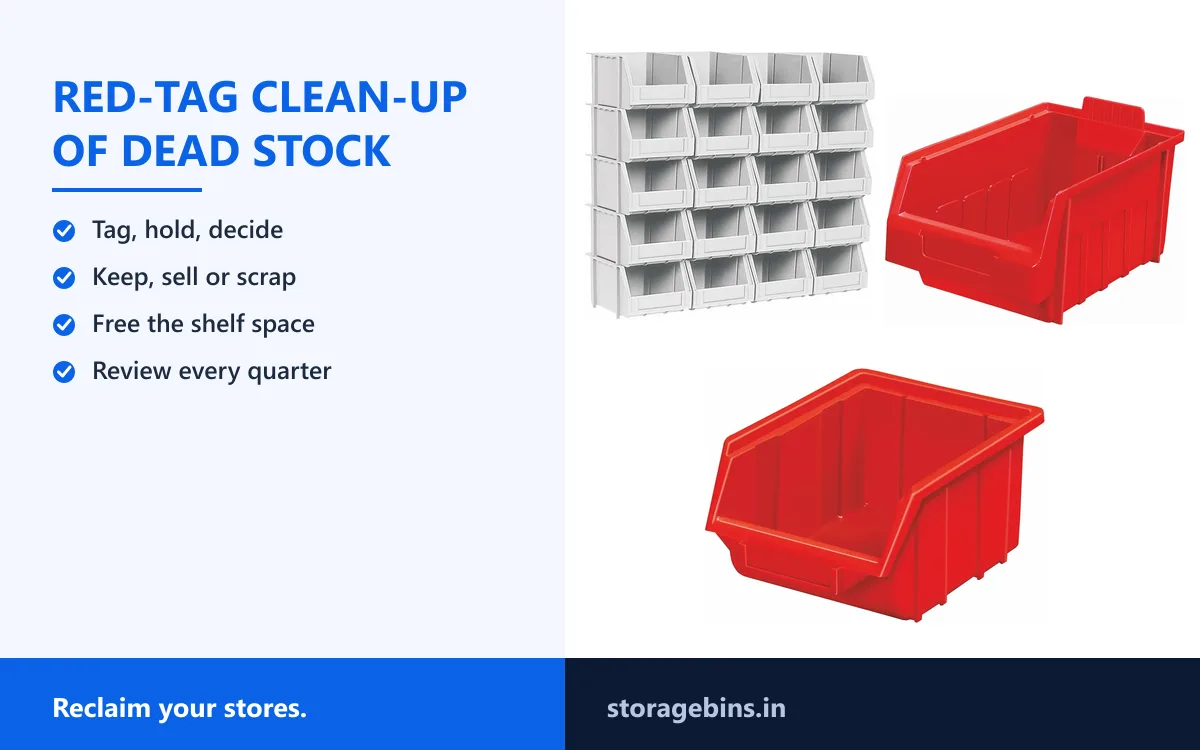
Every stores carries items that will never be used again. A red-tag audit finds them, a simple decision rule disposes of them, and a few standing habits stop the pile growing back, freeing space, cash and attention for the stock that matters.
The corner nobody visits
Every stores has one. It may be a shelf at the back, a cage behind the door, a loft above the tool room or a row of steel almirahs nobody opens. In it sit items that were bought for a project that was cancelled, spares for a machine that was sold, parts from a product that was discontinued, an over-order that never moved and things whose purpose nobody remembers. Dust has settled on them, rust has begun on some, and every few months someone proposes to clear it and nothing happens, because clearing it means deciding what to do with it.
That corner is expensive. It occupies floor and shelf space that costs money. It ties up cash in stock that will never be used. It hides useful stock among useless stock, so that a search takes longer. It distorts the stock value in the books. It makes counts harder and audits slower. And it teaches the stores team that the rule is to put things somewhere and forget them.
The red-tag clean-up is a technique from lean practice, widely used in 5S programmes, for dealing with it. It is not complicated: mark everything that might be unneeded with a red tag, give a short period for anyone to claim it, decide what to do with what is left, and clear it. The value is in doing it systematically, with a clear rule and a record, so that the clean-up happens and stays done. This article sets out how, for an Indian plant, warehouse or workshop.
What counts as dead, slow and surplus
Before tagging, be clear about the categories, because each is handled differently.
Dead stock is stock that has had no movement for a long period and has no foreseeable use. A common test is no issue in the last twelve to twenty-four months, depending on the business, and no planned use. Examples are parts for discontinued products, spares for machines that have gone, materials from cancelled orders and items bought in error.
Slow stock is stock that moves, but very slowly: a few pieces a year. It may be worth keeping, if the item is critical or hard to buy, or it may not. It needs a decision, not an assumption.
Surplus stock is more than is needed. An item that has a use, but where there are ten years' worth, has surplus: the excess beyond a sensible holding is, in effect, dead.
Obsolete stock is stock that can no longer be used, because the product, process or standard it served has changed. It may be in perfect condition and useless.
Deteriorated stock is stock that has aged or been damaged beyond use: hardened rubber, rusted parts, expired consumables. Its value is gone, whatever the book says.
Critical spares are not dead stock, however long they sit. A part that is used once in five years but whose absence would stop a plant is insurance, and should be kept, labelled and protected. The danger of any clean-up is throwing out such parts, and the safeguard is the rule that the maintenance or engineering owner decides on anything that might be critical.
The red-tag method
The method has five steps, and its power comes from being visible.
First, prepare. Choose the area, set a date, tell everyone, appoint a small team, with someone from stores, someone from the user departments and someone with authority to decide, and gather red tags, a camera, a log sheet and somewhere to put tagged items. Agree the rules in advance: what counts as dead, what period the tag stays on and who decides.
Second, tag. The team walks the area and puts a red tag on every item that does not obviously belong: not used recently, no label, no known owner, surplus, damaged or unidentifiable. Each tag records the item, the quantity, the location, the date and the reason. Take a photograph of each batch of tagged items.
Third, hold. Tagged items stay in place, or move to a marked holding area, for a set period, often two to four weeks, during which anyone who thinks they need an item may claim it by writing the reason on the tag. A claim is not a veto: the decision-maker reviews it.
Fourth, decide. At the end of the period, the team reviews each tagged item and applies a decision rule. An item that has been claimed with a good reason stays and gets a proper label and location. An item with no claim is disposed of.
Fifth, clear and record. Disposal happens, the space is cleaned and a record is made: what was removed, how, what it was worth and what the space is used for next. The result is photographed.
The decision rule: keep, move, sell, return or scrap
Each tagged item needs one of a short list of outcomes.
Keep: the item is needed, either because it is used, critical or part of a planned requirement. It gets a label, a location and, if needed, a minimum and maximum quantity. If it is a slow mover but needed, it moves to a slow-stock area, out of the prime space.
Move: the item belongs elsewhere, such as in another department's store or a project area. Return it to its owner with a record.
Sell or transfer: the item has value to someone else. Surplus new stock may be returned to the supplier, sold to a dealer, transferred to another plant of the same group or offered to other users. Sale of surplus can recover cash and always frees space.
Return to supplier: new, unused stock in its original packaging may be returnable within the supplier's terms. Check the terms before the stock ages beyond them.
Donate or reuse: items with little commercial value but real usefulness, such as fasteners, tools, furniture and containers, may be reused in the plant or donated, where the policy allows.
Scrap: items with no use and no resale value are scrapped. Metal goes for recycling, polypropylene bins and plastics for plastic recycling, and hazardous items follow the proper disposal procedure for their type. Record the scrap value, however small.
Write the rule on one page, with the person who decides at each level of value: a storekeeper for low-value items, a supervisor for medium and a manager or the finance head for high. A clean-up that stalls waiting for decisions is a clean-up that fails.
Handling the finance side
Dead stock has a value in the books, and writing it off has an effect on the accounts. Involve finance early, and keep the process honest.
Record the book value of each item or group before disposal. Decide, with finance, how the write-off will be treated, and in which period. Many companies prefer to write off over a period, and some policies require approval from a senior manager or the auditors for large write-offs. Follow your own rules.
Do not hide dead stock to avoid the write-off. Stock that is kept in the books but cannot be used misleads everyone, and it will have to be dealt with eventually. A one-time clean-up that clears the books is better than a slow decline.
Look at the cost of holding stock. Space, handling, insurance, deterioration and the capital tied up all cost money, and for dead stock they produce nothing. A calculation of the annual cost of holding the tagged items, set against the one-time write-off, often shows that clearing them pays back quickly. Our article on the true cost of storage bins describes how to put space and handling into the arithmetic.
Safe handling and special items
A clean-up uncovers things that need care. Plan for them before the day.
Chemicals, solvents, paints, oils and adhesives may be hazardous, expired or leaking. Do not move them without the right protective equipment, and follow the plant's procedure for hazardous waste. Never put them in ordinary bins.
Electronic items, batteries and equipment containing hazardous materials need proper recycling or disposal channels.
Sharp, heavy or awkward items need lifting aids and a safe plan. Do not let one person move a heavy item alone, and take care on ladders and high shelves.
Items that may be someone's property, such as customer-supplied material, consignment stock or tools lent by a contractor, must not be scrapped. Check ownership before disposal.
Documents and records stored in the area may have legal retention requirements. Check before discarding.
Rodents, insects and moisture may have taken hold in a long-neglected corner. Wear gloves and masks, and plan a clean and pest control afterwards.
Making the space useful
The point of the clean-up is not an empty room but a better one. Plan what the freed space will do, so that it does not simply fill up again.
Put the fast movers in the best space. With the clutter gone, the most-used items can move to the prime positions, between knee and shoulder, near the point of use. Our article on organising a maintenance spares store describes how.
Put proper storage in. Bins on panels, Panda shelving with shelf bins, pigeon hole compartments and drawer containers give each remaining item a labelled home, and make the new order visible and countable. The modular ALKON range lets you build up the system bay by bay as the clean-up proceeds.
Set aside a slow-stock area. A dedicated, labelled, out-of-the-way place for slow movers, with its own location codes, keeps them from clogging the main stores while keeping them accessible.
Set aside a holding area for future red-tag items. A clearly marked cage or shelf where questionable items go until they are reviewed stops them from sliding back into the main stores.
Photograph the finished room, and display the photograph. A before-and-after picture on the wall is a powerful reminder.
Keeping it clean: standing rules
A clean-up that is not followed by new habits is wasted, because the pile will grow back. A few standing rules prevent it.
Every item has a place and a label. Anything without a label is a candidate for a red tag at the next review. Make that the rule, and make it known.
Every item has an owner. Someone is responsible for deciding what happens to it, whether by department, by project or by machine.
Buy to need. Order quantities are based on consumption and lead time, not on volume discounts that produce years of stock. Project purchases are tracked and the leftovers are returned to stores with a label.
Review slow stock regularly. Once a quarter, or twice a year, list the items with no issue in the last twelve months and decide for each: keep, reduce, sell or scrap. Our article on cycle counting with storage bins describes a count routine that can include a check of last movement.
Return what is not used. A job that finishes with leftover parts returns them to the stores, labelled, instead of leaving them on a bench or in a cupboard.
Make the red-tag walk a regular event. A short walk each quarter, with tags, keeps the stores honest and avoids the need for a large clean-up.
Measuring the result
A few simple measures show whether the clean-up has worked.
Space recovered, in shelf bays, floor area or cubic metres, is the visible result. Measure it before and after.
Value recovered, from sale, return or scrap, and value written off, are the financial results. Report both honestly.
Time to find an item, measured on a sample of picks before and after, shows the gain in efficiency, as described in our article on the true cost of storage bins.
Stock accuracy, from cycle counts, shows whether the cleaner store is easier to keep right.
The age profile of stock, such as the share of lines with no movement in twelve months, shows whether the pile is growing back. A figure that creeps up is a signal to hold another review.
Report the results on a single page, with photographs, and share them with the team. People who see the effect of their work are more likely to keep it up.
The team, the tags and the communication
A clean-up works when people understand it, and a short communication plan makes the difference between cooperation and suspicion.
Tell everyone before it starts. A notice, or a brief talk at the start of a shift, explains what the red-tag walk is, why it is being done, how long tagged items will be held and how to claim an item. Stress that the aim is to free space and make things findable, and not to find fault.
Choose the team with care. A storekeeper who knows the history, a maintenance engineer who knows what is critical, a production supervisor who knows what is used, a finance person who knows the book values and a manager with authority make a balanced team. Rotate a younger person in to learn the process.
Design the tag so that it works. A red tag should carry the item description, quantity, location, date, the reason it was tagged and space for a claim, with a name and reason. Use a strong colour that nobody can mistake and tags that cannot fall off.
Keep the log. A simple sheet or spreadsheet with a row for each tagged item, its photograph reference, its decision, its value and its outcome gives a full record. It is the document that finance, auditors and the next team will ask for.
Celebrate the result. When the area is clear, tidy and labelled, show it to the people who work there and thank the team. A project that people are proud of tends to stick.
Selling and returning surplus
Surplus stock that has value is worth the effort of selling, and a few routes work in India.
Start with the supplier. Many suppliers take back unused stock in original packaging within a time limit, sometimes with a restocking charge. Check the terms, and ask while the stock is still within them.
Offer to other users. Another plant of the same company, a sister unit, a neighbouring unit or a regular contractor may need the items. A short list sent to the purchase teams of related units often finds a buyer.
Sell to dealers and traders. Dealers in bearings, fasteners, electrical items, tools and machinery spares buy surplus stock, usually at a discount. Get two or three offers, and sell what is genuine and complete.
Sell as scrap by weight, where there is no other use. Scrap dealers pay by weight for metals, and plastic recyclers for plastics, including polypropylene bins that have reached the end of their life. The value is small but real, and the disposal is clean.
Keep records of every sale, with the buyer, the items, the price and the approval, and make sure the items leave the site with the proper documents.
What to do with the freed space
A cleared area is an opportunity, and a plan for it keeps the gain. A few options work well.
Expand the fast-moving storage. Move the most-used items to the best positions, and give them more room, so that picking is quicker. Panda shelving with shelf bins, louvre panels with Supra and Hippo bins, and pigeon hole compartments suit this.
Create a proper kitting or staging area. A table, shelving and trolleys for kits, with marked bays, uses space to speed up the flow of work.
Add an inspection or quarantine corner. A clearly marked area for items that are awaiting inspection or decision keeps them out of the main stores.
Improve aisles. Wider aisles make trolley movement and picking easier and safer.
Return space to production, if the plant needs it. A cleared corner may be worth more as a work cell than as storage.
Keep some free. A store that is not full has room for the next change. Leave a reserve of ten to twenty per cent.
Questions people ask about red-tag clean-ups
How old must an item be to count as dead? There is no universal rule. Many plants use no movement in twelve to twenty-four months as a trigger for review, and adjust for items that are critical or seasonal. Decide your own rule, write it down and apply it consistently.
What about spares for machines we still own? Keep them if the machine is in use and the part is hard to buy or its absence would stop work. Review the criticality with maintenance, and label the item with the machine it serves.
Can I scrap items still on the books? Only with the approval your own policy requires, and with the finance team informed. Record the value and the approval.
Should I tag items that are labelled and in a bin? If they have not moved in a long time, yes, they may be slow or dead, and a review is worthwhile. Labels show what an item is, not whether it is needed.
How often should we repeat it? A full clean-up once, then a short quarterly walk and a half-yearly slow-stock review, is a sound pattern.
Is it worth doing in a small workshop? Yes. A small workshop with one cupboard of forgotten parts benefits as much as a large store, and the clean-up takes a weekend.
Common mistakes
A few mistakes recur in clean-ups.
Doing it all in one day is the first. A big bang clean-up exhausts people and leads to hasty decisions. A schedule of one area at a time works better.
Throwing out critical spares is the second. Involve the engineers, and mark insurance spares clearly before the walk.
Skipping the holding period is the third. A fortnight in which people can claim items prevents arguments and mistakes.
Leaving decisions open is the fourth. Items that sit in a holding area for months are the same pile in a new place. Set a deadline and a decision-maker.
Not recording is the fifth. Without a log, there is no proof of what was done, no value reported and no lesson for next time.
Not changing habits is the sixth. A clean room that fills up again within a year was never really cleaned.
Blaming people is the seventh. Dead stock is usually the result of changes in business, not carelessness, and a blame culture makes people hide it. Treat it as information.
The weekend version for a small workshop
A small workshop or a single cupboard does not need a team and a three-week plan. A weekend does it, and the steps are the same in miniature.
On the first morning, empty one cupboard or shelf onto a bench. Wipe the shelf. Put each item into one of four boxes: keep and use, keep but rarely used, sell or give away, and scrap. If you cannot decide in ten seconds, put it in a fifth box marked with the date, and decide in three months. Do not reopen the boxes during the sort.
At midday, put the keep-and-use items back in labelled bins and drawers, arranged so that the most-used are in reach. Hang the small bins on a panel, put the drawer containers in the tool cabinet and put the labels on. Put the rarely used items on the top and bottom shelves, with a label naming them.
In the afternoon, deal with the rest. Take the sell or give-away box to the dealer or the neighbour, and the scrap box to the scrap dealer. Write down what went and what it fetched.
On the second day, repeat for the next cupboard. By the end of the weekend, the workshop has space, a system and a habit, and a ten-minute tidy at the end of each day keeps it. The same method suits a home garage, a shop's back room and a small factory's corner.
Red-tagging the records as well as the shelves
Dead stock lives in the records as well as on the shelves, and a clean-up should include both.
Compare the stock list with the shelves. Items on the list that cannot be found are phantom stock, and items on the shelves that are not on the list are unrecorded. Each needs resolving: find the item, correct the record or write off the difference, with a note of the cause.
Look at the list for lines with no movement. Most systems can report the date of the last issue for each item, and sorting by that date brings the dead stock to the top. Use the report to prepare the walk, and to check the tagged items.
Clean up the part numbers. Duplicate codes for the same item, codes for items that no longer exist and inconsistent descriptions make a stock list hard to use. Merge duplicates, retire dead codes and standardise descriptions, with the user departments' agreement.
Review the minimum and maximum levels. Levels set years ago for a different volume often cause overstock. Reset them from current consumption and lead times, and check that ordering rules follow.
Record the clean-up in the system: dates, quantities, values and reasons. The record shows that the stock is under control, which is what an auditor wants to see.
A worked example with invented numbers
To make it concrete, consider an invented case. A mid-sized engineering plant has a stores of about twelve hundred square feet and a long history. Over the years, it has changed products twice, sold several machines and cancelled two projects. The stores manager estimates that a quarter of the space holds items that have not moved in years.
The team of four, drawn from stores, maintenance, production and finance, sets a plan of three weeks, one area per week. In the first week, they tag the back shelves and the loft, a total of about three hundred line items. During the two-week holding period, the maintenance team claims about forty items, mostly critical spares that were poorly labelled, and production claims a handful of fixtures.
In the decision meeting, the team classifies the rest: a large part goes for scrap, some goes back to suppliers who accept returns within terms, a quantity of new fasteners and fittings is moved to the main stores, and a lot of surplus bearings and belts is sold to a dealer. The finance head agrees a write-off schedule. The cleared bays are fitted with Panda shelving and shelf bins, a pigeon hole unit and a louvre panel with bins for the fast movers, all labelled. A slow-stock area with its own location codes holds the claimed items that are rarely used.
After the project, the stores manager reports that about a fifth of the floor and shelf space has been freed, the time to find parts has fallen noticeably and the next audit finds the room in order. A quarterly red-tag walk keeps it that way. The numbers are invented, and a real plant will differ, but the shape of the project, a plan, a team, a holding period, a rule and a standing routine, is the one to follow.
A checklist you can print
- Agree the definition of dead, slow, surplus and critical stock, and involve the engineers.
- Choose the area and the dates, appoint a small team and prepare tags, a log and a holding area.
- Tag everything that is unlabelled, unused, surplus or unidentifiable, and photograph it.
- Hold for two to four weeks, and review claims.
- Decide: keep, move, sell, return, donate or scrap, with decision levels by value.
- Clear and clean, record values and photograph the result.
- Fit the freed space with proper, labelled storage for the fast movers.
- Set standing rules: every item labelled and owned, buy to need, return leftovers, review slow stock and walk with tags each quarter.
- Measure space, value, time to find and stock age, and report them.
Where to go from here
If you would like help re-planning a stores after a clean-up, send us a photograph of the room and a list of what you hold, and we will suggest bins, shelving, panels and a labelling scheme from the catalogue. Shreeram Metafusion Engineers supplies the full ALKON range from Vashi, Navi Mumbai, as authorised stockist of ALKON Plastics Pvt. Ltd. for over thirty years, and the product pages on this website list the dimensions, packing and accessories for every item mentioned here.
Read next